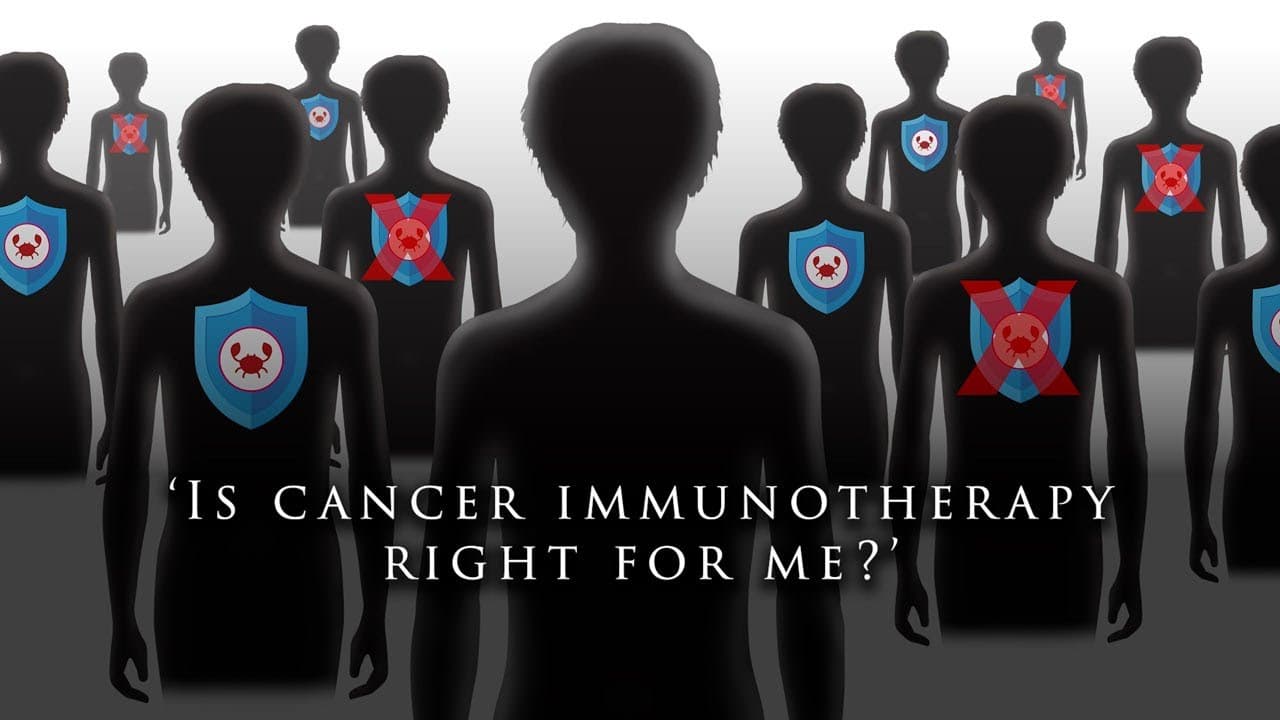
‘Is cancer immunotherapy right for me?’
TL;DR
Research helps determine if cancer immunotherapy is suitable for patients.
Transcript
[music] The human body comes equipped with natural defenses against disease and infection. The immune system is built to identify signs of trouble and put down possible threats. Let's say, for example, that you catch a cold. Like any virus, it works by infecting your cells and turning them into factories for making more of the virus. Your immune ... Read More
Key Insights
- The immune system naturally defends against diseases by identifying and eliminating threats, such as viruses, through immune responses.
- Cancer immunotherapy leverages the immune system's ability to detect and fight cancer cells, but not all cancer cases are suitable for this treatment.
- Research by Peter Westcott suggests that the type of mutations in cancer cells affects the effectiveness of immunotherapy.
- High tumor mutation burden was initially thought to be a good indicator for immunotherapy success, but it doesn't always predict positive outcomes.
- Subclonal mutations in tumor cells can hinder the immune system's ability to recognize and respond to cancer, reducing immunotherapy effectiveness.
- Clonal mutations, where tumor cells have uniform mutations, may enhance the immune system's response and improve immunotherapy success.
- Westcott's research aims to provide crucial insights into patient suitability for immunotherapy, potentially guiding treatment decisions.
- Further research is needed to translate these findings into clinical practice, but the potential impact on treatment personalization is significant.
Install to Summarize YouTube Videos and Get Transcripts
Explore YouTube Video Summarizer or Get YouTube Transcript Extractor
Questions & Answers
Q: How does the immune system typically respond to infections?
The immune system responds to infections by identifying and attacking infected cells. For example, when a virus infects cells, the immune system targets and kills these cells, preventing the virus from replicating and spreading. This natural defense mechanism helps eliminate infections like the common cold and other viral diseases.
Q: What is cancer immunotherapy?
Cancer immunotherapy is a treatment approach that utilizes the body's immune system to detect and fight cancer cells. By enhancing the immune response, immunotherapy aims to target and destroy cancer cells more effectively. However, its success depends on various factors, including the type of mutations present in the cancer cells.
Q: What did researchers initially believe about high tumor mutation burden?
Researchers initially believed that a high tumor mutation burden, where cancer cells have numerous mutations, would make patients good candidates for immunotherapy. The assumption was that more mutations would make cancer cells more recognizable to the immune system. However, this has not consistently proven true in practice.
Q: What are subclonal mutations, and how do they affect immunotherapy?
Subclonal mutations are diverse mutations within tumor cells that can give off different signals, making it difficult for the immune system to recognize and target the cancer effectively. This diversity can reduce the effectiveness of immunotherapy, as the immune system may struggle to mount a coordinated response against the cancer.
Q: How might clonal mutations improve immunotherapy outcomes?
Clonal mutations involve uniform mutations across tumor cells, leading to consistent signals that the immune system can more easily recognize. This uniformity can trigger a stronger and more coordinated immune response, potentially making immunotherapy more effective for patients with clonal mutations in their cancer cells.
Q: What is the significance of Peter Westcott's research?
Peter Westcott's research is significant because it provides insights into why immunotherapy may work for some patients but not others. By understanding the role of different mutation types in cancer, his work could help doctors predict patient responses to immunotherapy, leading to more personalized and effective cancer treatments.
Q: What are the potential future applications of this research?
The potential future applications of this research include the ability to better predict which patients will respond to immunotherapy, allowing for more personalized treatment plans. This could improve treatment success rates and reduce unnecessary exposure to ineffective therapies, ultimately enhancing patient outcomes and optimizing healthcare resources.
Q: Why is further research needed before clinical application?
Further research is necessary to validate the findings and understand the mechanisms involved in mutation-driven immune responses. This research will ensure that the insights are robust and applicable across different cancer types and patient populations, ultimately paving the way for safe and effective clinical applications of personalized immunotherapy treatments.
Summary & Key Takeaways
-
Cancer immunotherapy uses the body's immune system to fight cancer, but its effectiveness varies based on the type of mutations in cancer cells. Research suggests that clonal mutations may enhance treatment success, while subclonal mutations can hinder it. Understanding these factors is crucial for determining patient suitability for immunotherapy.
-
Research by Peter Westcott at CSHL is exploring why immunotherapy works for some cancer patients but not others. The study focuses on the types of mutations in cancer cells, suggesting that uniform mutations may trigger better immune responses, while diverse mutations might obscure immune detection.
-
The potential applications of Westcott's research are promising, as it could allow doctors to better predict patient responses to immunotherapy. This advancement could lead to more personalized cancer treatments, ensuring patients receive the most effective therapies based on their specific cancer mutation profiles.
Read in Other Languages (beta)
Share This Summary 📚
Summarize YouTube Videos and Get Video Transcripts with 1-Click
Try YouTube Summary with ChatGPT & Claude or YouTube Transcript Generator
Explore More Summaries from Cold Spring Harbor Laboratory 📚
Summarize YouTube Videos and Get Video Transcripts with 1-Click
Try YouTube Summary with ChatGPT & Claude or YouTube Transcript Generator