Engaging Pre-K Learners By Following Their Interests
TL;DR
Children's interests and questions drive the emergent curriculum in early childhood education, fostering engagement and learning.
Transcript
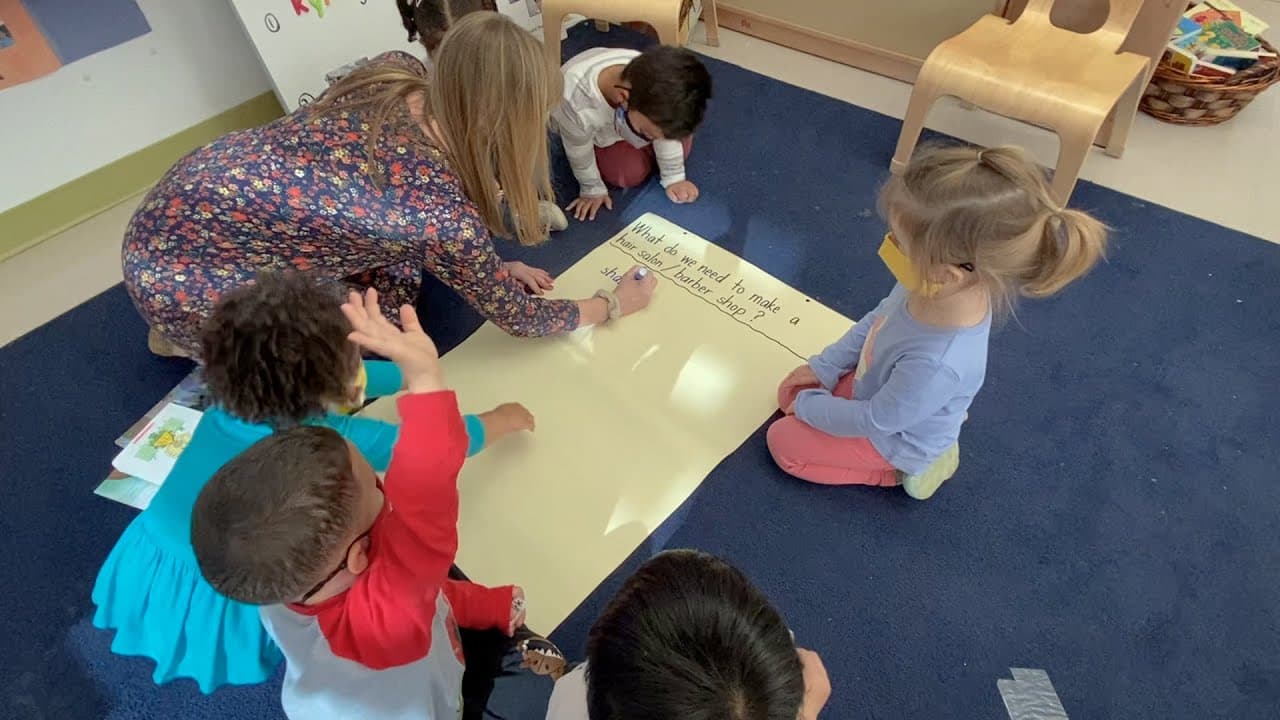
Student: Stop sign. >>Teacher: Oh, this real stop sign. Oh, that's going to give you a clue of how to write the word. >>Student: We could put the stop sign on the bus. >>Teacher: Let's make a stop sign for the bus. >>Irene Garneau: Emergent curriculum is often born from the questions, interests, passions of young children. The curriculum responds... Read More
Key Insights
- 👶 Emergent curriculum is driven by children's interests, questions, and passions, making it more engaging and meaningful.
- 👻 The curriculum is flexible and allows for changes based on the children's input, enhancing their sense of ownership.
- 🖐️ Dramatic play areas are transformed according to the children's interests, promoting imagination, communication, and problem-solving skills.
- 👶 Virtual field trips and storytelling can be effective tools for introducing new topics and engaging children's curiosity.
- 👶 Giving children the opportunity to contribute to the planning process fosters their engagement and investment in learning.
- 🖐️ Fine motor skills and other developmental objectives can be incorporated into dramatic play activities, making learning more holistic.
- 🖐️ Dramatic play provides a platform for children to practice sharing, taking turns, and resolving conflicts.
Install to Summarize YouTube Videos and Get Transcripts
Explore YouTube Video Summarizer or Get YouTube Transcript Extractor
Questions & Answers
Q: What is emergent curriculum in early childhood education?
Emergent curriculum is a teaching approach where the curriculum is developed based on the questions, interests, and passions of young children. It allows children to take an active role in their learning, making it more engaging and meaningful.
Q: How does the curriculum change throughout the school year?
The curriculum addresses about 48 learning objectives throughout the year, acting as the foundation for teaching. However, the children have the power to decide on the specific content, such as colors, furniture, and themes for dramatic play areas.
Q: How does emergent curriculum foster engagement?
By allowing children to decide on the content of their learning experiences, they become more invested and engaged in the process. This sense of ownership and autonomy enhances their motivation and enjoyment of learning.
Q: How does dramatic play contribute to learning in early childhood education?
Dramatic play provides opportunities for children to explore different roles, problem-solve, communicate, and work together. It helps develop social skills, creativity, and cognitive abilities while making learning fun and interactive.
Summary & Key Takeaways
-
Emergent curriculum in early childhood education is based on the questions, interests, and passions of young children.
-
The curriculum is flexible and responsive, addressing 48 learning objectives throughout the school year.
-
Children have the power to decide on the content, such as colors, furniture, and themes for dramatic play areas.
Read in Other Languages (beta)
Share This Summary 📚
Summarize YouTube Videos and Get Video Transcripts with 1-Click
Try YouTube Summary with ChatGPT & Claude or YouTube Transcript Generator
Explore More Summaries from Edutopia 📚


Summarize YouTube Videos and Get Video Transcripts with 1-Click
Try YouTube Summary with ChatGPT & Claude or YouTube Transcript Generator