Rules for Plotting Root Locus - Root Locus Technique - Control Systems
TL;DR
Learn the step-by-step rules for plotting the root locus of a system, including determining poles and zeros, finding starting and ending points, calculating the number of branches, and more.
Transcript
hello friends in this video we are going to study the general rules used to plot the root locus of a system okay so let's see what are the various rules start with the first rule the rule number one that is the first step whenever we are plotting the root locus of a system is first determine the open loop poles and the zeros of the system okay from... Read More
Key Insights
- 🫚 The root locus helps analyze the behavior of a system as the gain varies.
- #️⃣ The number of branches of the root locus depends on the number of poles and zeros.
- 👉 The direction of the branches on the real axis is determined by the number of poles and zeros to the right of the point.
- 💈 Complex poles and zeros can affect the angles of departure and arrival.
- 💨 As the gain increases, the root locus moves away from the poles and zeros, often approximated by asymptotes.
- 😥 The intersection points with the real and imaginary axis provide important information about system stability.
Install to Summarize YouTube Videos and Get Transcripts
Explore YouTube Video Summarizer or Get YouTube Transcript Extractor
Questions & Answers
Q: What is the first step in plotting the root locus?
The first step is to determine the open loop poles and zeros of the system and plot them on the S plane.
Q: How does the root locus start and end?
The root locus starts from the open loop poles and terminates at the zeros of the system.
Q: How is the number of branches of the root locus determined?
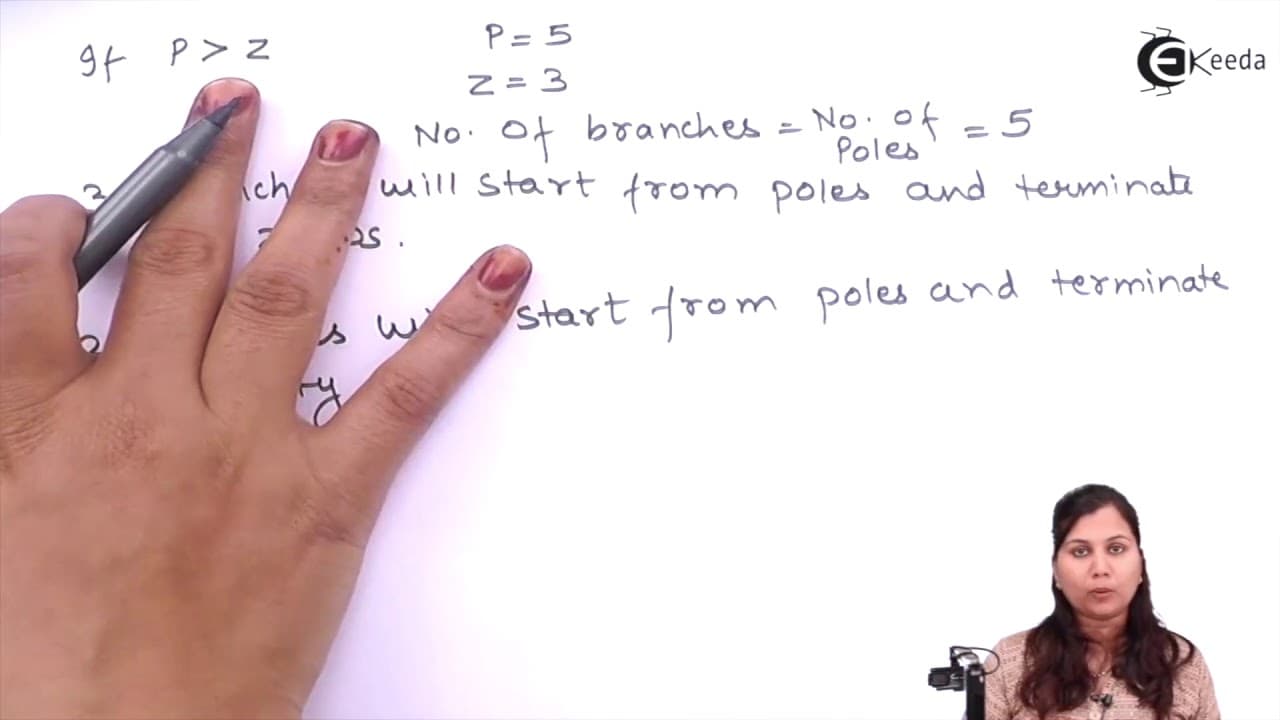
The number of branches is determined by the number of poles and zeros, with excess branches starting from infinity.
Q: How is the direction of the branches on the real axis determined?
The direction is determined by the number of open loop poles and zeros to the right of the point. If the number is odd, the branch lies on the real axis.
Q: What happens to the root locus as the gain increases?
As the gain (k) increases, the root locus moves away from the poles and zeros and can be approximated by asymptotes.
Q: How can the intersection points of the root locus with the real and imaginary axis be determined?
The points can be determined by substituting s=jω into the characteristic equation or using the root stability criteria.
Q: How are the angles of departure and arrival for complex poles calculated?
The angle of departure is calculated using the formula 180 degrees - Σp - Σz, and the angle of arrival is calculated using -180 degrees + Σp - Σz.
Q: How is the value of k on the root locus determined?
The value of k is determined by taking the product of lengths of vectors from the poles and zeros to the point of interest.
Summary & Key Takeaways
-
The first step in plotting the root locus is to determine the open loop poles and zeros of the system and plot them on the S plane.
-
The root locus starts from the open loop poles and terminates at the zeros of the system.
-
The number of branches of the root locus depends on the number of poles and zeros, with excess branches starting from infinity.
-
The direction of the branches on the real axis is determined by the number of open loop poles and zeros to the right of the point.
-
As the gain (k) increases, the root locus moves away from the poles and zeros and can be approximated by asymptotes.
-
The intersection points of the root locus with the real and imaginary axis can be determined by substituting s=jω into the characteristic equation or using the root stability criteria.
-
For complex poles, the angles of departure and arrival can be calculated using specific formulas.
-
The value of k on the root locus can be determined by taking the product of lengths of vectors from the poles and zeros to the point of interest.
Read in Other Languages (beta)
Share This Summary 📚
Summarize YouTube Videos and Get Video Transcripts with 1-Click
Try YouTube Summary with ChatGPT & Claude or YouTube Transcript Generator
Explore More Summaries from Ekeeda 📚





Summarize YouTube Videos and Get Video Transcripts with 1-Click
Try YouTube Summary with ChatGPT & Claude or YouTube Transcript Generator