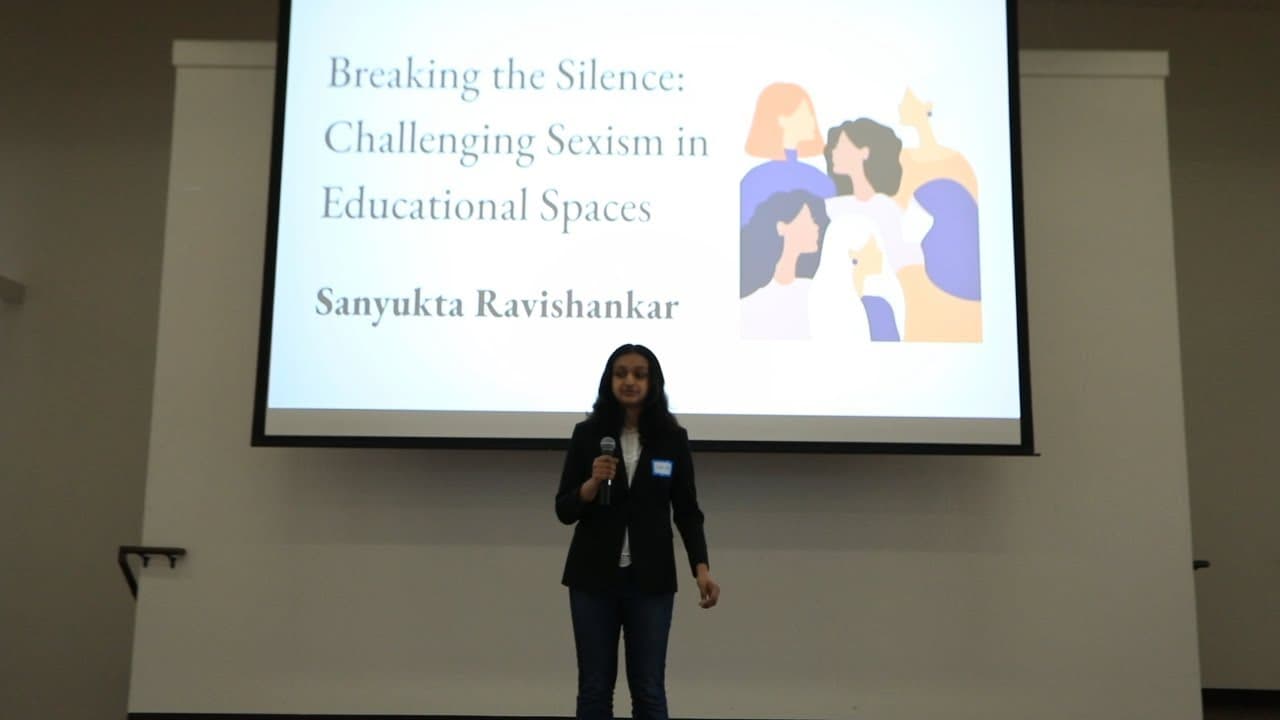
Challenging Sexism in Educational Spaces | Sanyukta Ravishankar | TEDxFruitvale Avenue Youth
TL;DR
Sexism persists in education affecting girls, leading to gender biases and stereotypes in speech and debate.
Transcript
hello everyone I love dictionaries breaking down words finding dramatic synonyms to use in essays all of it so when I was first delving into basic definitions of words for my own knowledge I decided to ask a simple question what does it mean to be a woman not biologically but the title itself woman woman man wife man the origin of the term woman ac... Read More
Key Insights
- 👧 Gender stereotypes and biases persist in education, affecting girls' opportunities and experiences.
- 😯 Sexism in speech and debate competitions leads to girls facing challenges and unfair treatment.
- ⚧️ Addressing microaggressions is crucial to challenging gender biases and promoting gender equality in education.
- 😯 Girls are more likely to quit speech and debate due to facing gender biases and challenges in competitions.
- 🤳 Microaggressions hinder girls' self-esteem and performance in academic settings.
- 🧑🏫 Teachers enforcing stereotypes contribute to gender disparities in education.
- 🥺 Challenging microaggressions and biases can lead to a more inclusive and equitable education system.
Install to Summarize YouTube Videos and Get Transcripts
Explore YouTube Video Summarizer or Get YouTube Transcript Extractor
Questions & Answers
Q: How do gender stereotypes impact girls' experiences in speech and debate?
Gender stereotypes in speech and debate lead to girls facing challenges such as being perceived as less assertive, aggressive, or effective communicators, affecting their performance and success in competitions.
Q: Why are girls more likely to quit speech and debate compared to boys?
Females are more likely to quit speech and debate due to facing gender biases, stereotypes, and challenges such as being judged differently and pressured to conform to male communication styles.
Q: How can microaggressions hinder girls' performance and self-esteem in education?
Microaggressions in education contribute to girls feeling undervalued, restricted by stereotypes, and impacting their self-esteem and overall performance in academic and extracurricular activities.
Q: Why is it important to address gender disparities and biases in education?
Addressing gender disparities in education is crucial to creating a fair and inclusive learning environment, promoting equity, challenging stereotypes, and empowering girls to excel without gender-based limitations.
Summary & Key Takeaways
-
Gender stereotypes and biases persist in education, affecting girls' opportunities and treatment.
-
Sexism is evident in speech and debate competitions, where girls face challenges compared to boys.
-
Microaggressions and stereotypes need to be addressed to promote gender equality in education.
Read in Other Languages (beta)
Share This Summary 📚
Summarize YouTube Videos and Get Video Transcripts with 1-Click
Try YouTube Summary with ChatGPT & Claude or YouTube Transcript Generator
Explore More Summaries from TEDx Talks 📚






Summarize YouTube Videos and Get Video Transcripts with 1-Click
Try YouTube Summary with ChatGPT & Claude or YouTube Transcript Generator