Pythagorean theorem 2 | Right triangles and trigonometry | Geometry | Khan Academy
TL;DR
Use the Pythagorean theorem to find the length of the missing side in a right triangle given the lengths of the other two sides.
Transcript
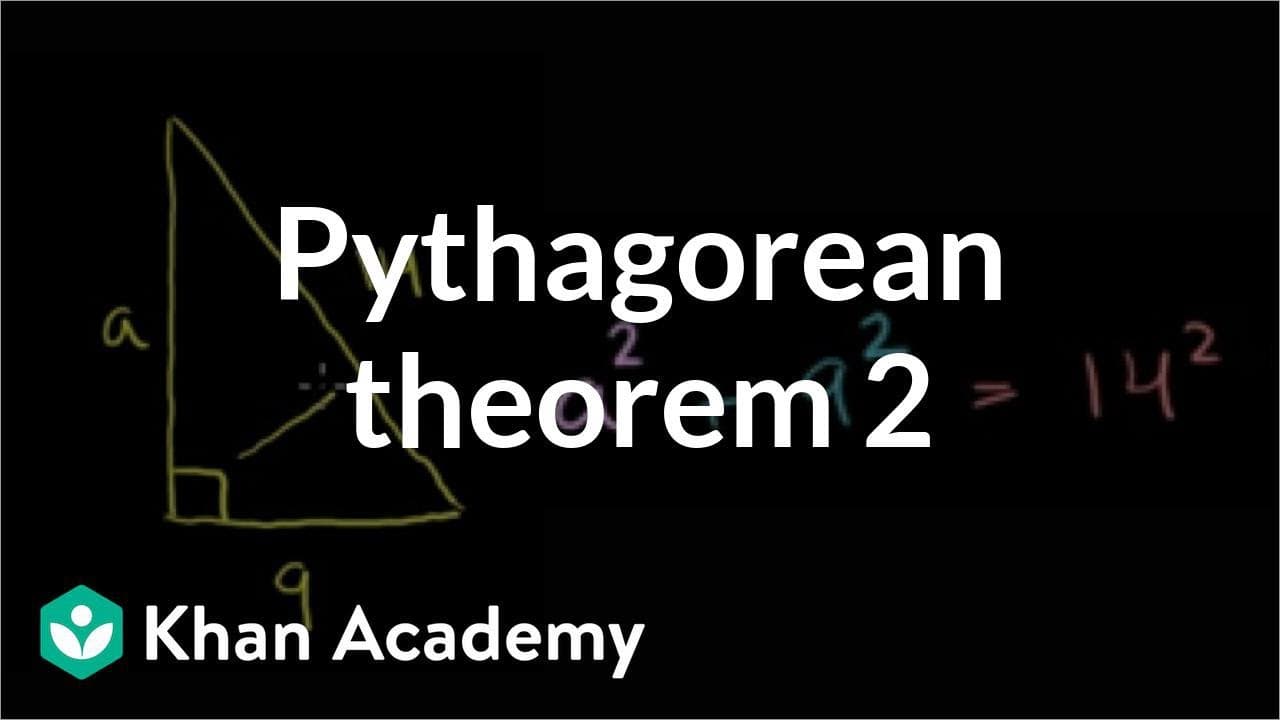
Say we have a right triangle. Let me draw my right triangle just like that. This is a right triangle. This is the 90 degree angle right here. And we're told that this side's length right here is 14. This side's length right over here is 9. And we're told that this side is a. And we need to find the length of a. So as I mentioned already, this is a ... Read More
Key Insights
- 🗯️ The Pythagorean theorem is a fundamental concept in geometry used to find missing side lengths in right triangles.
- 🔺 The hypotenuse is the longest side in a right triangle and is opposite the 90-degree angle.
- 🔺 The Pythagorean theorem can only be applied to right triangles and not other types of triangles.
- ❎ The theorem states that the sum of the squares of the shorter sides is equal to the square of the hypotenuse.
- ❎ To solve for the missing side length, square the known side lengths, add them together, and take the square root of the sum.
- 🙃 The Pythagorean theorem provides a mathematical relationship between the sides of a right triangle.
- ❓ Understanding the concept of the hypotenuse is crucial for correctly applying the Pythagorean theorem.
Install to Summarize YouTube Videos and Get Transcripts
Explore YouTube Video Summarizer or Get YouTube Transcript Extractor
Questions & Answers
Q: How do you determine which side is the hypotenuse in a right triangle?
In a right triangle, the hypotenuse is the side opposite the 90-degree angle. It is the longest side in the triangle.
Q: What is the Pythagorean theorem?
The Pythagorean theorem states that in a right triangle, the sum of the squares of the two shorter sides is equal to the square of the hypotenuse. Mathematically, it can be written as a² + b² = c², where 'a' and 'b' are the shorter sides, and 'c' is the hypotenuse.
Q: Can the Pythagorean theorem be used for any triangle?
No, the Pythagorean theorem only applies to right triangles. The theorem relies on the presence of a 90-degree angle.
Q: How do you solve for the missing side length using the Pythagorean theorem?
To find the length of the missing side, square the lengths of the known sides, add them together, and then take the square root of the sum. This will give you the length of the missing side.
Summary & Key Takeaways
-
The Pythagorean theorem states that the sum of the squares of the shorter sides in a right triangle is equal to the square of the longest side (hypotenuse).
-
In a right triangle, the side opposite the 90-degree angle is the hypotenuse, which is the longest side.
-
To find the length of the missing side, square the known side lengths, add them together, and then take the square root of the sum.
Read in Other Languages (beta)
Share This Summary 📚
Summarize YouTube Videos and Get Video Transcripts with 1-Click
Try YouTube Summary with ChatGPT & Claude or YouTube Transcript Generator
Explore More Summaries from Khan Academy 📚



Summarize YouTube Videos and Get Video Transcripts with 1-Click
Try YouTube Summary with ChatGPT & Claude or YouTube Transcript Generator