Products
Features
YouTube Video Summarizer
Summarize YouTube videos
Web & PDF Highlighter
Highlight web pages & PDFs
Chat with PDF
Ask any PDF questions with AI
Ask AI Clone
Chat with your highlights & memories
Audio Transcriber
Transcribe audio files to text
Glasp Reader
Read and highlight articles
Kindle Highlight Export
Export your Kindle highlights
Idea Hatch
Hatch ideas from your highlights
Integrations
Obsidian Plugin
Notion Integration
Pocket Integration
Instapaper Integration
Medium Integration
Readwise Integration
Snipd Integration
Hypothesis Integration
Apps & Extensions
Chrome Extension
Safari Extension
Edge Add-ons
Firefox Add-ons
iOS App
Android App
Discover
Discover
Ideas
Discover new ideas and insights
Articles
Curated articles and insights
Books
Book recommendations by great minds
Posts
Essays and notes from readers
Quotes
Inspiring quotes collection
Videos
Curated videos and summaries
Explore Glasp
Glasp Newsletter
Weekly insights and updates
Glasp Talk
Interview series with great minds
Glasp Blog
Latest news and articles
Glasp Use Cases
Learn how others use Glasp
Build & Support
Glasp API
Access Glasp's API for developers
MCP Connector
Connect Glasp to Claude & ChatGPT
Community
Glasp Reddit Community
Students
Student discount and benefits
FAQs
Frequently Asked Questions
AboutPricing
DashboardLog inSign up

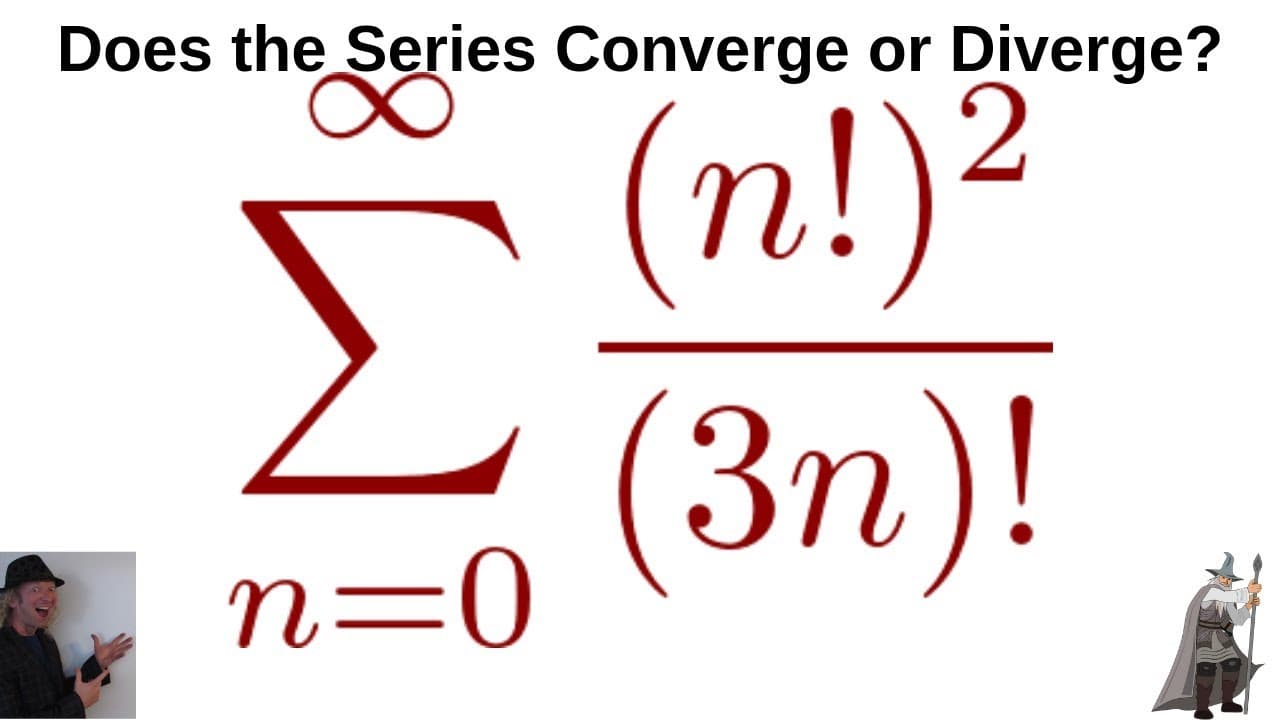
How to use the Ratio Test for Infinite Series to Determine Convergence or Divergence
1.1K views
•
October 26, 2018
by
The Math Sorcerer
YouTube video player
How to use the Ratio Test for Infinite Series to Determine Convergence or Divergence

TL;DR

Using the ratio test with factorials, determine convergence.

Transcript

hey what's up we're going to determine whether this series converges or diverges whenever you have factorials it's usually a good idea to use the ratio test the ratio test says if you take the limit as n approaches infinity of a sub n plus 1 over a sub N and you get L there's three possible cases so if L is less than 1 we have convergence if L is b... Read More

Key Insights

  • 🏆 Factorials in series often require specialized convergence tests.
  • 🥳 Ratio test involves taking the limit of subsequent terms to check convergence.
  • 🥳 The ratio test results in three possible outcomes: convergence, divergence, or inconclusive.
  • 🥳 The example demonstrates the application of the ratio test for convergence with factorials.
  • 🥳 Understanding the growth rate of factorials aids in applying the ratio test effectively.
  • 🥳 Conceptualizing the ratio test helps in determining the convergence behavior of series.
  • 🥳 The ratio test is a valuable tool in mathematical analysis for series convergence.

Install to Summarize YouTube Videos and Get Transcripts

Explore YouTube Video Summarizer or Get YouTube Transcript Extractor

Questions & Answers

Q: What is the ratio test in mathematics?

The ratio test is a method to determine the convergence or divergence of a series by taking the limit of the absolute value of a sub n+1 over a sub N as n approaches infinity.

Q: When is a series said to converge?

A series converges if the limit from the ratio test is less than 1, indicating that the series converges to a finite value as the number of terms approaches infinity.

Q: How does the ratio test work with factorials?

When factorials are involved, the ratio test helps evaluate their growth rate to ascertain convergence or divergence based on the limit of the ratio of subsequent terms as n approaches infinity.

Q: Why is the ratio test particularly useful with factorials?

The ratio test is effective with factorials due to their rapid growth; it provides a quantitative method to determine the convergence behavior of series involving factorials.

Summary & Key Takeaways

  • Ratio test useful with factorials for convergence or divergence.

  • Limit as n approaches infinity for a sub n+1 over a sub N determines convergence.

  • Example calculation shows convergence with factorials using the ratio test.


Read in Other Languages (beta)

English

Share This Summary 📚

Summarize YouTube Videos and Get Video Transcripts with 1-Click

Download browser extensions on:

Try YouTube Summary with ChatGPT & Claude or YouTube Transcript Generator

Explore More Summaries from The Math Sorcerer 📚

How to Find the Curvature using the Cross Product Formula for r(t) = ti + t^2j + (t^2/2)k thumbnail
How to Find the Curvature using the Cross Product Formula for r(t) = ti + t^2j + (t^2/2)k
The Math Sorcerer
Prove that Every Integer is Even or Odd thumbnail
Prove that Every Integer is Even or Odd
The Math Sorcerer
Proving two Spans of Vectors are Equal Linear Algebra Proof thumbnail
Proving two Spans of Vectors are Equal Linear Algebra Proof
The Math Sorcerer
Integral sin(sin(x)) ****Horseshoe Integral*** thumbnail
Integral sin(sin(x)) ****Horseshoe Integral***
The Math Sorcerer
How to Sketch a Vector Valued Function and Find Orientation and Rectangular Form thumbnail
How to Sketch a Vector Valued Function and Find Orientation and Rectangular Form
The Math Sorcerer
How to Show a Function is Not a Linear Transformation thumbnail
How to Show a Function is Not a Linear Transformation
The Math Sorcerer

Summarize YouTube Videos and Get Video Transcripts with 1-Click

Download browser extensions on:

Try YouTube Summary with ChatGPT & Claude or YouTube Transcript Generator

Apps & Extensions

  • Chrome Extension
  • Safari Extension
  • Edge Add-ons
  • Firefox Add-ons
  • iOS App
  • Android App

Key Features

  • YouTube Video Summarizer
  • Web & PDF Summarizer
  • Web & PDF Highlighter
  • Chat with PDF
  • Ask AI Clone
  • Audio Transcriber
  • Glasp Reader
  • Kindle Highlight Export
  • Idea Hatch

Integrations

  • Obsidian Plugin
  • Notion Integration
  • Pocket Integration
  • Instapaper Integration
  • Medium Integration
  • Readwise Integration
  • Snipd Integration
  • Hypothesis Integration

More Features

  • APIs
  • MCP Connector
  • Blog & Post
  • Embed Links
  • Image Highlight
  • Personality Test
  • Quote Shots

Company

  • About us
  • Blog
  • Community
  • FAQs
  • Job Board
  • Newsletter
  • Pricing
Terms

•

Privacy

•

Guidelines

© 2026 Glasp Inc. All rights reserved.