What Is AES and How Does It Encrypt Data?
TL;DR
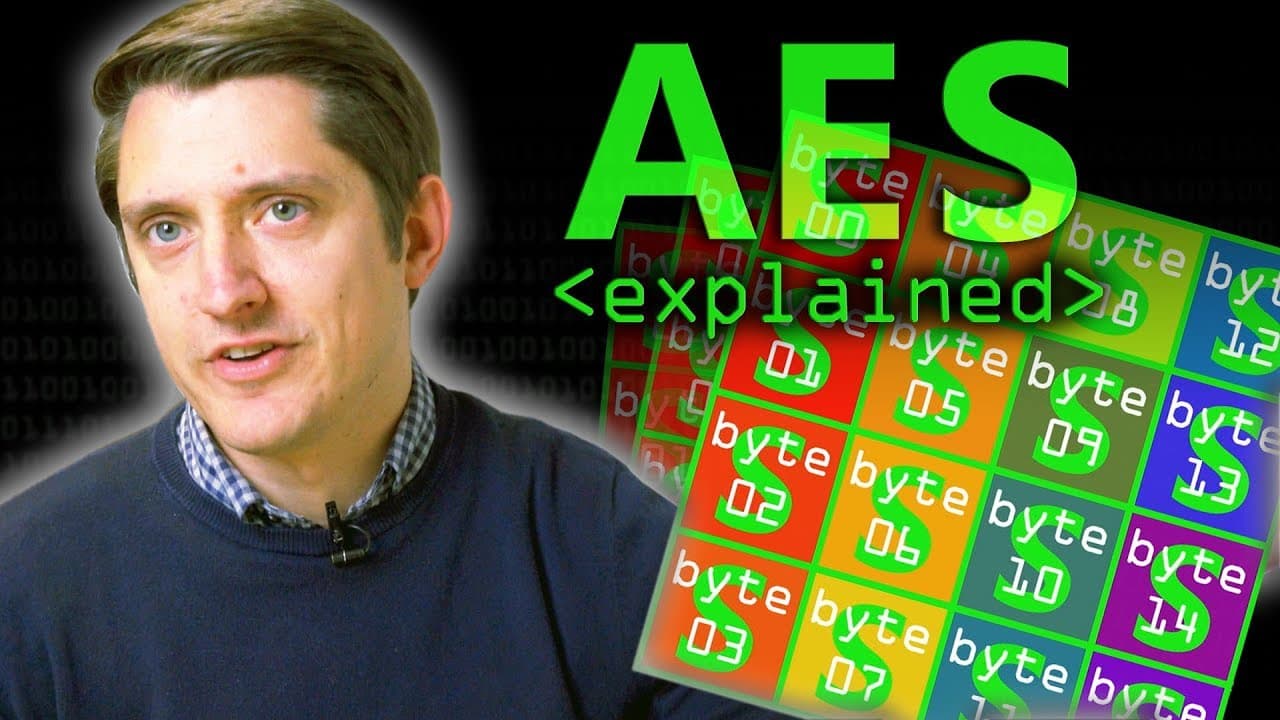
AES is a sophisticated encryption method that transforms 128-bit blocks of data into ciphertext using substitution and permutation techniques on a 4x4 grid. With key sizes of 128, 192, or 256 bits, AES balances security and performance, allowing for swift encryption while ensuring robust data protection.
Transcript
let's delve into aes and talk about you know what's good about it how it works and why it was judged good enough to be the advanced encryption standard so why aes is a yes what yeah why is aes well why ryan diaz have you heard of reindoll ryan doll no no okay so in that perhaps slightly infuriating way i managed to not say anything about how it wor... Read More
Key Insights
- 👤 AES operates on a 4x4 grid and uses substitution, permutation, and diffusion techniques to provide encryption.
- 🔐 Key sizes of 128, 192, or 256 bits determine the level of security in AES.
- 🏑 AES encryption operates within a finite field, ensuring that all calculations stay within the designated byte size.
- ◀️ AES encryption can be reversed by applying the inverse operations with the correct key.
- 🔐 Implementation of AES encryption must be done carefully to avoid security vulnerabilities, such as cache timing attacks.
- ⏬ AES encryption is supported by hardware instructions in modern CPUs, enabling fast and secure encryption.
- 🈸 AES encryption is widely used in various applications, providing efficient and reliable data protection.
Install to Summarize YouTube Videos and Get Transcripts
Explore YouTube Video Summarizer or Get YouTube Transcript Extractor
Questions & Answers
Q: How does AES encryption work?
AES encrypts messages by dividing them into 128-bit blocks, performing substitution and permutation operations on a 4x4 grid, and mixing the columns. This process is repeated for multiple rounds, with the key being introduced at each round.
Q: What are the different key sizes in AES?
AES can use key sizes of 128, 192, or 256 bits. These key sizes determine the level of security provided by the encryption.
Q: Can AES encryption be reversed?
Yes, AES encryption can be reversed by applying the inverse operations. Each step in the encryption process has a corresponding inverse step, allowing for decryption with the correct key.
Q: How secure is AES encryption?
AES is considered highly secure and has been extensively tested. It is widely used in various applications, including data encryption, network security, and secure communication protocols.
Key Insights:
- AES operates on a 4x4 grid and uses substitution, permutation, and diffusion techniques to provide encryption.
- Key sizes of 128, 192, or 256 bits determine the level of security in AES.
- AES encryption operates within a finite field, ensuring that all calculations stay within the designated byte size.
- AES encryption can be reversed by applying the inverse operations with the correct key.
- Implementation of AES encryption must be done carefully to avoid security vulnerabilities, such as cache timing attacks.
- AES encryption is supported by hardware instructions in modern CPUs, enabling fast and secure encryption.
- AES encryption is widely used in various applications, providing efficient and reliable data protection.
- The development of AES was influenced by the work of mathematician Évariste Galois, who made significant contributions to finite fields.
Summary & Key Takeaways
-
AES is a 128-bit symmetric block cipher that operates on a 4x4 grid and uses substitution, permutation, and diffusion to encrypt data.
-
The key used in AES can be 128, 192, or 256 bits, providing varying levels of security.
-
AES performs operations within a finite field, ensuring that all calculations stay within the designated byte size.
Read in Other Languages (beta)
Share This Summary 📚
Summarize YouTube Videos and Get Video Transcripts with 1-Click
Try YouTube Summary with ChatGPT & Claude or YouTube Transcript Generator
Explore More Summaries from Computerphile 📚




Summarize YouTube Videos and Get Video Transcripts with 1-Click
Try YouTube Summary with ChatGPT & Claude or YouTube Transcript Generator