Evolution, Speciation, and Adaptation of Cichlid Fish | Axel Meyer || Radcliffe Institute
TL;DR
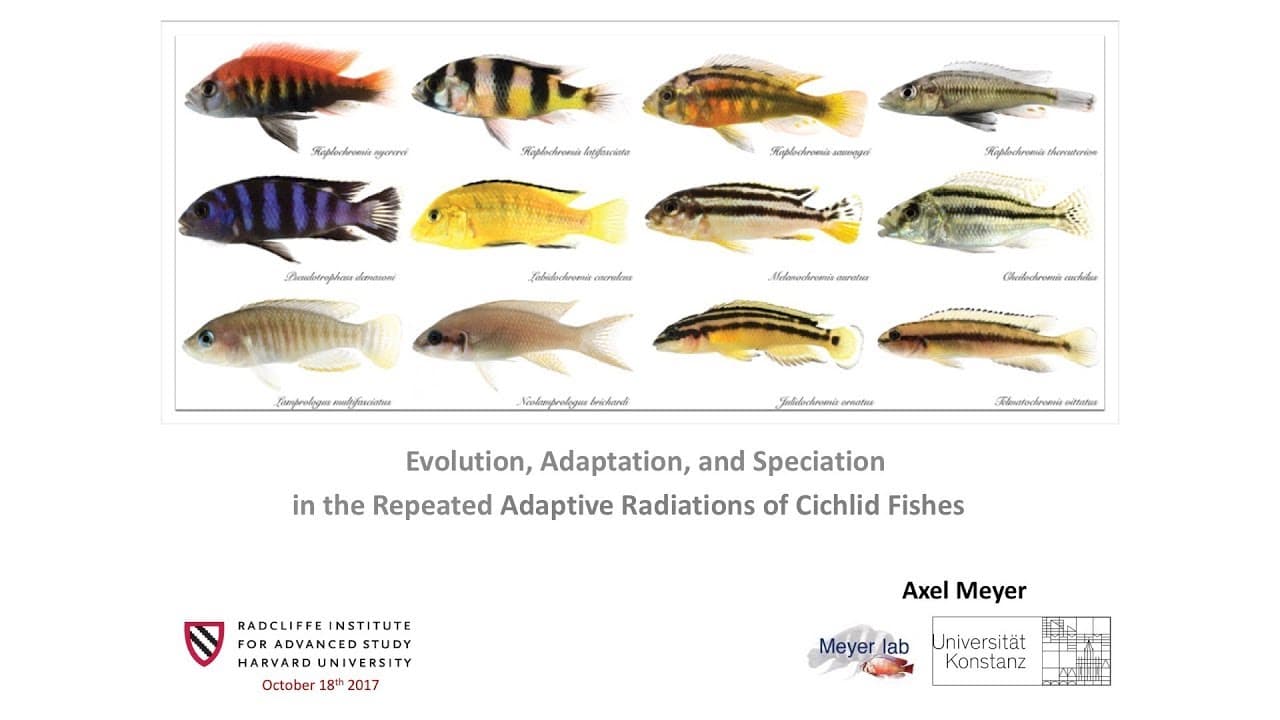
Cichlid fish are an evolutionary success story, with diverse colors and behaviors that have evolved through gene duplication, jumping genes, and convergent evolution.
Transcript
- Thank you very much, Judy for the kind introduction, and thank you and also Dean Cohen for allowing me to be here. It's a great honor and privilege, and maybe more importantly a great prince pleasure to be among the Fellows of this year. It's an experience that broadens one's horizons, and I'm very grateful for this opportunity. So I've been work... Read More
Key Insights
- 🐟 Cichlid fish are an evolutionary success, with diverse behaviors, color patterns, and social systems.
- 🖐️ Gene duplication, jumping genes, and convergent evolution have all played a role in cichlid fish evolution and speciation.
- 💋 Adaptations such as egg spots, large lips, and color patterns have evolved in response to ecological niches and sexual selection.
- 🐟 Sympatric speciation can occur in cichlid fish without geographic barriers, driven by differences in mate preference, ecological niches, and genetic adaptations.
Install to Summarize YouTube Videos and Get Transcripts
Explore YouTube Video Summarizer or Get YouTube Transcript Extractor
Questions & Answers
Q: What makes cichlid fish an interesting model system for evolutionary biology?
Cichlid fish offer a diverse range of behaviors, color patterns, and social systems to study. They have experienced gene duplication, jumping genes, and convergent evolution, providing insights into the mechanisms behind evolution.
Q: How do cichlid fish use their big lips?
Big lips in cichlid fish may serve various purposes such as housing mechanoreceptors, containing taste buds, protecting against sharp surfaces, and creating a seal for efficient feeding.
Q: Can sympatric speciation occur in cichlid fish without geographic barriers?
Yes, sympatric speciation has been observed in cichlid fish, particularly in Nicaraguan crater lakes, where new species have evolved due to adaptation to different ecological niches despite the absence of geographic barriers.
Q: How do cichlid fish detect and respond to brood parasitism by catfish?
Cichlid fish have evolved to detect and reject foreign eggs laid by catfish. Some cichlids show an evolutionary learning response, while others develop the ability to detect catfish eggs based on previous experience.
Summary & Key Takeaways
-
Cichlid fish are incredibly diverse, with over 3,000 species and unique characteristics such as coloration, body shape, and social systems.
-
Gene duplication and jumping genes have played a role in the evolution of cichlid fish, allowing for the development of new functions and increased species diversity.
-
The presence of egg spots on male cichlids' anal fins is a key adaptation for attracting mates and fertilizing eggs.
-
Cichlid fish also display traits such as large lips, which can be influenced by multiple genes or a single gene with a large effect.
Read in Other Languages (beta)
Share This Summary 📚
Summarize YouTube Videos and Get Video Transcripts with 1-Click
Try YouTube Summary with ChatGPT & Claude or YouTube Transcript Generator
Explore More Summaries from Harvard University 📚






Summarize YouTube Videos and Get Video Transcripts with 1-Click
Try YouTube Summary with ChatGPT & Claude or YouTube Transcript Generator