How to Convert Degrees to Radians Easily
TL;DR
To convert degrees to radians, multiply the degree measure by π and divide by 180. For example, to convert 150 degrees, compute 150 × π / 180, which simplifies to 5π/6 radians. The key relationship is that π radians equals 180 degrees, so both positive and negative angles can be converted using this method.
Transcript
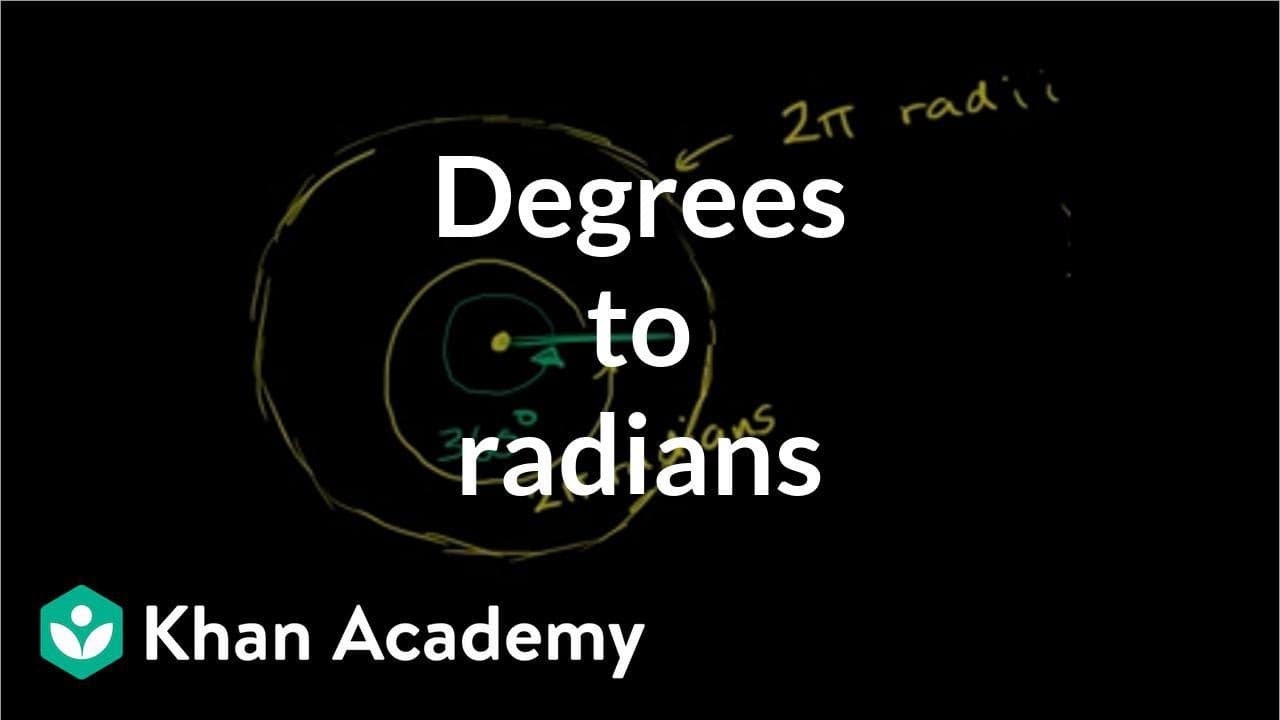
- [Instructor] We're asked to convert 150 degrees and negative 45 degrees to radians. Let's think about the relationship between degrees and radians, and to do that, let me just draw a little circle here. So that's the center of the circle, and then do my best shot, best attempt to freehand draw a reasonable-looking circle. That's not, I've done wo... Read More
Key Insights
- ⭕ One full circle is equivalent to 360 degrees or 2π radians.
- ⭕ The formula for the circumference of a circle is C = 2πr.
- ❓ The relationship between degrees and radians is π radians = 180 degrees.
- 🗂️ To convert degrees to radians, multiply the degree measure by π and divide by 180.
- 🧑🏭 The conversion factor for radians to degrees is π radians = 180 degrees.
- 😑 Converting degrees to radians involves canceling out the degree units and simplifying the expression.
- ❎ Negative degree measures can also be converted to radians using the same formula.
Install to Summarize YouTube Videos and Get Transcripts
Explore YouTube Video Summarizer or Get YouTube Transcript Extractor
Questions & Answers
Q: What is the relationship between degrees and radians?
Degrees and radians are units of measurement for angles. One full circle is equal to 360 degrees or 2π radians.
Q: How can we convert degrees to radians?
To convert degrees to radians, use the formula: radians = (degrees * π) / 180. Multiply the degree measure by π and divide by 180 to get the radian measure.
Q: What is the significance of the formula for the circumference of a circle?
The formula for the circumference of a circle, C = 2πr, is useful in understanding the relationship between degrees and radians. It implies that the length of the circumference is equal to 2π times the radius.
Q: How do we simplify the conversion of degrees to radians?
To simplify the conversion, we can divide both sides of the equation π radians = 180 degrees by 2, resulting in the equation π radians = 90 degrees. This allows for easier calculations when converting specific degree measures.
Summary & Key Takeaways
-
Degrees and radians are two different measurement units for angles, with 360 degrees representing a full circle and 2π radians also representing a full circle.
-
The relationship between degrees and radians is π radians = 180 degrees.
-
To convert degrees to radians, multiply the given degree measure by π and divide by 180.
Read in Other Languages (beta)
Share This Summary 📚
Summarize YouTube Videos and Get Video Transcripts with 1-Click
Try YouTube Summary with ChatGPT & Claude or YouTube Transcript Generator
Explore More Summaries from Khan Academy 📚



Summarize YouTube Videos and Get Video Transcripts with 1-Click
Try YouTube Summary with ChatGPT & Claude or YouTube Transcript Generator