When the functions of money break down: Hyperinflation | AP Macroeconomics | Khan Academy
TL;DR
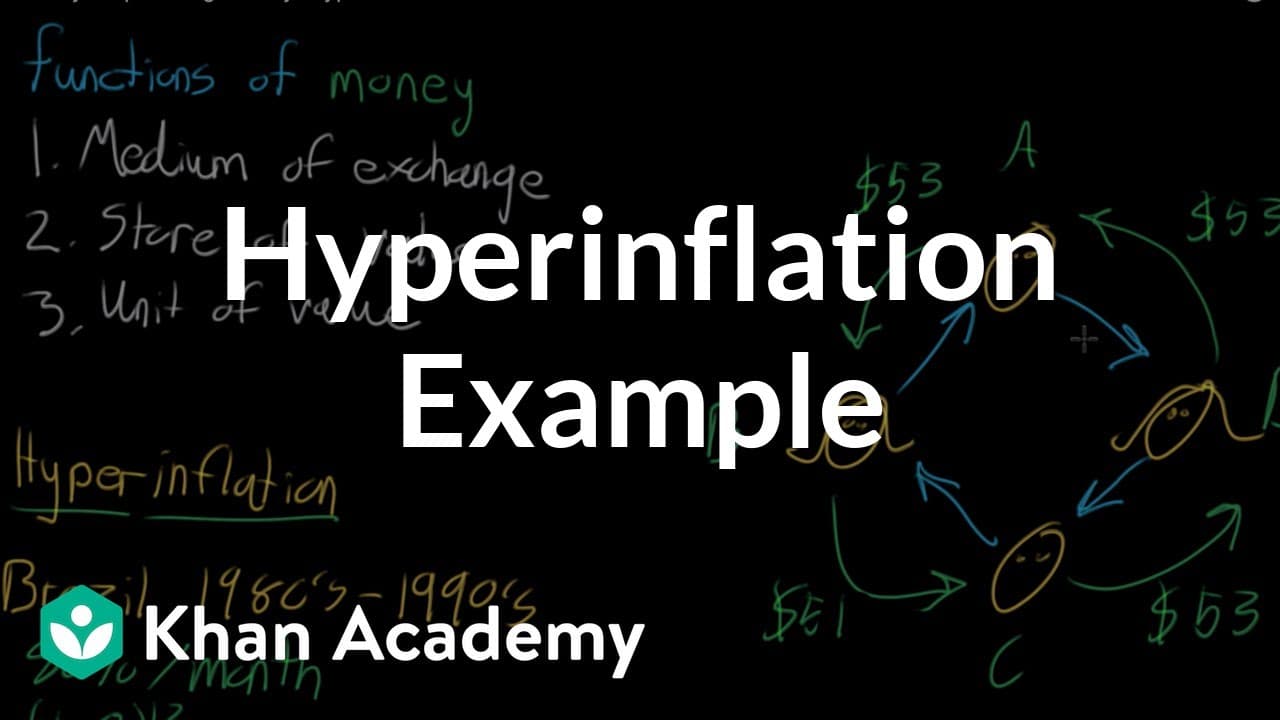
Hyperinflation leads to the breakdown of money's function as a store of value and unit of value, while still serving as a medium of exchange.
Transcript
- [Voiceover] So in the last video, I was talking about various functions of money. The first was that it's a medium of exchange. If you want to trade for things, typically you give someone money and they give you the thing, rather than trying to barter. Trading apples for oranges or horses for legal services or things like this. The second is that... Read More
Key Insights
- 🤑 Hyperinflation leads to the breakdown of money's functions as a store of value and unit of value.
- 🤑 Money still serves as a medium of exchange during hyperinflationary periods.
- 😒 In hyperinflation, people tend to use stable foreign currencies as a reference for evaluating the value of goods.
Install to Summarize YouTube Videos and Get Transcripts
Explore YouTube Video Summarizer or Get YouTube Transcript Extractor
Questions & Answers
Q: What are the three functions of money explained in the video?
The three functions of money are a medium of exchange, a store of value, and a unit of value.
Q: Why does money lose its function as a store of value in hyperinflation?
In hyperinflation, the rapid increase in prices reduces the value of money, making it ineffective for storing wealth.
Q: How does hyperinflation impact the unit of value function of money?
In hyperinflation, the fluctuating and rapidly increasing prices make it difficult to assign a stable value to goods, leading people to use more stable foreign currencies as a unit of value.
Q: How did Brazil address the breakdown of the unit of value function during hyperinflation?
Brazil introduced a fake currency called URV, which was loosely pegged to the U.S. dollar, to serve as a stable unit of value. Over time, they transitioned to using URV as the new currency, solving the problem.
Summary & Key Takeaways
-
Hyperinflation occurs when prices increase rapidly, and Brazil experienced it in the 1980s and early 1990s, with an inflation rate of 80% per month.
-
In hyperinflation, money loses its function as a store of value because its value rapidly decreases over time.
-
Money also loses its function as a unit of value, causing people to use stable foreign currencies as reference points for evaluating the value of goods.
Read in Other Languages (beta)
Share This Summary 📚
Summarize YouTube Videos and Get Video Transcripts with 1-Click
Try YouTube Summary with ChatGPT & Claude or YouTube Transcript Generator
Explore More Summaries from Khan Academy 📚



Summarize YouTube Videos and Get Video Transcripts with 1-Click
Try YouTube Summary with ChatGPT & Claude or YouTube Transcript Generator