A Giant Jurassic Sea Dragon, Unearthed | Dean R. Lomax | TED
TL;DR
Discover the incredible journey of a paleontologist who stumbled upon the most complete skeleton of a large prehistoric reptile ever found in the UK.
Transcript
Paleontology. I know what you're all thinking. "Jurassic Park." Maybe Ross from "Friends." (Laughter) Perhaps even Indiana Jones? But that's archaeology. Let me show you some real paleontology. Now, first of all, let's take a step back in time. Not quite to the Jurassic, at least not yet, but to January 21, 2021, when I received an email about a cu... Read More
Key Insights
- 🦖 Real paleontology involves incredible discoveries and is not just like "Jurassic Park".
- 🌊 The Rutland Water Nature Reserve in the UK is where a significant fossil discovery was made.
- 📧 Many messages claiming to have made cool fossil discoveries turn out to be false, but one email turned out to be life-changing.
- 🐉 Ichthyosaurs, or sea dragons, are ancient marine reptiles that lived during the time when dinosaurs ruled the land.
- 🌍 Rutland was once covered by a tropical sea during the Jurassic period.
- 💡 The initial discovery of the ichthyosaur led to a mini excavation and the realization that it was a unique and significant find.
- 🧠 Revolutionary techniques like photogrammetry allow for detailed analysis of fossils while they are still in the ground.
- 🏞️ The excavation and removal of the ichthyosaur skeleton took a great deal of time, effort, and collaboration among a team of paleontologists.
Install to Summarize YouTube Videos and Get Transcripts
Explore YouTube Video Summarizer or Get YouTube Transcript Extractor
Questions & Answers
Q: What was the curious discovery made in Rutland in the Midlands?
The curious discovery made in Rutland was a structure spotted by Joe Davis, who works for the Leicestershire and Rutland Wildlife Trust. He found large vertebrae from the spine of an ichthyosaur, or sea dragon, while doing routine maintenance in one of the Reserve's lagoons.
Q: What are ichthyosaurs?
Ichthyosaurs are ancient marine reptiles that lived in the prehistoric seas around 180 million years ago. They are not dinosaurs or dragons but belonged to a group of reptiles that gave birth to live young and breathed air. They went extinct around 90 million years ago.
Q: How did the paleontologists conduct the excavation of the Rutland ichthyosaur?
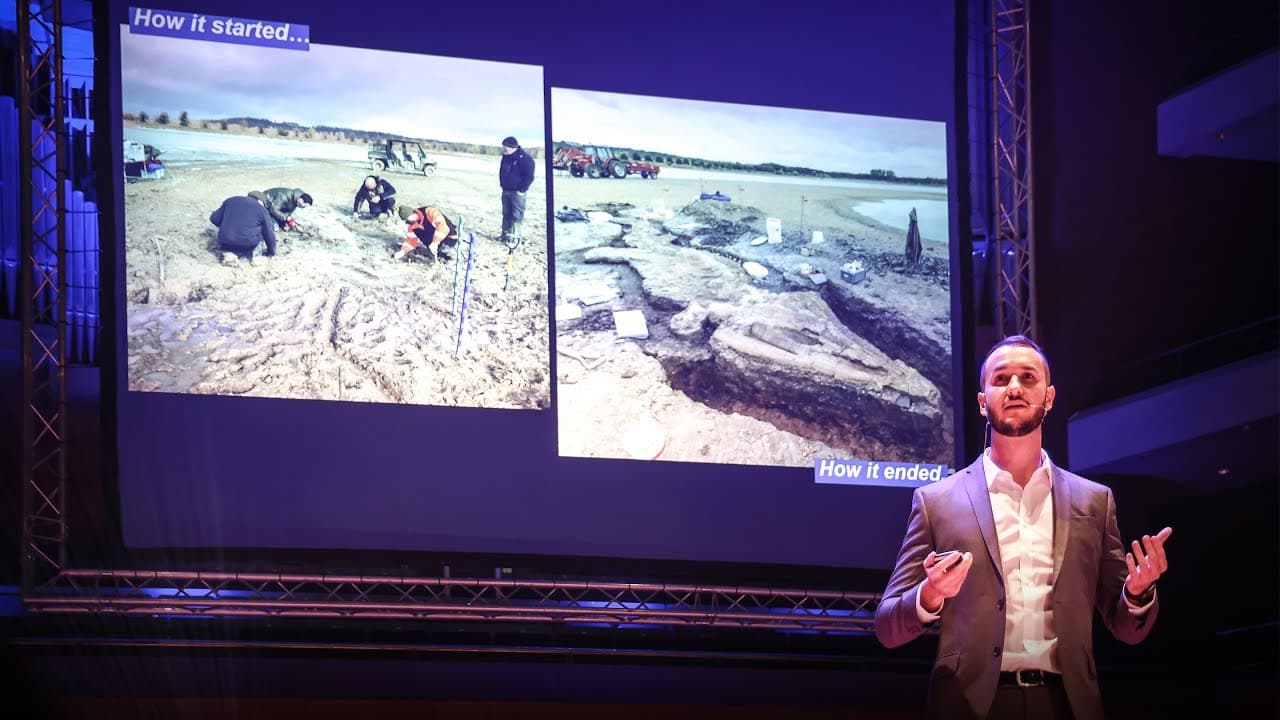
After receiving photos of the find, paleontologists visited the site in February and conducted an exploratory dig. Due to the fragile nature of the skeleton and the wintery conditions, the ichthyosaur had to be reburied and protected. They returned six months later with a team of paleontologists and spent 14 and a half days over three weeks excavating the skeleton.
Q: What techniques were used to capture data and document the ichthyosaur?
The paleontologists used photogrammetry, a technique that involves taking thousands of photos to create a three-dimensional model of the skeleton. This allowed them to capture all the data while the ichthyosaur was still in the ground. The three-dimensional model helped them analyze the bones and share the information with colleagues worldwide.
Q: Why did the Rutland ichthyosaur attract so much interest?
The Rutland ichthyosaur attracted a lot of interest because it was a complete and large fossil of an apex predator from the Jurassic sea. Such finds are rare, especially in the UK, where most ichthyosaur fossils are found on the coast. The rarity of this discovery, along with its size and completeness, made it a fascinating and viral story.
Q: What are the future plans for the Rutland ichthyosaur?
The next major step for the Rutland ichthyosaur is for Nigel to clean and conserve the entire skeleton, a process that will take at least two years. Once conserved, the team will study the specimen in detail and prepare it for display at Rutland. The hope is that the ichthyosaur will attract millions of visitors, allowing them to marvel at this Jurassic giant and learn about the hidden history beneath their feet.
Summary & Key Takeaways
-
The speaker received an email about a fossil discovery in Rutland, UK, which turned out to be the skeleton of an ichthyosaur, an ancient marine reptile.
-
The excavation of the ichthyosaur skeleton lasted several weeks and was a race against time to prevent further degradation.
-
The skeleton, weighing several tons, was successfully removed from the ground and is now being cleaned and conserved for eventual display to the public.
Read in Other Languages (beta)
Share This Summary 📚
Summarize YouTube Videos and Get Video Transcripts with 1-Click
Try YouTube Summary with ChatGPT & Claude or YouTube Transcript Generator
Explore More Summaries from TED 📚






Summarize YouTube Videos and Get Video Transcripts with 1-Click
Try YouTube Summary with ChatGPT & Claude or YouTube Transcript Generator