What Are Position Vectors and Displacement Vectors?
TL;DR
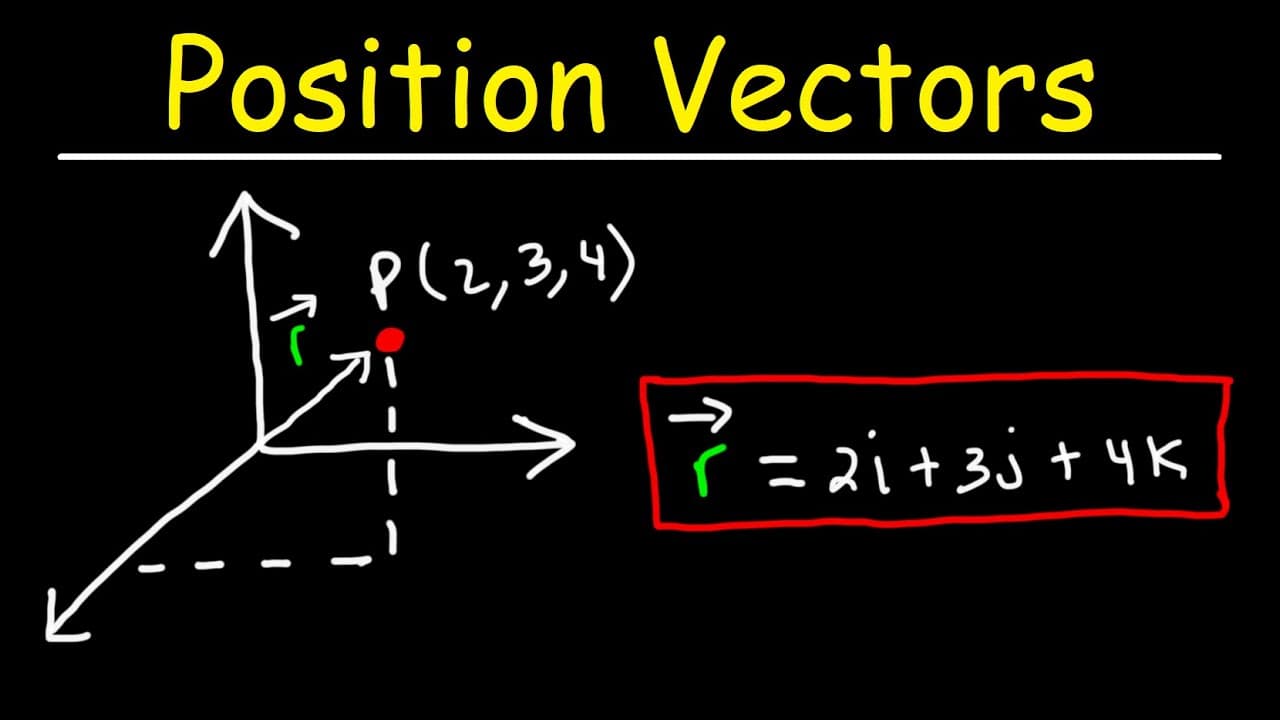
Position vectors originate from the coordinate system's origin and point to a specific location, while displacement vectors indicate the change in position by subtracting the initial position vector from the final position vector. To calculate these vectors, identify the differences in coordinates for both 2D and 3D systems.
Transcript
in this video we're going to talk about position vectors and how to use them to calculate a displacement vector so what are position vectors to answer that question let's draw a picture so here we have a graph that's the x-axis this is the y-axis and let's put a point on this graph we'll call this point p which is at 3 comma two now to draw the pos... Read More
Key Insights
- 😥 Position vectors start from the origin and point towards a specific point in a coordinate system.
- ❎ The length or magnitude of a position vector can be found by calculating the square root of the sum of the squares of its components.
- 🧘 Displacement vectors are calculated by subtracting the initial position vector from the final position vector.
- 😥 Displacement vectors represent the change in position as an object moves from one point to another.
- 🧘 Position vectors can be calculated in both 2D and 3D coordinate systems.
- 🤪 The x, y, and z components of a position vector correspond to the differences in the x, y, and z values between the origin and the point of interest.
- 🧘 The magnitude of a position vector represents its length or distance from the origin.
Install to Summarize YouTube Videos and Get Transcripts
Explore YouTube Video Summarizer or Get YouTube Transcript Extractor
Questions & Answers
Q: What are position vectors?
Position vectors are vectors that start from the origin and point towards a specific point in a coordinate system. They are represented by the symbol "r" with a vector symbol attached to it.
Q: How do you calculate the length of a position vector?
To find the length of a position vector, you calculate its magnitude. For a 2D coordinate system, it is the square root of the sum of the squares of the x and y components. For a 3D coordinate system, it is the square root of the sum of the squares of the x, y, and z components.
Q: How do you calculate the displacement vector?
The displacement vector is calculated by subtracting the initial position vector from the final position vector. This gives the change in position as the particle moves from the initial point to the final point.
Q: What is the difference between position vectors and displacement vectors?
Position vectors start from the origin and point towards a specific point, representing the position of that point. Displacement vectors represent the change in position as an object moves from one point to another and are calculated by subtracting the initial position vector from the final position vector.
Summary & Key Takeaways
-
Position vectors start from the origin and point towards a specific point in a coordinate system.
-
In a 2D coordinate system, the position vector is calculated by finding the difference in the x and y values between the origin and the point of interest.
-
In a 3D coordinate system, the position vector is calculated by finding the difference in the x, y, and z values between the origin and the point of interest.
Read in Other Languages (beta)
Share This Summary 📚
Summarize YouTube Videos and Get Video Transcripts with 1-Click
Try YouTube Summary with ChatGPT & Claude or YouTube Transcript Generator
Explore More Summaries from The Organic Chemistry Tutor 📚


Summarize YouTube Videos and Get Video Transcripts with 1-Click
Try YouTube Summary with ChatGPT & Claude or YouTube Transcript Generator