Stability | Continuous and Discrete Time Systems | Signals and Systems
TL;DR
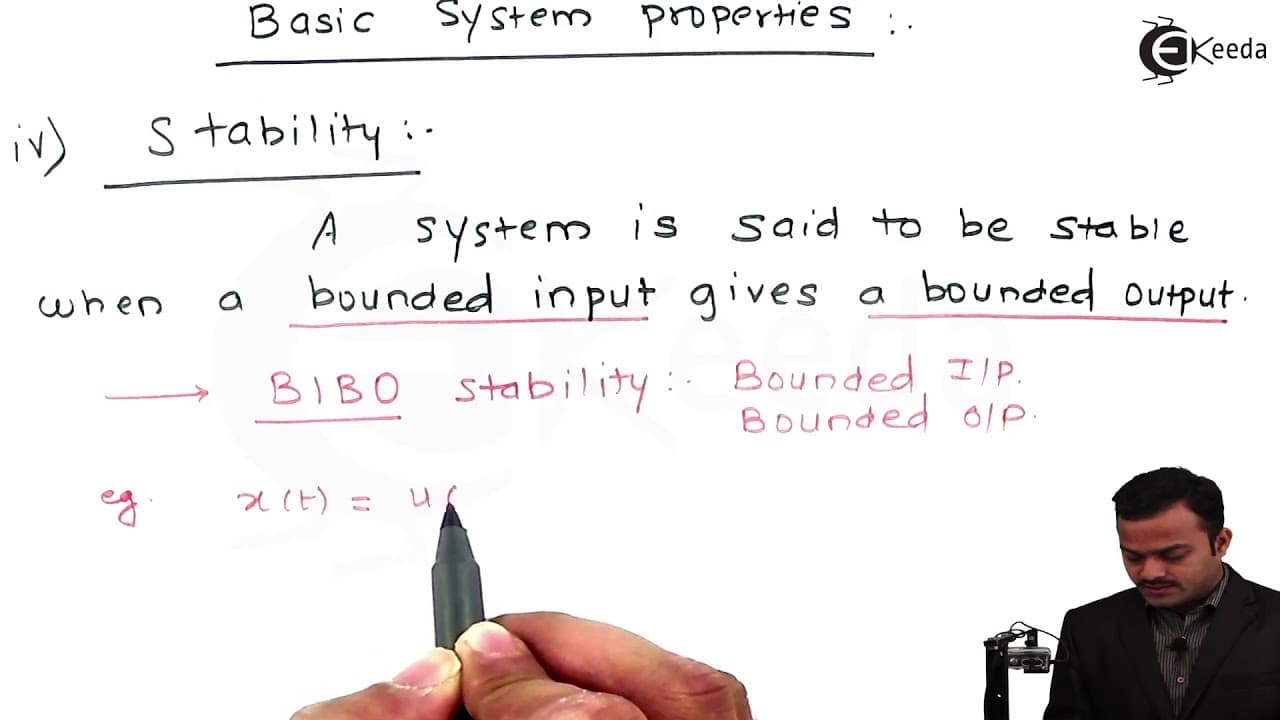
The video explains the stability criteria for systems, stating that a stable system should have a bounded output for any bounded input.
Transcript
hi students in this video we are going to see one of the basic property of a system that is the stability as we know a stable means it should not deviate or it should not increase in terms of magnitude so what we can say for the stable system for any bounded input we should get a bounded output so we can call this as a bebo stability criteria for s... Read More
Key Insights
- 🔠 Stability is a fundamental property of systems, indicating that the magnitude of the output should not increase for a bounded input.
- 🔠 A stable system produces a bounded output for any bounded input, while an unstable system exhibits unbounded output.
- 🎨 Understanding stability criteria is crucial in system analysis and design.
- 🔠 The concept of bounded input and bounded output is central to determining system stability.
- 🔠 The example of a unit step function illustrates a bounded input and a converging output in a stable system.
- 🤗 On the other hand, an unstable system leads to an output that increases exponentially with time for a bounded input.
- 🖐️ Stability plays a crucial role in ensuring the reliability and predictability of systems.
Install to Summarize YouTube Videos and Get Transcripts
Explore YouTube Video Summarizer or Get YouTube Transcript Extractor
Questions & Answers
Q: What is the stability criteria for a system?
The stability criteria for a system states that it should have a bounded output for any bounded input. In other words, the magnitude of the output should not increase as time goes to infinity.
Q: How is a stable system different from an unstable system?
In a stable system, the output remains bounded for a bounded input, meaning it does not increase in magnitude over time. On the other hand, an unstable system exhibits unbounded output, where the magnitude increases exponentially with time for a bounded input.
Q: Can you give an example of a stable system?
An example of a stable system is when the input is a unit step function (bounded input) and the output converges to zero as time tends to infinity. This means that no matter the value of time, the output remains finite and does not increase in magnitude.
Q: What happens in an unstable system?
In an unstable system, the output increases in magnitude exponentially with time, even for a bounded input. This means that as time goes to infinity, the output magnitude becomes unbounded.
Summary & Key Takeaways
-
The video discusses the concept of stability in a system, highlighting that a stable system should not deviate or increase in magnitude.
-
A stable system is defined as one that produces a bounded output for any bounded input.
-
An example of a stable system is given, where the input is a unit step function and the output converges to zero as time tends to infinity.
-
An example of an unstable system is also provided, where the output exponentially increases with time for a bounded input.
Read in Other Languages (beta)
Share This Summary 📚
Summarize YouTube Videos and Get Video Transcripts with 1-Click
Try YouTube Summary with ChatGPT & Claude or YouTube Transcript Generator
Explore More Summaries from Ekeeda 📚






Summarize YouTube Videos and Get Video Transcripts with 1-Click
Try YouTube Summary with ChatGPT & Claude or YouTube Transcript Generator