Light Motor Vehicles
TL;DR
Learn about the specifications of light motor vehicles through examples of Hyundai Accent, Tata Indica Vista, Maruti 800, and Honda City.
Transcript
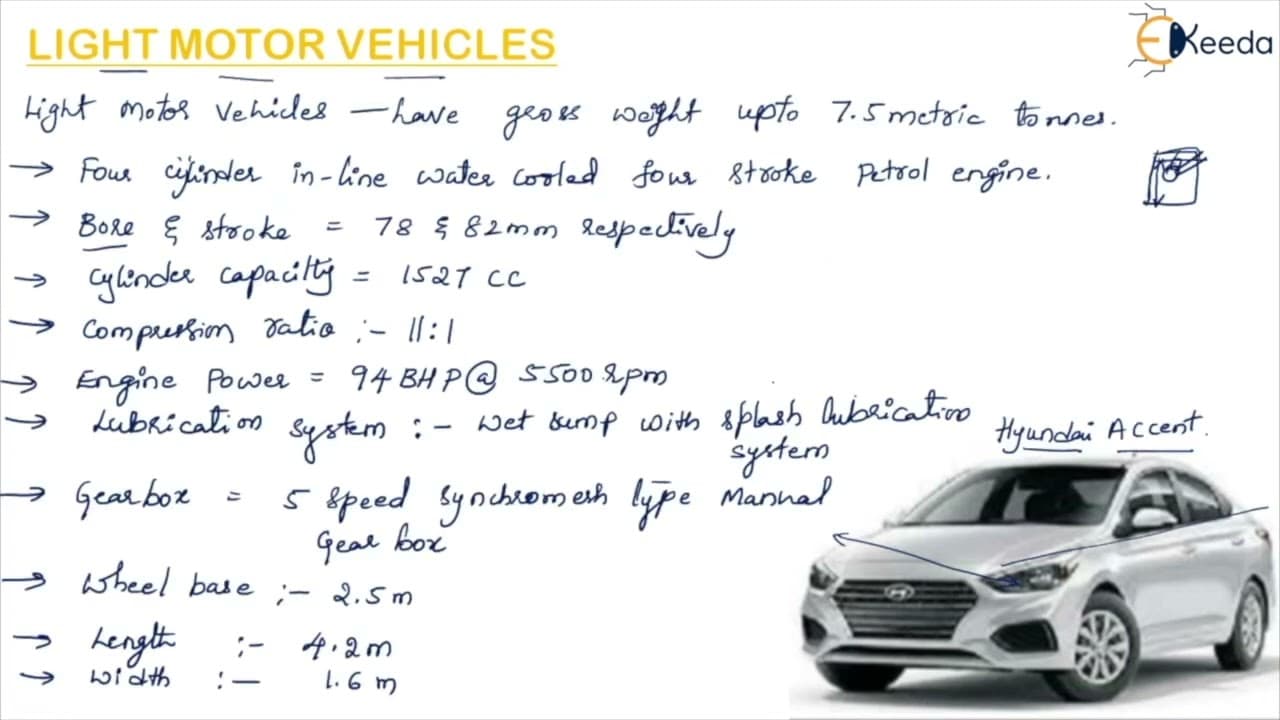
hello students today we will learn the topic light motor vehicles so as i have already told in the classification based on indian system so automobiles are classified in india as heavy motor vehicles light motor vehicles medium motor vehicles so these light motor vehicles are the vehicles whose gross weight is up to 7.5 metric tons so light motor v... Read More
Key Insights
- 🏋️ Light motor vehicles in India are categorized based on their weight, with a gross weight limit of 7.5 metric tons.
- 🙂 Engine specifications such as cylinder type, cooling system, stroke, bore, cylinder capacity, compression ratio, and power output vary for different light motor vehicles.
- 🙂 Lubrication systems can be either wet sump with splash or dry sump in light motor vehicles, with wet sump being more common.
- 🙂 Gearboxes in light motor vehicles are typically five-speed synchromesh type, offering a balance between gear ratios and simplicity.
- 🛝 Dimensions such as wheelbase, length, width, and ground clearance differ among the example vehicles.
- 🙂 Brake systems consist of disc brakes in the front and drum brakes in the rear for all the mentioned light motor vehicles.
- 😄 Steering systems are generally rack and pinion power-assisted in these cars, providing ease of maneuverability.
Install to Summarize YouTube Videos and Get Transcripts
Explore YouTube Video Summarizer or Get YouTube Transcript Extractor
Questions & Answers
Q: What is the classification of automobiles in India based on weight?
In India, automobiles are classified as heavy motor vehicles, light motor vehicles, and medium motor vehicles, with light motor vehicles having a gross weight of up to 7.5 metric tons.
Q: What are some examples of light motor vehicles and their engine types?
Examples of light motor vehicles include the Hyundai Accent (petrol engine), Tata Indica Vista (diesel engine), Maruti 800 (petrol engine), and Honda City (petrol engine).
Q: What is the significance of bore and stroke in engine specifications?
Bore refers to the diameter of the cylinder, while stroke measures the distance within the cylinder that the piston travels. These specifications impact the engine's performance and efficiency.
Q: How is the compression ratio determined, and what does it indicate?
The compression ratio is the ratio between the volume of the cylinder and the combustion chamber. It affects the engine's power output, fuel efficiency, and combustion characteristics.
Q: What is wet sump with splash lubrication?
Wet sump with splash lubrication is a lubrication system used in engines where an oil sump collects lubricating oil, which is then distributed to various engine components through oil splashing.
Summary & Key Takeaways
-
Light motor vehicles in India have a gross weight of up to 7.5 metric tons and are classified separately from heavy and medium motor vehicles.
-
Examples of light motor vehicles include Hyundai Accent, Tata Indica Vista, Maruti 800, and Honda City, each with different engine types and specifications.
-
Specifications such as engine type, bore and stroke, cylinder capacity, compression ratio, engine power, lubrication system, gearbox, dimensions, brake system, steering system, and curb weight vary for each vehicle.
Read in Other Languages (beta)
Share This Summary 📚
Summarize YouTube Videos and Get Video Transcripts with 1-Click
Try YouTube Summary with ChatGPT & Claude or YouTube Transcript Generator
Explore More Summaries from Ekeeda 📚



Summarize YouTube Videos and Get Video Transcripts with 1-Click
Try YouTube Summary with ChatGPT & Claude or YouTube Transcript Generator