Commas and introductory elements | Punctuation | Grammar | Khan Academy
TL;DR
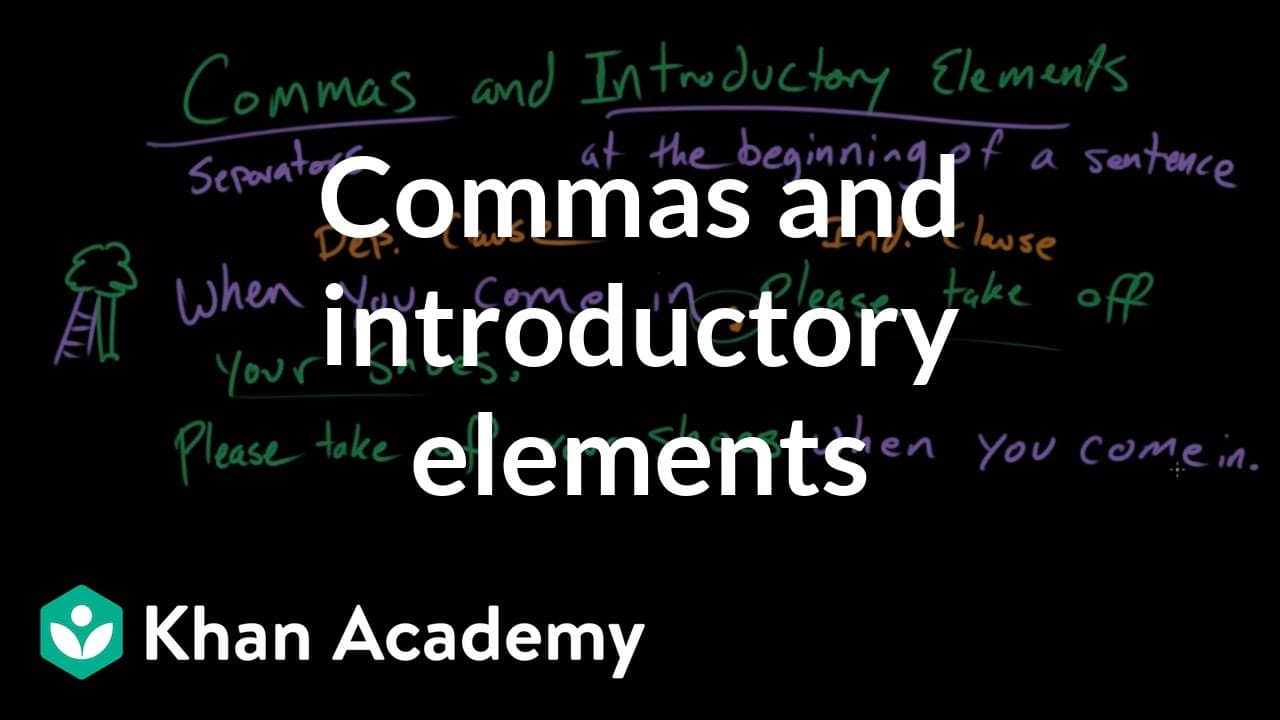
Comma usage is important when dealing with introductory elements like dependent clauses and sentence adverbs in sentences.
Transcript
- [Voiceover] Hello grammarians! Paige and I are here to teach you about introductory elements in sentences and how commas relate to them. Paige, how should we define what an introductory element is? - [Voiceover] So, it's pretty much something that happens at the beginning of a sentence. It can be a dependent clause or an adverb. But as we will se... Read More
Key Insights
- ❓ Introductory elements in sentences, like dependent clauses, should be separated by a comma.
- ☄️ When an independent clause comes before a dependent clause, no comma is needed.
- ❓ Two independent clauses can be connected with a comma and a conjunction.
- 😑 Sentence adverbs, like "initially" and "basically," modify the entire expression and should be separated by a comma.
- ❓ Comma usage for introductory elements is a matter of style and cultural context.
- ❓ The Federalist Papers and historical comma usage can provide insights into the evolution of comma usage.
- 💼 Semicolons can be used instead of commas in certain cases of connecting independent clauses.
Install to Summarize YouTube Videos and Get Transcripts
Explore YouTube Video Summarizer or Get YouTube Transcript Extractor
Questions & Answers
Q: What is an introductory element in a sentence?
An introductory element is something that occurs at the beginning of a sentence, such as a dependent clause or an adverb. It is typically separated from the rest of the sentence with a comma.
Q: Why is a comma necessary when starting a sentence with a dependent clause?
A comma is needed to distinguish the dependent clause from the independent clause. The dependent clause cannot stand on its own and needs the comma to indicate its separation.
Q: Do we always need a comma before a dependent clause?
No, if the dependent clause comes after the independent clause, there is no need for a comma. For example, "Please take off your shoes when you come in."
Q: How should two independent clauses be connected in a sentence?
Two independent clauses can be connected with a comma and a conjunction, such as "and." For example, "I rode an elephant, and then I ate a mango."
Summary & Key Takeaways
-
Introductory elements, such as dependent clauses, at the beginning of a sentence should be separated by a comma to differentiate them from the independent clause.
-
When an independent clause comes before a dependent clause, no comma is needed.
-
When uniting two independent clauses, a comma and a conjunction should be used.
Read in Other Languages (beta)
Share This Summary 📚
Summarize YouTube Videos and Get Video Transcripts with 1-Click
Try YouTube Summary with ChatGPT & Claude or YouTube Transcript Generator
Explore More Summaries from Khan Academy 📚



Summarize YouTube Videos and Get Video Transcripts with 1-Click
Try YouTube Summary with ChatGPT & Claude or YouTube Transcript Generator