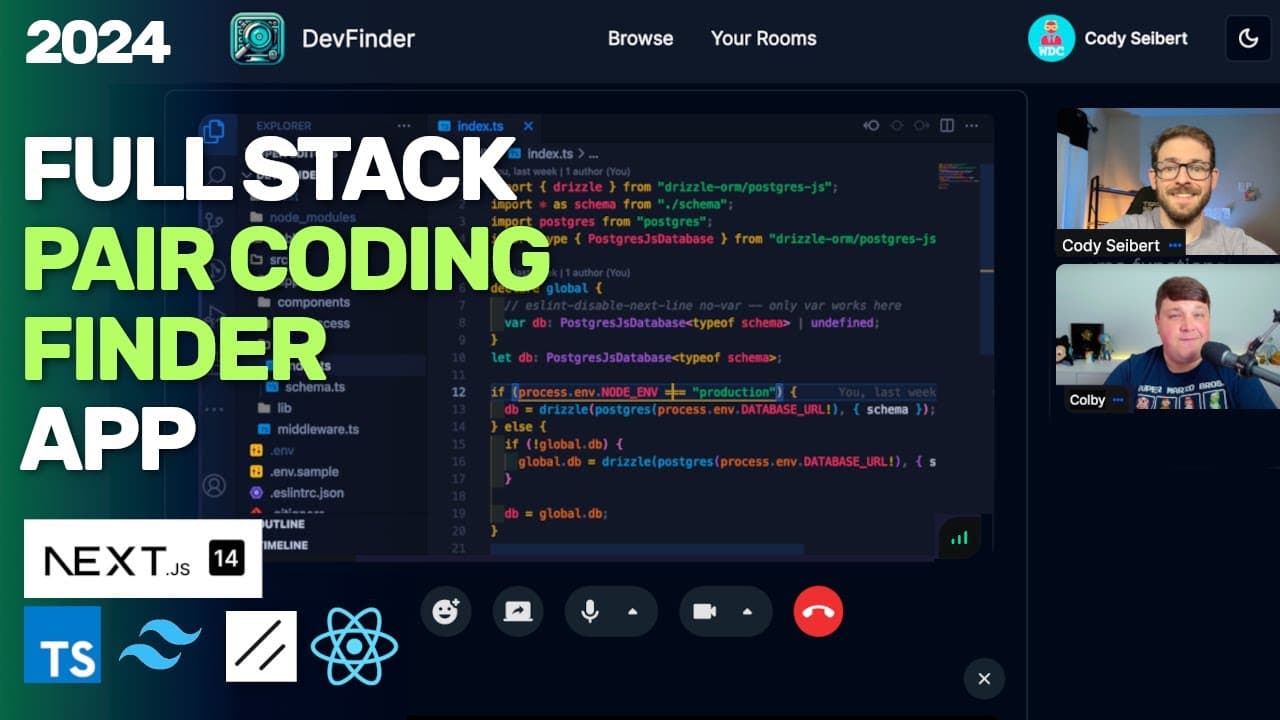
Build a Pair Programming Finder with Video & Screen Share (Next.js, Shadcn, Tailwind, Typescript)
TL;DR
This tutorial outlines building a full-stack pair programming application using Next.js, streamer services, and user authentication.
Transcript
hey everyone how's it going I have another full stack tutorial which I want to share with you all today hope you guys are interested basically in this tutorial I'm going to show you how to build out devinder which is a service that allows other developers to find people to pair program with maybe you're stuck on something you want to share your scr... Read More
Key Insights
- 👤 The tutorial emphasizes the importance of user authentication, leveraging NextAuth for secure and straightforward access control.
- 👤 Utilizing conditional rendering allows for a dynamic user experience, enabling features such as displaying specific components only when a user is logged in.
- 👻 The application’s modular structure enhances maintainability, allowing developers to reuse components like room cards across different features.
- 👤 Implementing a user-driven design encourages the inclusion of feedback mechanisms, such as toasts, which inform users after completing actions.
- 👨💼 Applying real-world application of services like Stream enables developers to focus on business logic rather than the complexities of real-time data handling.
- 😒 The use of modular functions enhances clarity between different actions, promoting cleaner code management and separation of responsibilities.
- 😒 The tutorial suggests making use of Docker for local database management to enhance resilience against external service changes.
Install to Summarize YouTube Videos and Get Transcripts
Explore YouTube Video Summarizer or Get YouTube Transcript Extractor
Questions & Answers
Q: What technologies are used in building the Devinder application?
The Devinder application employs Next.js for the front-end framework, Drizzle ORM for database interactions with PostgreSQL, and Stream's video and chat functions for real-time communication among users.
Q: How does user authentication work in the application?
User authentication is managed using NextAuth, which allows users to sign in with their Google accounts. This framework handles session management efficiently, ensuring secure access to the application's features.
Q: Can users edit or delete their rooms after creation?
Yes, users can edit or delete rooms. They can navigate to an edit interface where they can change room details, and a confirmation dialog prompts them before permanently deleting a room.
Q: What happens if a user tries to access certain routes without being logged in?
If a user attempts to access protected routes like "Your Rooms" without being authenticated, the application redirects them to the login page, ensuring that only users with valid sessions can access these features.
Summary & Key Takeaways
-
The tutorial begins with setting up a web application called "Devinder," aimed at helping developers find peers for pair programming via video calls and screen sharing.
-
It covers user authentication, real-time video functionalities, and features like room creation, searching, and joining based on programming tags.
-
The application is extended to include account management features, enabling users to edit or delete rooms and accounts with proper validations and user feedback.
Read in Other Languages (beta)
Share This Summary 📚
Summarize YouTube Videos and Get Video Transcripts with 1-Click
Try YouTube Summary with ChatGPT & Claude or YouTube Transcript Generator
Explore More Summaries from Web Dev Cody 📚
Summarize YouTube Videos and Get Video Transcripts with 1-Click
Try YouTube Summary with ChatGPT & Claude or YouTube Transcript Generator