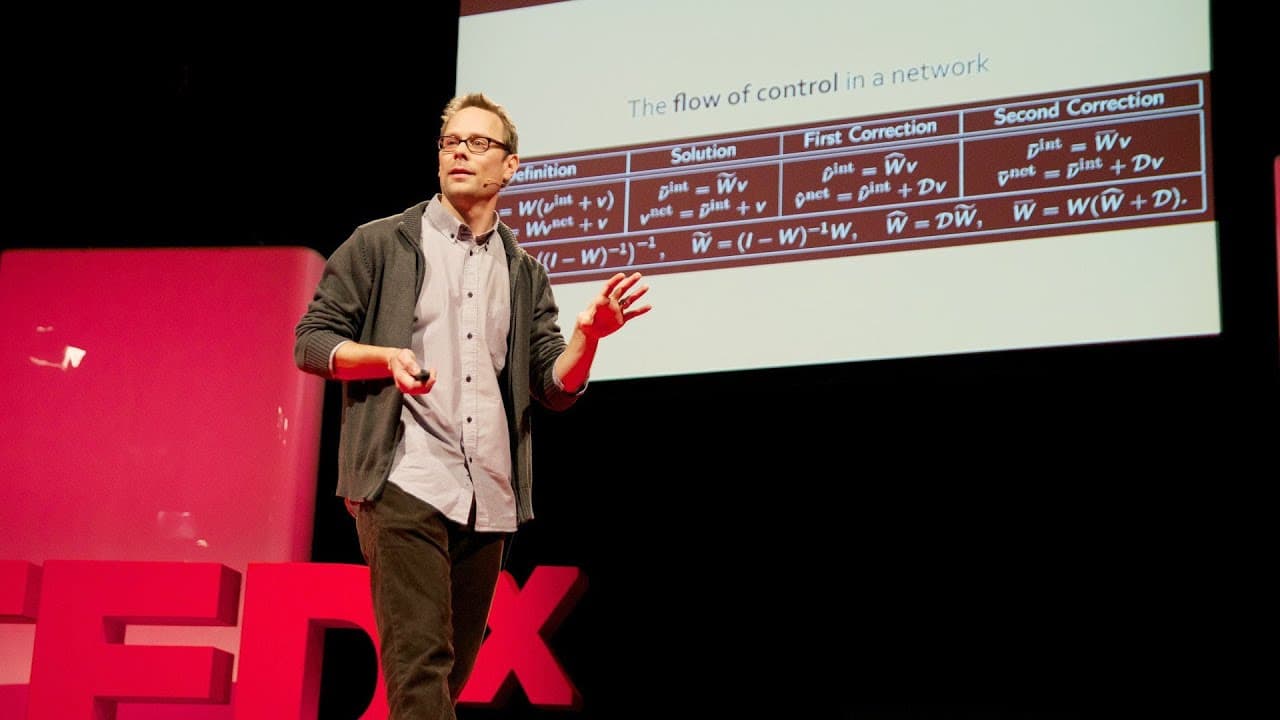
James B. Glattfelder: Who controls the world?
TL;DR
In this talk, the speaker discusses the limitations of existing economic models and introduces the concept of complex systems to understand the fabric that emerges from human interactions.
Transcript
Translator: Joseph Geni Reviewer: Morton Bast "When the crisis came, the serious limitations of existing economic and financial models immediately became apparent." "There is also a strong belief, which I share, that bad or oversimplistic and overconfident economics helped create the crisis." Now, you've probably all heard of similar criticism comi... Read More
Key Insights
- 🌐 Existing economic and financial models have serious limitations and contributed to the global financial crisis.
- 💰 The head of the UK Financial Services Authority and former governor of the European Central Bank suggest that oversimplistic and overconfident economics played a role in creating the crisis.
- ❓ We understand more about the origins of the universe than we do about the conditions for a stable society, a functioning economy, or peace.
- 🔍 The complexity of human interactions and systems is not well-understood, leading to a lack of understanding in economics and finance.
- 🌌 The science of complexity offers a potential solution to understanding complex systems and their behaviors.
- 🔬 Physics has been successful in describing reality by translating it into mathematics, but it has its limits in understanding complex systems.
- 🐦 Complex systems are made up of simple rules of interaction, leading to emergent behavior that cannot be predicted by just looking at the individual components.
- 🌐 Complex networks, like economic networks, can be used to study complex systems and provide insights into the distribution of control and systemic risk.
Install to Summarize YouTube Videos and Get Transcripts
Explore YouTube Video Summarizer or Get YouTube Transcript Extractor
Questions & Answers
Q: What limitations of existing economic and financial models were exposed during the crisis?
According to Jean-Claude Trichet, the governor of the European Central Bank, and the head of the UK Financial Services Authority, existing economic and financial models had serious limitations that became apparent during the crisis.
Q: How did oversimplistic and overconfident economics contribute to the crisis?
According to the same sources, oversimplistic and overconfident economics played a role in creating the crisis.
Q: What is the science of complexity?
The science of complexity is a field that studies complex systems, which are made up of many interconnected or interacting parts. These systems, such as swarms of birds or fish, ant colonies, ecosystems, brains, and financial markets, exhibit behavior that cannot be easily captured by traditional mathematical equations.
Q: How are complex systems different from traditional physical systems?
Complex systems cannot be easily mapped into mathematical equations like physical systems can. Instead, understanding complex systems requires focusing on the interactions between their components rather than the components themselves.
Q: What type of network is an ideal representation of complex systems?
Networks, where the nodes are the components of the system and the links represent their interactions, are ideal representations of complex systems. Just as equations are used in physics, complex networks can be used to study complex systems in various fields.
Q: What was the focus of the study published last year?
The study, called "The Network of Global Corporate Control," focused on analyzing ownership networks within transnational corporations (TNCs). It aimed to understand the patterns of shareholding relations and the distribution of control within the global economy.
Q: What was the notable finding of the study on economic networks?
The study found that a small core of highly interconnected companies, making up only 0.1 percent of all players, had the potential to collectively control a significant portion of the value of transnational corporations. This high level of control and interconnectivity within the core raises concerns about systemic risk in the global economy.
Q: What does the study's findings suggest about the structure of economic networks?
The study suggests that the structure of economic networks, particularly ownership networks, is likely the result of self-organization rather than a top-down approach. The emergent properties and patterns of interaction within the system play a significant role in shaping the structure of economic networks.
Summary & Key Takeaways
-
The existing economic and financial models have serious limitations and contributed to the financial crisis.
-
The study of complex systems, which focuses on interactions and emergence, can provide a solution for understanding the complexity of economic systems.
-
The study of the network of global corporate control revealed that a small group of top shareholders have a high degree of control over the global economy, posing a significant systemic risk.
Read in Other Languages (beta)
Share This Summary 📚
Summarize YouTube Videos and Get Video Transcripts with 1-Click
Try YouTube Summary with ChatGPT & Claude or YouTube Transcript Generator
Explore More Summaries from TED 📚



Summarize YouTube Videos and Get Video Transcripts with 1-Click
Try YouTube Summary with ChatGPT & Claude or YouTube Transcript Generator