The Four Color Map Theorem - Numberphile
TL;DR
Every map can be colored with four colors, a significant mathematical breakthrough.
Transcript
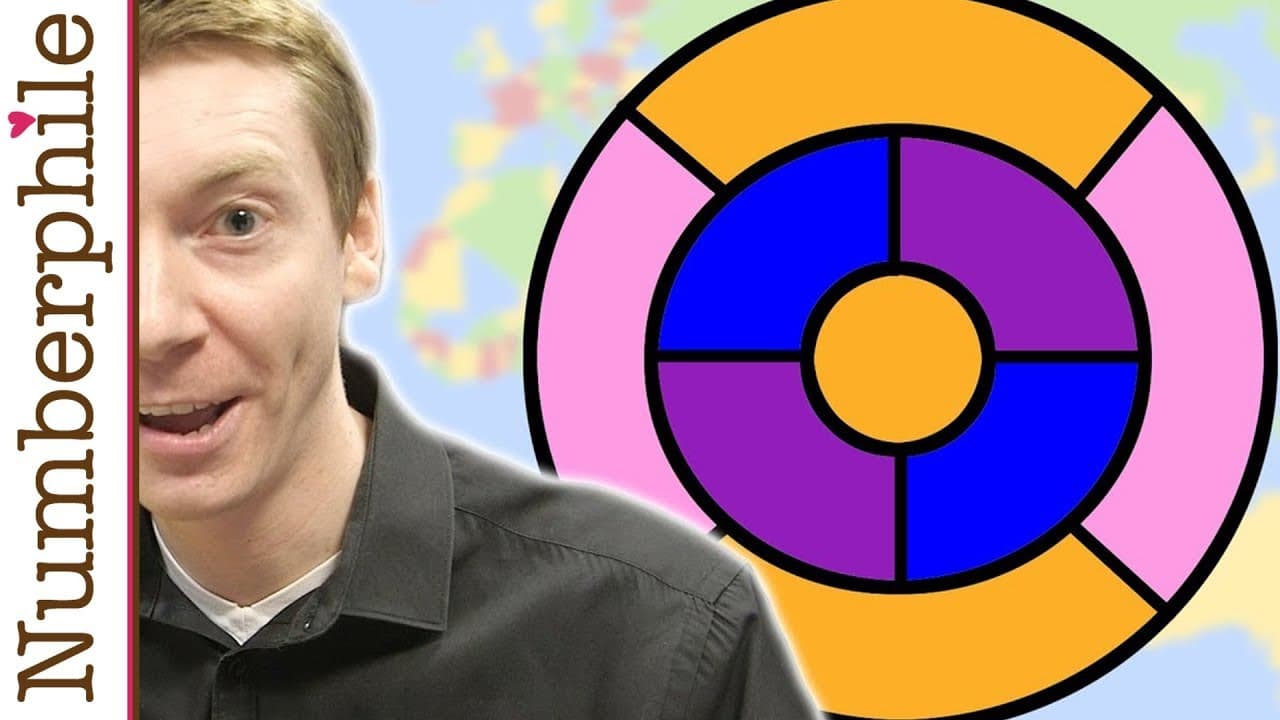
So let's talk about the four color theorem! It's a favorite with mathematicians. It's easy to state, so the statement is, every map can be colored using four colors, such that two neighboring countries are different colors. That would be confusing if it wasn't. So all maps can be done in four colors. In other words I'm saying there are no maps that... Read More
Key Insights
- 🍁 The Four Color Theorem guarantees that any map can be colored using only four colors, ensuring clarity and distinction between neighboring regions.
- 🛀 The final proof of the Four Color Theorem involved showing that all maps contain networks that can be colored with four colors or fewer.
- 💖 Computer assistance was crucial in proving the Four Color Theorem, sparking controversy due to the extensive case-checking involved.
- 💋 The Four Color Theorem marked a significant milestone in mathematics, demonstrating the power of technology in solving complex problems.
- 😫 The proof of the Four Color Theorem highlighted the intersection of mathematics and technology, setting a precedent for future mathematical research.
- 👻 The idea of reducing maps to networks simplified the problem, allowing for a more systematic approach to solving the Four Color Theorem.
- ❓ The Four Color Theorem's resolution showcased the importance of collaboration and innovation in solving longstanding mathematical conundrums.
Install to Summarize YouTube Videos and Get Transcripts
Explore YouTube Video Summarizer or Get YouTube Transcript Extractor
Questions & Answers
Q: What is the Four Color Theorem about?
The Four Color Theorem asserts that every map can be colored using only four colors, ensuring that no adjacent regions share the same color.
Q: How was the Four Color Theorem finally proven in the 1970s?
Mathematicians Kenneth Appel and Wolfgang Haken used a computer to analyze and prove that all maps contain networks that can be colored with four colors, marking the solution to the long-standing problem.
Q: Why was the proof of the Four Color Theorem controversial at the time?
The use of a computer for the proof was controversial because it involved checking a large number of cases, which some mathematicians felt did not offer a deep conceptual understanding of the theorem.
Q: How did the proof of the Four Color Theorem influence mathematics?
The proof of the Four Color Theorem was the first computer-assisted proof in mathematics, paving the way for increased use of technology in mathematical research and proofs.
Summary & Key Takeaways
-
The Four Color Theorem states that every map can be colored using four colors.
-
Solved in the 1970s by Kenneth Appel and Wolfgang Haken after 125 years of being unsolved.
-
The proof involved showing that all maps contain networks that can be colored with four colors.
Read in Other Languages (beta)
Share This Summary 📚
Summarize YouTube Videos and Get Video Transcripts with 1-Click
Try YouTube Summary with ChatGPT & Claude or YouTube Transcript Generator
Explore More Summaries from Numberphile 📚





Summarize YouTube Videos and Get Video Transcripts with 1-Click
Try YouTube Summary with ChatGPT & Claude or YouTube Transcript Generator