The Articles of Confederation | Period 3: 1754-1800 | AP US History | Khan Academy
TL;DR
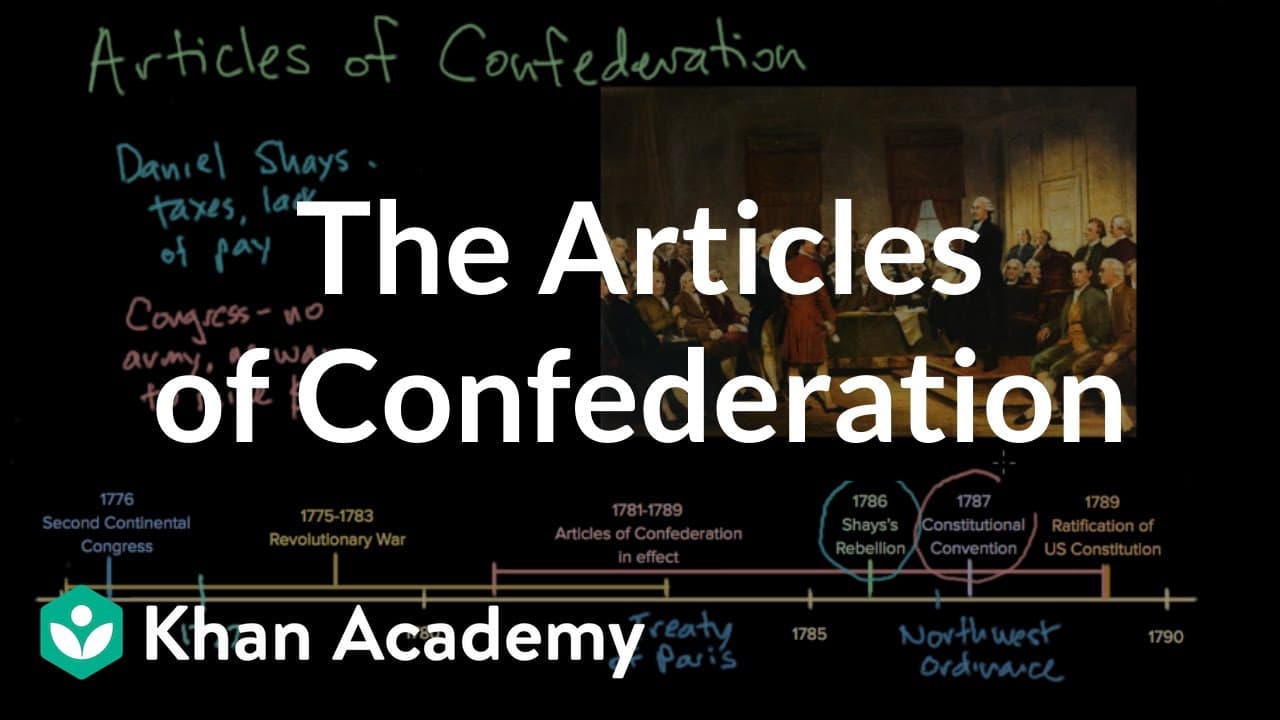
The Articles of Confederation were the first constitution of the United States, but they had limitations and led to problems such as lack of central power and inability to collect taxes, eventually leading to the drafting of a new constitution.
Transcript
- [Instructor] Hey, this is Kim and I'm here with Leah, Khan Academy's US Government and Politics Fellow. Welcome Leah. - [Leah] How's it going? - [Kim] Alright, so we're talking about the Articles of Confederation, which I think many people don't realize was the first constitution of the United States before the one that we have now since 1789. So... Read More
Key Insights
- ✊ The Articles of Confederation aimed to create a government that was different from monarchy and emphasized limited power.
- 🛩️ The central government under the Articles was extremely small, with only Congress and no executive or judicial branch.
- 🤨 The weaknesses of the Articles, including the inability to collect taxes and raise a national military, were revealed during Shays' Rebellion.
Install to Summarize YouTube Videos and Get Transcripts
Explore YouTube Video Summarizer or Get YouTube Transcript Extractor
Questions & Answers
Q: Why were the Articles of Confederation created?
The Articles were created to establish a government that was different from monarchy and to address the balance of power between the federal and state governments during the American Revolution.
Q: What were the limitations of the Articles of Confederation?
The central government under the Articles was limited in power, with no executive or judicial branch, and Congress required unanimous consent from all 13 states to pass amendments.
Q: What led to the realization that the Articles needed to be abandoned?
Shays' Rebellion, a group of farmers rebelling due to unpaid Revolutionary War duty and high state taxes, revealed the weaknesses of the Articles, including the inability to collect taxes and raise a national military.
Q: Who were some of the key figures involved in the decision to draft a new constitution?
Founding fathers like George Washington, Ben Franklin, Alexander Hamilton, and James Madison recognized the problems with the Articles and took part in the Constitutional Convention to create a new constitution.
Summary & Key Takeaways
-
The Articles of Confederation were created during the American Revolution as a way to establish a government that differed from monarchy and emphasized limited government.
-
Under the Articles, the central government was extremely small, with only Congress representing all 13 states and no executive or judicial branch.
-
While the Articles did unite the states and allow for some important accomplishments such as a favorable treaty with Britain and the Northwest Ordinance, they also presented challenges and growing pains.
Read in Other Languages (beta)
Share This Summary 📚
Summarize YouTube Videos and Get Video Transcripts with 1-Click
Try YouTube Summary with ChatGPT & Claude or YouTube Transcript Generator
Explore More Summaries from Khan Academy 📚



Summarize YouTube Videos and Get Video Transcripts with 1-Click
Try YouTube Summary with ChatGPT & Claude or YouTube Transcript Generator