Models of the Atom Timeline
TL;DR
Scientists have evolved their understanding of atoms over time, from Democritus' uncuttable particles to the quantum mechanical model.
Transcript
as scientists have done experiments and learned more and more about atoms they've changed the way they think about atoms so in this video we're going to look at a timeline of the different ways that scientists have pictured or imagined atoms over the years now the first people to really talk about the idea of atoms were the ancient Greek philosophe... Read More
Key Insights
- 🫀 Democritus and Leucippus were the first to propose the concept of atoms, which Democritus believed to be uncuttable particles with various sizes and shapes.
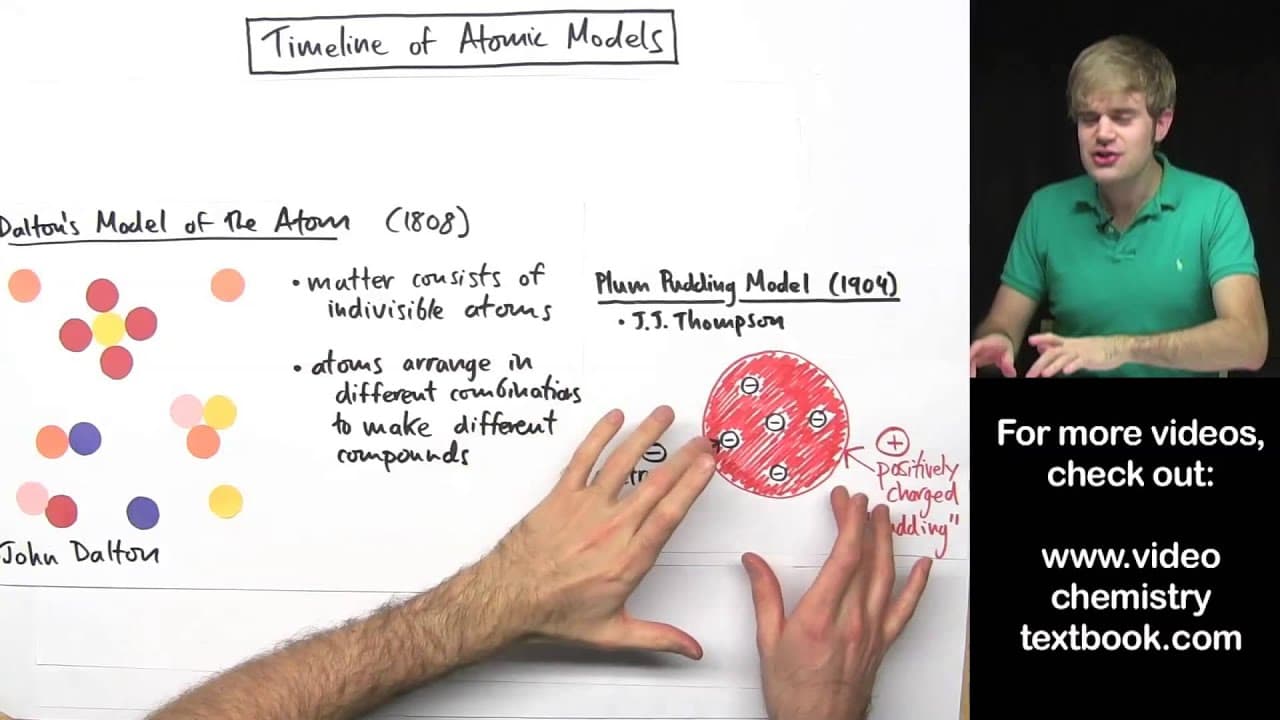
- 💨 John Dalton's experiments solidified the scientific acceptance of atoms as indivisible, tiny balls that combined in different ways.
- 🥺 J.J. Thompson's discovery of electrons led to the development of the plum pudding model, depicting electrons scattered within a positive dough-like substance.
- 🥺 Ernest Rutherford's gold foil experiment revealed the existence of a concentrated positive charge in the nucleus, leading to the nuclear model of the atom.
- 🤙 Niels Bohr's model introduced the idea of electrons in circular orbits around the nucleus, while later experiments called for the concept of orbitals.
- 🦾 Erwin Schrodinger's quantum mechanical model explained that electrons exhibit hyperactive motion and sketch out different shapes known as orbitals.
- 🫀 The nucleus of an atom consists of protons, discovered by Rutherford, and neutrons, discovered by Chadwick.
Install to Summarize YouTube Videos and Get Transcripts
Explore YouTube Video Summarizer or Get YouTube Transcript Extractor
Questions & Answers
Q: Who were the first individuals to propose the idea of atoms, and how did they imagine atoms to be?
The ancient Greek philosopher Democritus and his teacher Leucippus were the first to propose the concept of atoms. Democritus believed atoms were uncuttable particles that varied in size and shape. For example, he suggested iron atoms had hooks, while salt atoms had spikes.
Q: How did John Dalton contribute to the understanding of atoms?
John Dalton conducted the first scientific experiments to prove that matter was made of atoms. His model depicted atoms as indivisible, tiny balls that combined in different ways to form different substances. Initially met with skepticism, Dalton's ideas gained acceptance over time.
Q: What major discovery prompted a shift from Dalton's model to J.J. Thompson's plum pudding model?
J.J. Thompson's discovery of electrons in atoms, which are much smaller than atoms themselves, changed the perception of atoms. His plum pudding model depicted electrons scattered throughout the atom, resembling blueberries within a muffin dough.
Q: How did Ernest Rutherford's gold foil experiment impact the understanding of atoms?
Rutherford's experiment revealed that atoms have a concentrated positive charge in their nucleus, with electrons orbiting around it. This finding challenged the plum pudding model, leading to the development of the nuclear model of the atom.
Q: How did Niels Bohr's model differ from previous models of the atom?
Bohr's model maintained a central nucleus but introduced the idea of electrons orbiting the nucleus in circular paths, similar to planets around a sun. This model explained aspects of atomic behavior but was later refined.
Q: Why did Erwin Schrodinger propose the concept of orbitals?
Additional experiments in the 1920s ruled out Bohr's circular electron paths. Schrodinger's quantum mechanical model suggested that electrons were not in fixed orbits but rather exhibited hyperactive fly-like motion, sketching out different shaped orbitals.
Q: What subatomic particles were discovered to constitute the nucleus of an atom?
Ernest Rutherford discovered protons in 1919, representing the positive charge in the nucleus. James Chadwick later discovered neutrons in 1932, rounding out the correct view of atoms with both protons and neutrons inside the nucleus.
Q: Why is a combination of the Bohr model and quantum mechanical model often used to explain atoms?
While the quantum mechanical model is the most accurate, it can be complex to describe simple atom behaviors using electron orbitals. Therefore, a cross between the Bohr model and quantum mechanical model is often used to make explanations more accessible.
Summary & Key Takeaways
-
Ancient Greek philosopher Democritus proposed the idea of uncuttable atoms, but his ideas were overshadowed by Aristotle's belief in different elements.
-
British chemist John Dalton conducted scientific experiments to prove the existence of atoms, picturing them as tiny balls that cannot be divided.
-
J.J. Thompson's plum pudding model introduced the concept of electrons within atoms, while Ernest Rutherford's gold foil experiment discovered atomic nuclei.
-
Niels Bohr's model portrayed electrons orbiting the nucleus, but Erwin Schrodinger's quantum mechanical model explained the orbital shapes with hyperactive fly-like motion.
-
The quantum mechanical model is the most accurate representation of atoms today, but simpler tasks may still be explained using a combination of the outdated Bohr model.
Read in Other Languages (beta)
Share This Summary 📚
Summarize YouTube Videos and Get Video Transcripts with 1-Click
Try YouTube Summary with ChatGPT & Claude or YouTube Transcript Generator
Explore More Summaries from Tyler DeWitt 📚





Summarize YouTube Videos and Get Video Transcripts with 1-Click
Try YouTube Summary with ChatGPT & Claude or YouTube Transcript Generator