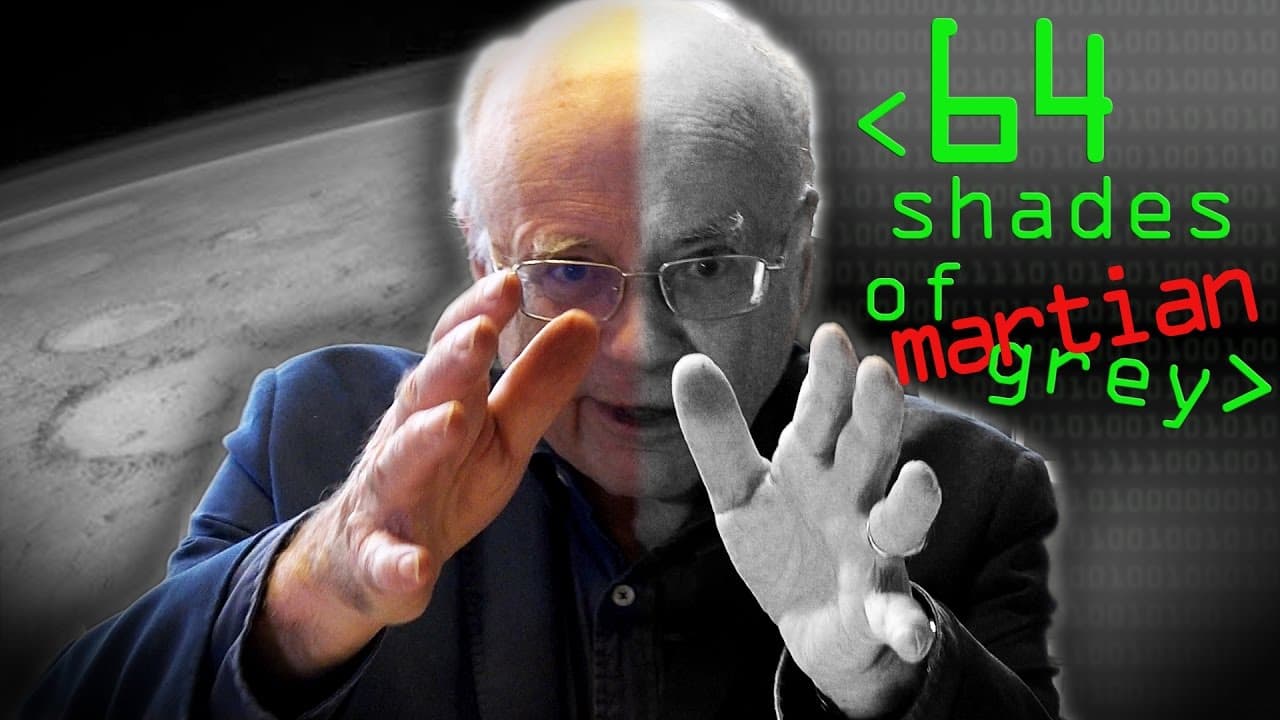
64 Shades of Martian Grey - Computerphile
TL;DR
Grayscale images sent from Mars in the 60s onwards were prone to noise and corruption due to the noisy interplanetary space, but engineers developed a robust coding scheme to correct the errors and improve the image quality.
Transcript
grayscale uh pictures from interplanetary space were actually sent back from mars to earth in from the mid 60s onwards and yeah i mean we call these black and white pictures as you all know by now they're not they're really grey scale pictures the scale used at the time was one of 64 shades and if i put that there black was shade 63 actually and ov... Read More
Key Insights
- 🇲🇭 Grayscale images sent from Mars were actually greyscale due to transmission limitations.
- 👾 The noisy environment of interplanetary space caused corruption in the grayscale images during transmission.
- 🫦 The Mariner missions used a coding scheme with hidden message bits and a distance of 16 to correct errors in the grayscale images.
- ⌛ Re-transmission of corrupted images was not possible due to the time delay between Earth and Mars.
- 👻 The coding scheme used in the Mariner missions allowed for up to seven correctable errors in a 32-bit package.
- ☠️ Grayscale images were recorded on tape and transmitted at a rate of 16 kilobits per second overnight.
- 👨💻 Advanced coding techniques were crucial for improving the image quality and reducing the impact of corruption.
Install to Summarize YouTube Videos and Get Transcripts
Explore YouTube Video Summarizer or Get YouTube Transcript Extractor
Questions & Answers
Q: What caused the grayscale images sent from Mars to be fuzzy and corrupt?
The noisy interplanetary space, which includes x-rays, gamma rays, cosmic rays, and solar activity, caused corruption in the grayscale images during transmission, resulting in fuzzy and noisy images.
Q: How was the issue of corruption in grayscale images addressed during the Mariner missions?
Engineers developed a coding scheme with hidden message bits and a distance of 16, which allowed for up to seven correctable errors in a 32-bit package. This helped improve the image quality and reduce the impact of corruption.
Q: Why couldn't the images be sent again if they were corrupted during transmission?
Due to the time it takes for radio signals to travel between Earth and Mars (about 9 minutes during the Mariner missions), it was not feasible to request a re-transmission of images. The focus was on developing coding techniques to correct errors without relying on re-transmission.
Q: How were the grayscale images transmitted from Mars to Earth during the Mariner missions?
The images were recorded on a tape recorder on board the Mariner spacecraft and then transmitted at a rate of 16 kilobits per second overnight when the spacecraft was in Earth's shadow.
Summary & Key Takeaways
-
Grayscale images sent from Mars to Earth were actually greyscale (not black and white) due to the limitations of the transmission technology at the time.
-
The noisy interplanetary space led to significant corruption in the grayscale images, with up to 25% of the pixels being affected during transmission.
-
The Mariner missions, which transmitted images at a rate of 8 bits per second, used a coding scheme with hidden message bits and a distance of 16 to correct errors and improve the image quality.
Read in Other Languages (beta)
Share This Summary 📚
Summarize YouTube Videos and Get Video Transcripts with 1-Click
Try YouTube Summary with ChatGPT & Claude or YouTube Transcript Generator
Explore More Summaries from Computerphile 📚





Summarize YouTube Videos and Get Video Transcripts with 1-Click
Try YouTube Summary with ChatGPT & Claude or YouTube Transcript Generator