Solving system with elimination | Algebra | Khan Academy
TL;DR
Learn how to find the intersection point of two linear equations by graphing them and identifying the X and Y coordinates.
Transcript
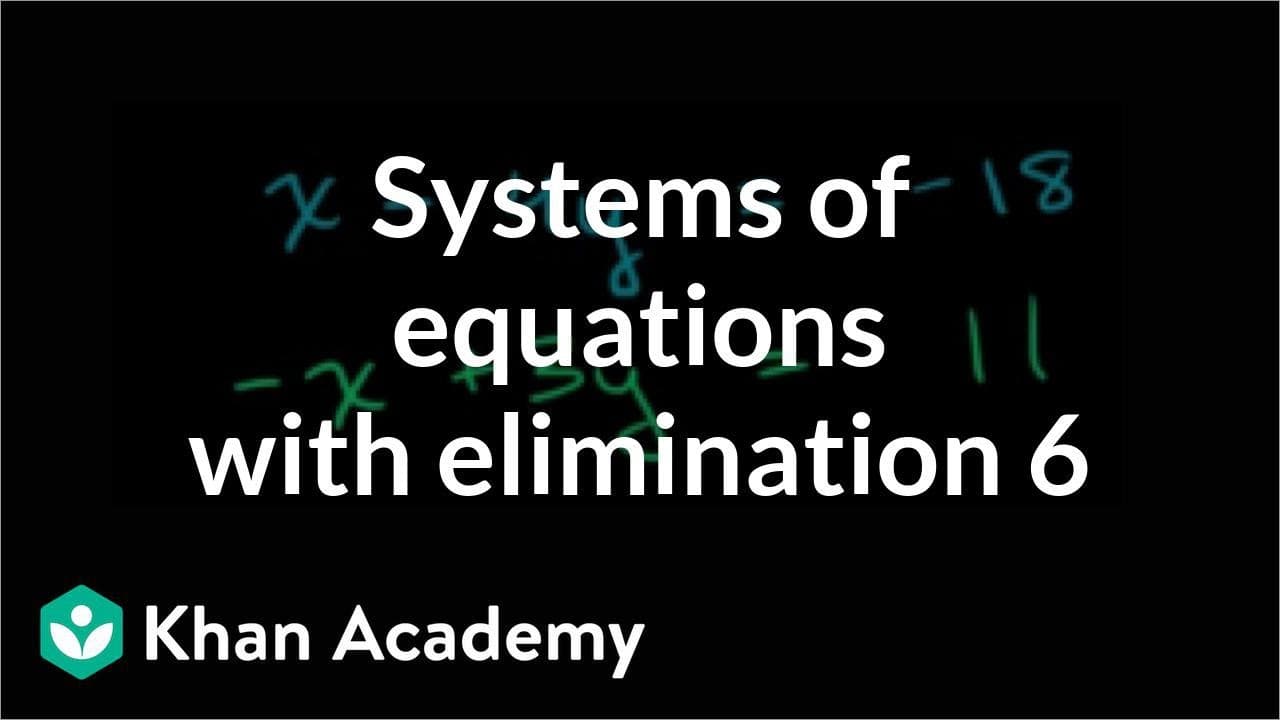
- [Instructor] So we have a system of two linear equations here. This first equation, X minus four Y is equal to negative 18, and the second equation, negative X plus three Y is equal to 11. Now what we're gonna do is find an X and Y pair that satisfies both of these equations. That's what solving the system actually means. As you might already hav... Read More
Key Insights
- 😥 Solving a system of linear equations involves finding the point where the equations intersect on a graph.
- 👈 Adding the left side terms of both equations cancels out the X values, leaving us with an equation only containing Y.
- 😑 To maintain equality, we add a value equivalent to the eliminated variable expression, which is derived from the second equation.
- ☺️ The Y value is then substituted back into one of the equations to solve for the X value.
- 😥 The X and Y coordinates of the intersection point represent the solution to the system of equations.
- 🫥 Graphing the equations allows visualizing the lines and their intersection point.
- 🫥 The lines represent all the X and Y pairs that satisfy each equation individually.
Install to Summarize YouTube Videos and Get Transcripts
Explore YouTube Video Summarizer or Get YouTube Transcript Extractor
Questions & Answers
Q: What is the purpose of solving a system of linear equations?
Solving a system of linear equations helps us find the point where both equations intersect. This point represents the X and Y values that satisfy both equations simultaneously.
Q: How can we eliminate one of the variables in the equations?
By adding the left side terms of both equations, we can eliminate the X values. This leaves us with one equation containing only the Y value, which we can then solve for.
Q: Can we add any value to the right side of the equation?
No, we need to add a value that is equivalent to the eliminated variable expression. In this case, we use the number 11, derived from the second equation, to maintain equality.
Q: How do we find the X value?
Once we have the Y value, we can substitute it into either equation and solve for X. Regardless of which equation we choose, we will obtain the same X value.
Summary & Key Takeaways
-
This video explains the process of finding the intersection point of two linear equations by graphing them.
-
By adding the left side terms of both equations, the X values cancel out, allowing us to solve for the Y value.
-
The Y value is then substituted back into one of the equations to solve for the X value.
Read in Other Languages (beta)
Share This Summary 📚
Summarize YouTube Videos and Get Video Transcripts with 1-Click
Try YouTube Summary with ChatGPT & Claude or YouTube Transcript Generator
Explore More Summaries from Khan Academy 📚



Summarize YouTube Videos and Get Video Transcripts with 1-Click
Try YouTube Summary with ChatGPT & Claude or YouTube Transcript Generator