Thermal Conductivity - Basic Concept of Radiation - Heat Transfer
TL;DR
Thermal conductivity is the rate at which heat is transferred through a material, and it can vary based on the type of material, space, time, and temperature.
Transcript
click the bell icon to get latest videos from akira hello friends we have seen what is the mechanism of heat transfer by conduction in this topic we are going to talk elaborately about the thermal conductivity thermal conductivity we know by four years law the expression is well-known that is Q dash can be given as minus ka DT by DX now this is not... Read More
Key Insights
- 🥵 Thermal conductivity is defined by Fourier's law of heat transfer, which relates heat transfer rate, temperature gradient, and surface area.
- 🤘 Thermal conductivity can vary based on the type of material, such as metals, alloys, nonmetals, and fluids.
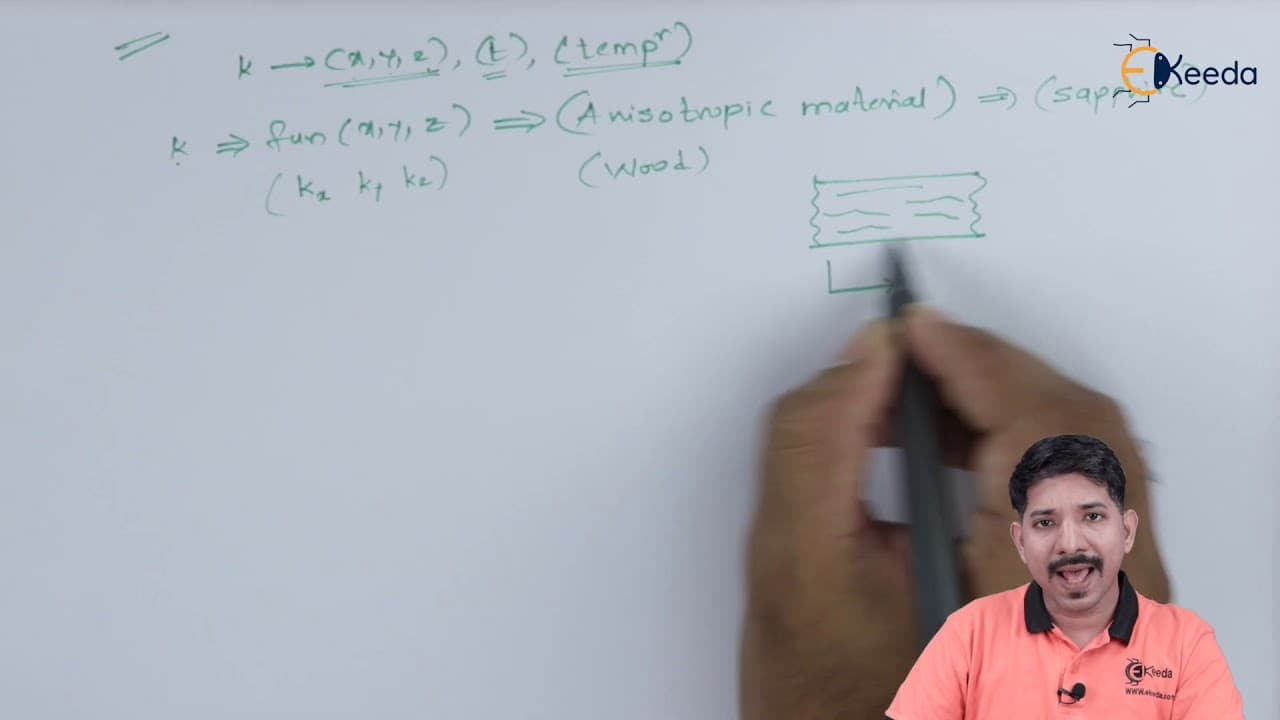
- ❓ Anisotropic materials have different thermal conductivities in different directions.
- ⌛ Thermal conductivity can change with time, depending on the material.
- 💦 The thermal conductivity of air, styrofoam, water, concrete, copper, and diamond varies significantly.
- 🏑 Understanding thermal conductivity is important in various fields, such as insulation, refrigeration, and material science.
- 🥵 Heat transfer in solids occurs through molecular movement and the movement of free electrons.
Install to Summarize YouTube Videos and Get Transcripts
Explore YouTube Video Summarizer or Get YouTube Transcript Extractor
Questions & Answers
Q: What is thermal conductivity and how is it calculated?
Thermal conductivity is the rate at which heat is transferred through a material. It is calculated using Fourier's law of heat transfer, which states that Q = -KA(dT/dx), where Q is the heat transfer rate, K is the thermal conductivity, A is the cross-sectional area, and dT/dx is the temperature gradient.
Q: Can thermal conductivity vary for different materials?
Yes, thermal conductivity can vary for different materials. It can be different for metals, alloys, nonmetals, and fluids. Different materials have different mechanisms of heat transfer, such as molecular movement and the movement of free electrons, which affect their thermal conductivity.
Q: What is anisotropic material?
Anisotropic materials are materials that have different properties in different directions. In the context of thermal conductivity, anisotropic materials have different thermal conductivities in different directions. For example, in wood, heat transfer is higher in the direction parallel to the grain compared to the perpendicular direction.
Q: Can thermal conductivity change with time?
Yes, thermal conductivity can be a function of time. Some materials exhibit changes in thermal conductivity over time, meaning their thermal conductivity can vary as time progresses. This can be observed in certain materials where the structure or composition changes due to external factors.
Summary & Key Takeaways
-
Thermal conductivity is defined by Fourier's law of heat transfer, and it can be calculated using the equation Q = -KA(dT/dx), where Q is the heat transfer rate, K is the thermal conductivity, A is the cross-sectional area, and dT/dx is the temperature gradient.
-
Thermal conductivity can vary for different materials, such as metals, alloys, nonmetals, and fluids, and it can be affected by molecular movement and the movement of free electrons.
-
Anisotropic materials, like wood, can have different thermal conductivities in different directions, and thermal conductivity can also depend on time and temperature.
Read in Other Languages (beta)
Share This Summary 📚
Summarize YouTube Videos and Get Video Transcripts with 1-Click
Try YouTube Summary with ChatGPT & Claude or YouTube Transcript Generator
Explore More Summaries from Ekeeda 📚






Summarize YouTube Videos and Get Video Transcripts with 1-Click
Try YouTube Summary with ChatGPT & Claude or YouTube Transcript Generator