Multivariable chain rule
TL;DR
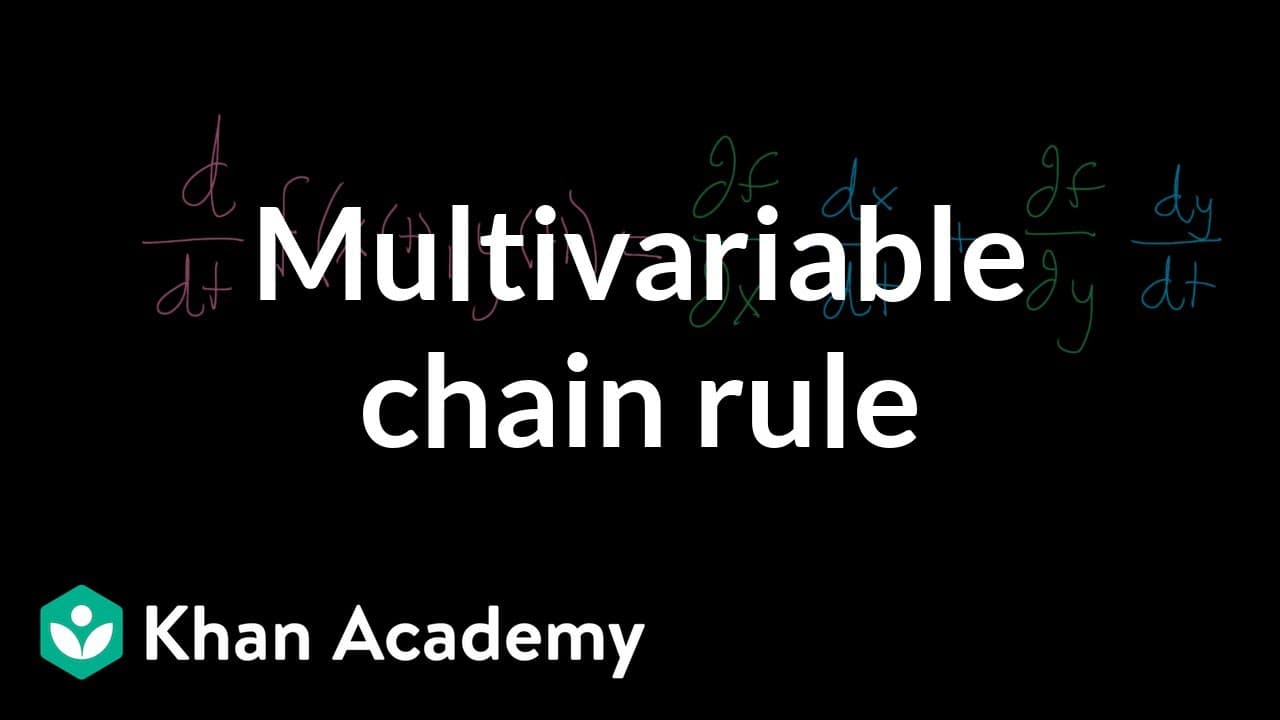
This video explains the concept of the multivariable chain rule, which allows for the calculation of derivatives in compositions of multivariable functions.
Transcript
- [Voiceover] So I've written here three different functions. The first on is a multivariable function, it has a two variable input, x, y, and a single variable output, that's x squared times y, that's just a number, and then the other two functions are each just regular old single variable functions. And what I want to do is start thinking about t... Read More
Key Insights
- 🔠 Function composition involves combining the outputs of one function as the inputs to another function.
- 👻 The multivariable chain rule allows for the calculation of derivatives in compositions of multivariable functions by considering the partial derivatives of the main function and the ordinary derivatives of the intermediate functions.
- 🍹 The multivariable chain rule can be simplified into a formula that involves multiplying the partial derivatives by the ordinary derivatives and summing them up.
- 🌍 The multivariable chain rule is a theoretical model that provides a framework for understanding function composition and its effect on derivatives in the multivariable world.
- 📏 Understanding the connection between partial derivatives and ordinary derivatives is crucial in applying the multivariable chain rule effectively.
- 📏 The multivariable chain rule is a powerful tool in calculus that simplifies the calculation of derivatives in complex compositions of functions.
- 😑 The multivariable chain rule can be further generalized and expressed using vector notation, leading to a more compact and elegant representation.
Install to Summarize YouTube Videos and Get Transcripts
Explore YouTube Video Summarizer or Get YouTube Transcript Extractor
Questions & Answers
Q: What is the purpose of the multivariable chain rule?
The multivariable chain rule allows for the calculation of derivatives in compositions of multivariable functions by combining partial derivatives and ordinary derivatives of intermediate functions.
Q: How is the multivariable chain rule applied in the example shown?
In the example, the multivariable chain rule is applied by taking the partial derivative of the multivariable function with respect to each variable and multiplying it by the ordinary derivative of the respective intermediate function. These products are then added together to obtain the derivative of the composition.
Q: Is the multivariable chain rule always necessary for calculating derivatives in multivariable functions?
No, the multivariable chain rule is not always necessary. In some cases, like the example shown in the video, the derivatives can be calculated without explicitly applying the multivariable chain rule. However, the multivariable chain rule serves as a useful tool and theoretical model for understanding function composition and its implications for derivatives in the multivariable world.
Q: Are there any limitations or special cases where the multivariable chain rule does not apply?
The multivariable chain rule is a general rule that applies to compositions of multivariable functions. However, there may be special cases or specific functions where alternative methods or rules need to be used to calculate derivatives more accurately.
Summary & Key Takeaways
-
The video introduces the concept of function composition and how it relates to derivatives in multivariable functions.
-
It demonstrates the calculation of the derivative of a specific composition of functions step-by-step.
-
The video highlights the connection between the partial derivatives of a multivariable function and the derivatives of the intermediary functions involved in the composition.
Read in Other Languages (beta)
Share This Summary 📚
Summarize YouTube Videos and Get Video Transcripts with 1-Click
Try YouTube Summary with ChatGPT & Claude or YouTube Transcript Generator
Explore More Summaries from Khan Academy 📚



Summarize YouTube Videos and Get Video Transcripts with 1-Click
Try YouTube Summary with ChatGPT & Claude or YouTube Transcript Generator