Calculating a P-value given a z statistic | AP Statistics | Khan Academy
TL;DR
This video explains how to perform a statistical significance test using a real-world example.
Transcript
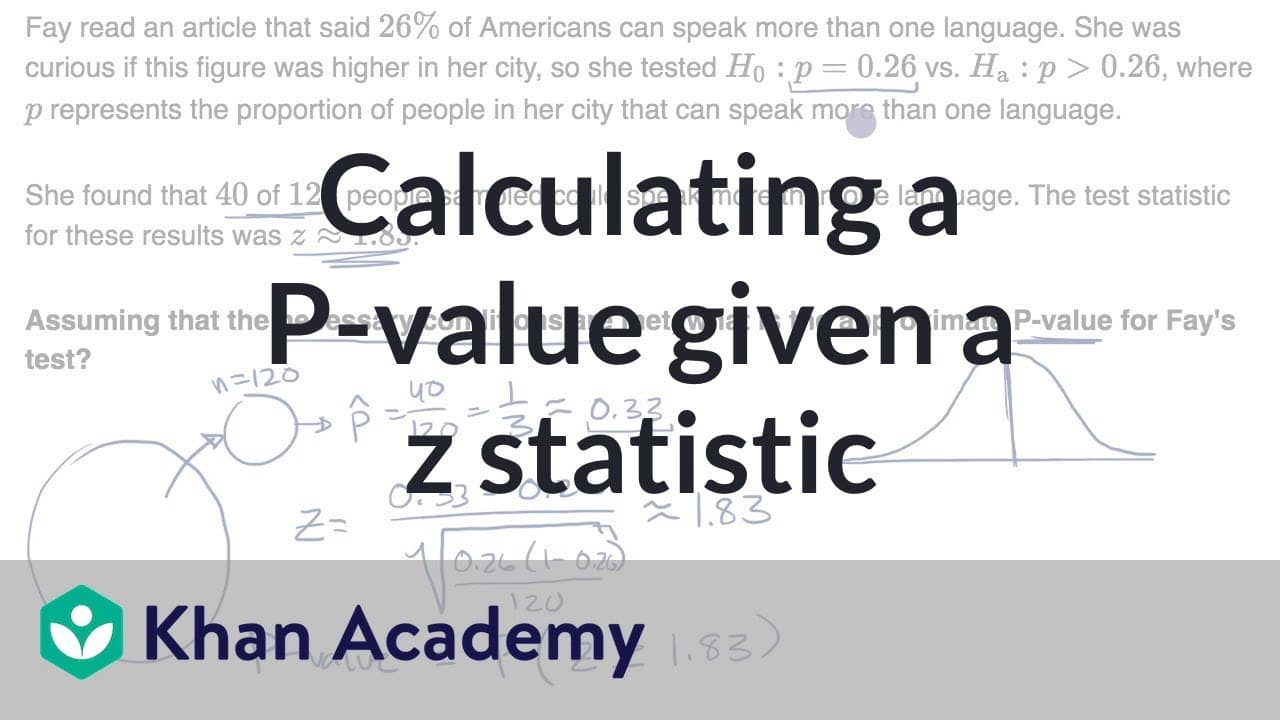
- [Instructor] Fay read an article that said 26% of Americans can speak more than one language. She was curious if this figure was higher in her city, so she tested her null hypothesis that the proportion in her city is the same as all Americans, 26%. Her alternative hypothesis is it's actually greater than 26%, where P represents the proportion of... Read More
Key Insights
- 🏆 A statistical significance test helps determine if observed data provide enough evidence to support or reject a null hypothesis.
- 🤪 The test statistic (Z) measures how many standard deviations the observed data is from the assumed proportion.
- 🏆 The P value represents the probability of obtaining a test statistic as extreme as, or more extreme than, the observed value.
- 🥘 Comparing the P value to the significance level allows one to make a decision about rejecting or failing to reject the null hypothesis.
- 🏆 The assumed population proportion and sample size are important factors in calculating the test statistic and determining the P value.
- ❓ The necessary conditions for assuming a normal sampling distribution include randomness, normality, and independence.
Install to Summarize YouTube Videos and Get Transcripts
Explore YouTube Video Summarizer or Get YouTube Transcript Extractor
Questions & Answers
Q: What is the purpose of a statistical significance test?
A statistical significance test is used to determine if there is enough evidence to support or reject a null hypothesis, based on sample data.
Q: How is the test statistic (Z) calculated in this example?
The Z statistic is calculated by finding the difference between the sample proportion and the assumed true proportion, and dividing it by the standard deviation of the sampling distribution of sample proportions.
Q: What does the P value represent in this context?
The P value is the probability of obtaining a test statistic as extreme as, or more extreme than, the observed value, assuming the null hypothesis is true. In this example, it represents the probability of obtaining a Z value greater than or equal to 1.83.
Q: How does Fay determine whether to reject or fail to reject the null hypothesis?
Fay compares the P value to the significance level she set before conducting the test. If the P value is lower than the significance level, she can reject the null hypothesis. Otherwise, she fails to reject it.
Summary & Key Takeaways
-
The video discusses a scenario where a person named Fay wants to test if the proportion of Americans who can speak more than one language is higher in her city.
-
Fay takes a sample of 120 people from her city and finds that 40 of them can speak more than one language.
-
Using the sample proportion, Fay calculates the test statistic (Z) and compares it to a significance level to determine if she can reject the null hypothesis.
Read in Other Languages (beta)
Share This Summary 📚
Summarize YouTube Videos and Get Video Transcripts with 1-Click
Try YouTube Summary with ChatGPT & Claude or YouTube Transcript Generator
Explore More Summaries from Khan Academy 📚



Summarize YouTube Videos and Get Video Transcripts with 1-Click
Try YouTube Summary with ChatGPT & Claude or YouTube Transcript Generator