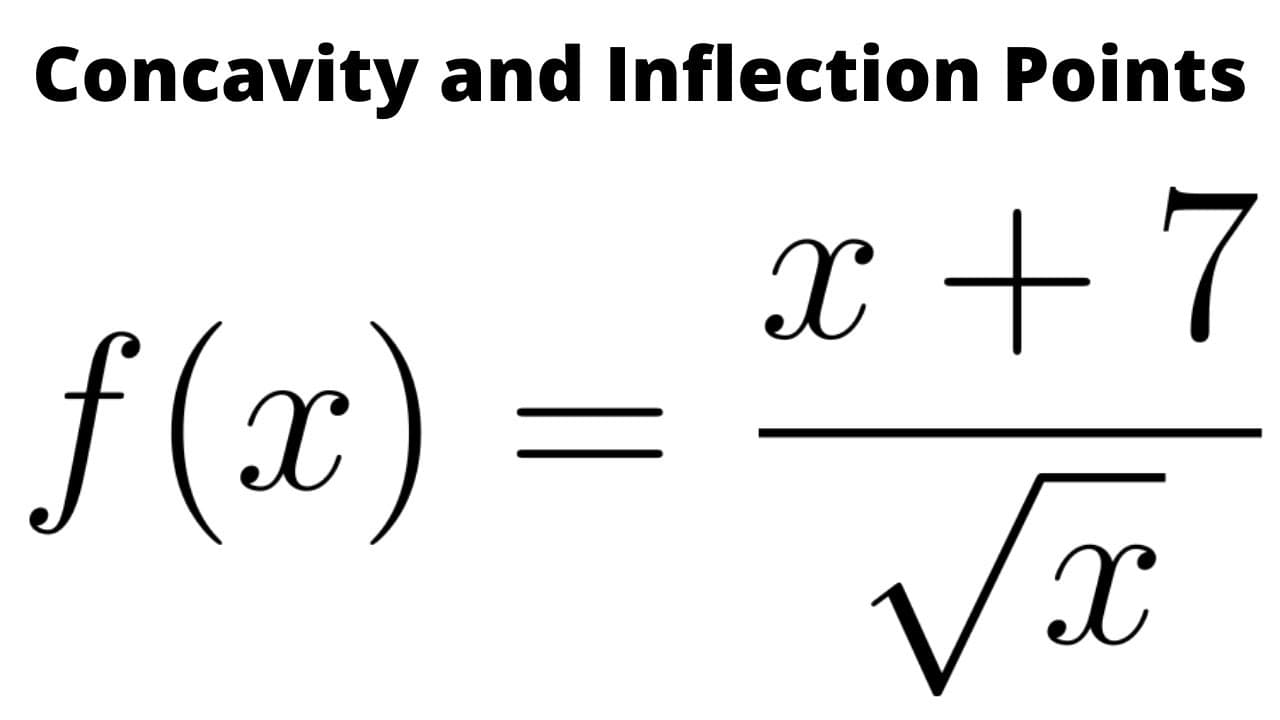
Concavity and Inflection Points
TL;DR
Finding concavity & inflection points using second derivative, set equal to zero for inflection points & test concavity changes.
Transcript
okay we have a function and we want to know uh where it's concave up where it's concave down and also what is the inflection point so to do all of this we have to find the second derivative and set it equal to zero so solution so we'll start first by rewriting this in a convenient way you could just take the derivative now but it becomes a huge mes... Read More
Key Insights
- 😥 Utilize the second derivative and set it equal to zero to find inflection points.
- 😥 Plot test points in the second derivative to determine concavity changes.
- 😥 Watch for domain restrictions to ensure the function is valid for finding inflection points.
- 😥 Concavity changes from up to down or vice versa indicate the presence of an inflection point.
- 😥 To find inflection points, plug the solution back into the original function.
- 😥 The process focuses on the second derivative instead of critical points for concavity analysis.
- 😥 Inflection points are crucial points where the concavity of a function changes.
Install to Summarize YouTube Videos and Get Transcripts
Explore YouTube Video Summarizer or Get YouTube Transcript Extractor
Questions & Answers
Q: How do you find concavity and inflection points in a function?
To find concavity and inflection points, utilize the second derivative and set it equal to zero. Plot inflection points when concavity changes from up to down or vice versa.
Q: Why is it crucial to plot test points to determine concavity?
Test points in the second derivative clarify if concavity is up or down. Positive results indicate concave up, while negative implies concave down, crucial for finding inflection points.
Q: What is the significance of domain restrictions in determining inflection points?
Domain restrictions are vital to find inflection points, ensuring the function is valid. Knowing where the function is defined helps in plotting test points accurately.
Q: Why is using the second derivative more effective than the first derivative in finding inflection points?
The second derivative is more effective for inflection points as it directly reveals concavity changes, unlike the first derivative which focuses on critical points for extrema.
Summary & Key Takeaways
-
To determine concavity & inflection points, find the second derivative by setting it equal to zero.
-
Rewrite the function in a convenient way before taking derivatives.
-
Inflection points occur when concavity changes, found by testing the second derivative at critical points.
Read in Other Languages (beta)
Share This Summary 📚
Summarize YouTube Videos and Get Video Transcripts with 1-Click
Try YouTube Summary with ChatGPT & Claude or YouTube Transcript Generator
Explore More Summaries from The Math Sorcerer 📚


Summarize YouTube Videos and Get Video Transcripts with 1-Click
Try YouTube Summary with ChatGPT & Claude or YouTube Transcript Generator