Equilibrium nominal interest rates in the money market | AP Macroeconomics | Khan Academy
TL;DR
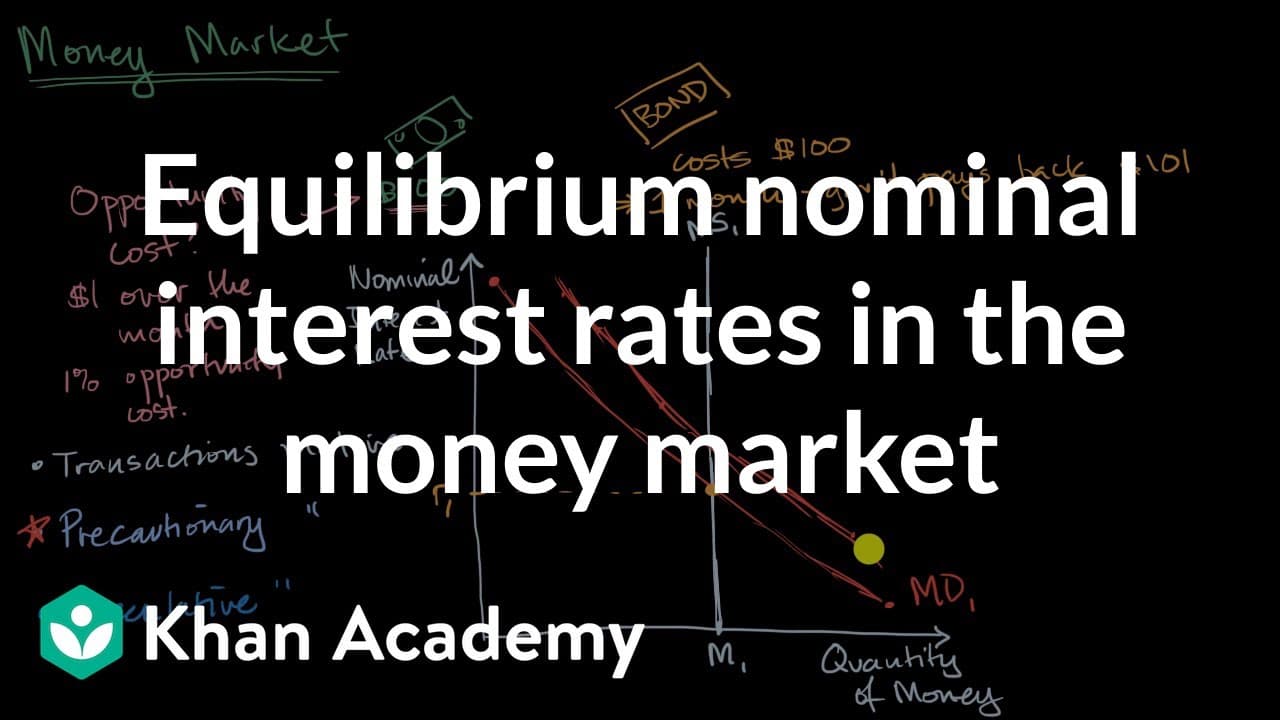
In a classical model, the supply of money is assumed to be perfectly inelastic, and the equilibrium nominal interest rate is determined by the intersection of the supply and demand for money.
Transcript
- [Instructor] So we've spent a lot of time justifying why we have this downward-sloping demand curve for money. But you're probably asking, well, this is a market, what, we didn't think about an equilibrium point. And to do that, we need to think about the supply of money. And in previous videos, we've started thinking about the supply of money, a... Read More
Key Insights
- 🤑 The classical model assumes a vertical supply curve for money, indicating a perfectly inelastic supply.
- 🤑 Changes in the demand for money can lead to shifts in the equilibrium nominal interest rate.
- 💵 In the real world, central banks often target a nominal interest rate, which can impact the quantity of money.
- 🤑 The classical model provides a simplified framework for understanding the money market.
- 🤑 Precautionary motives can affect the demand for money.
- 🤑 The equilibrium in the money market is influenced by both the supply and demand for money.
- 🤑 Changes in confidence and trust can impact the demand for money.
Install to Summarize YouTube Videos and Get Transcripts
Explore YouTube Video Summarizer or Get YouTube Transcript Extractor
Questions & Answers
Q: What is the assumption about the supply of money in the classical model?
In the classical model, the supply of money is assumed to be perfectly inelastic, meaning it is not impacted by the nominal interest rate.
Q: How is the equilibrium in the money market determined?
The equilibrium in the money market is determined by the intersection of the supply of money and the demand for money.
Q: What happens to the demand for money if people lose confidence in the electrical grid?
If people lose confidence in the electrical grid, the demand for money increases as individuals want to hold more cash as a precautionary measure.
Q: How does a change in the demand for money impact the equilibrium nominal interest rate?
An increase in the demand for money leads to a higher equilibrium nominal interest rate, as individuals require more incentive to part with their money. Conversely, a decrease in the demand for money results in a lower equilibrium nominal interest rate.
Summary & Key Takeaways
-
The classical model assumes a perfectly inelastic supply of money, represented by a vertical line on the graph.
-
The equilibrium in the money market occurs at the intersection of the supply and demand for money.
-
Changes in the demand for money can lead to shifts in the equilibrium nominal interest rate.
Read in Other Languages (beta)
Share This Summary 📚
Summarize YouTube Videos and Get Video Transcripts with 1-Click
Try YouTube Summary with ChatGPT & Claude or YouTube Transcript Generator
Explore More Summaries from Khan Academy 📚



Summarize YouTube Videos and Get Video Transcripts with 1-Click
Try YouTube Summary with ChatGPT & Claude or YouTube Transcript Generator