Potassium-argon (K-Ar) dating | Cosmology & Astronomy | Khan Academy
TL;DR
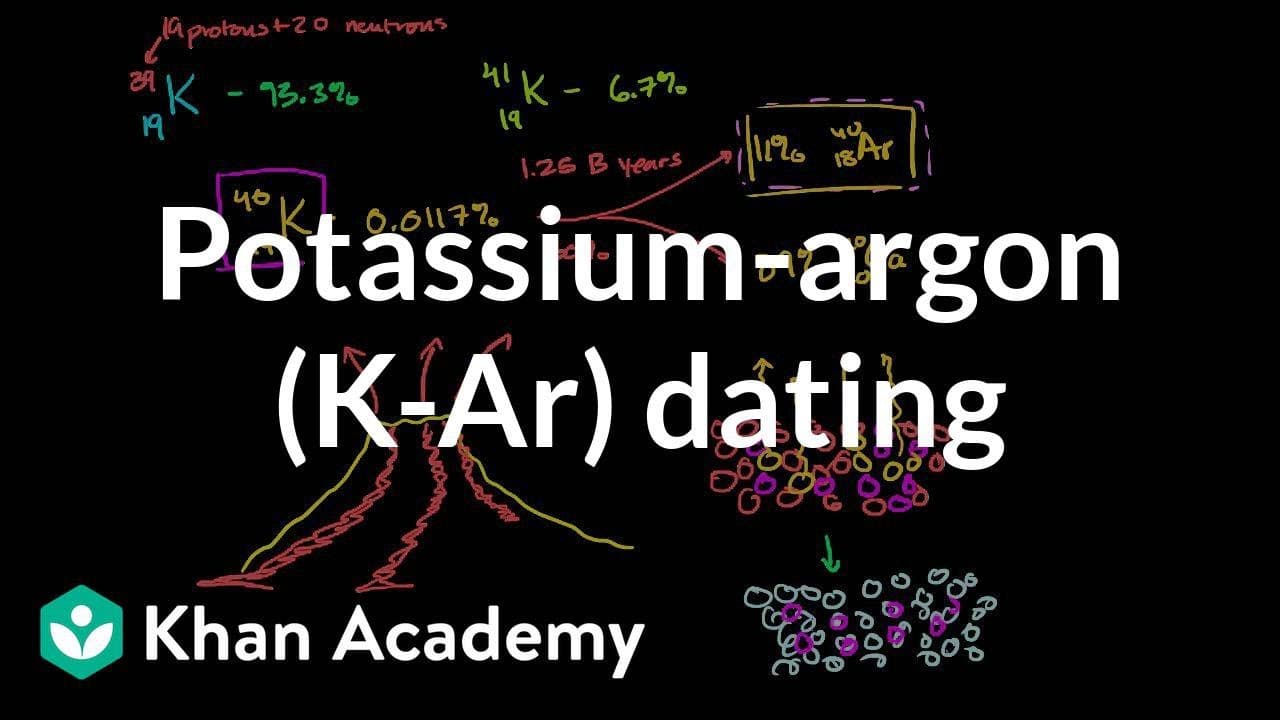
Isotopes of potassium, specifically potassium-40, can be used to date old volcanic rock and fossils due to its half-life and the presence of argon-40.
Transcript
We know that an element is defined by the number of protons it has. For example, potassium. We look at the periodic table of elements. And I have a snapshot of it, of not the entire table but part of it here. Potassium has 19 protons. And we could write it like this. And this is a little bit redundant. We know that if it's potassium that atom has 1... Read More
Key Insights
- 👻 Isotopes have different numbers of neutrons, allowing scientists to identify and study different forms of an element.
- 🛟 Potassium-40 is the most common isotope of potassium and has a long half-life of 1.25 billion years.
- 🥳 Potassium-40 decays into argon-40 and calcium-40, and the ratio of these decay products can be used to date volcanic rock and fossils.
- 👨🎤 The presence of argon-40 in volcanic rock indicates that the rock has solidified after the escape of argon-40 during a volcanic eruption.
- 🧑🤝🧑 Potassium-argon dating allows scientists to date very old materials, going beyond the limitations of carbon-14 dating.
- 🧑🔬 By studying the layers of volcanic rock, scientists can relatively date other objects and fossils found between the layers.
- ❓ Potassium-argon dating provides valuable insights into the timeline and history of geological events.
Install to Summarize YouTube Videos and Get Transcripts
Explore YouTube Video Summarizer or Get YouTube Transcript Extractor
Questions & Answers
Q: How do isotopes help scientists with dating old rocks and fossils?
Isotopes, like potassium-40, have different numbers of neutrons, allowing scientists to measure the decay of a specific isotope and determine the age of rocks and fossils.
Q: Why is potassium-40 particularly useful for dating old materials?
Potassium-40 has a long half-life of 1.25 billion years, allowing it to be used to date very old materials that carbon-14 dating cannot accurately measure.
Q: What happens to argon-40 during volcanic eruptions?
Argon-40, being a noble gas, can escape from liquid lava during volcanic eruptions, leading to a reset in the amount of argon-40 present in the volcanic rock once it solidifies.
Q: How does the presence of argon-40 help in dating volcanic rock?
The presence of argon-40 in volcanic rock indicates that the potassium-40 present in the rock has decayed since the volcanic event, allowing scientists to determine the age of the rock based on the ratio of potassium-40 to argon-40.
Summary & Key Takeaways
-
Elements are defined by the number of protons they have, and isotopes of an element have different numbers of neutrons.
-
Potassium-40 is the most common isotope of potassium and can be used to date old volcanic rock due to its long half-life of 1.25 billion years.
-
Potassium-40 decays into argon-40 and calcium-40, allowing scientists to determine the age of volcanic rock by measuring the ratio of potassium-40 to its decay products.
Read in Other Languages (beta)
Share This Summary 📚
Summarize YouTube Videos and Get Video Transcripts with 1-Click
Try YouTube Summary with ChatGPT & Claude or YouTube Transcript Generator
Explore More Summaries from Khan Academy 📚



Summarize YouTube Videos and Get Video Transcripts with 1-Click
Try YouTube Summary with ChatGPT & Claude or YouTube Transcript Generator