Transfer of respiratory pathogens: Viral deactivation in aerosols (ASIDE)
TL;DR
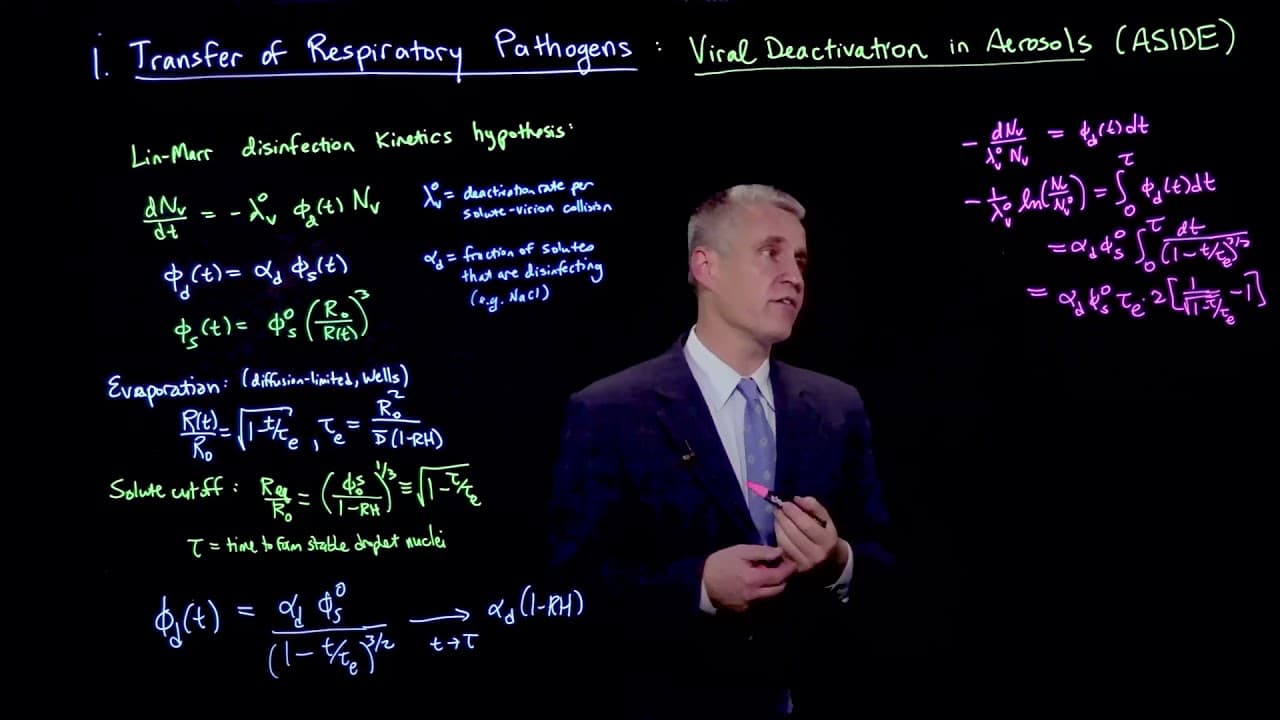
Mathematical analysis supports the Lin-Marr hypothesis on disinfection kinetics in virus droplets based on solute concentration and drying time.
Transcript
PROFESSOR: So, as an aside for more advanced students, let's try to fill in some mathematical details to provide a theory to support or interpret the Lin-Marr hypothesis of disinfection kinetics having to do with the concentration of solutes during drying and their effect on deactivating viruses. So, to put it in mathematical terms, if we have a ce... Read More
Key Insights
- ☠️ The mathematical equation incorporates solute concentration, volume fraction of disinfecting solutes, and drying time to describe the deactivation rate of viruses in droplets.
- 💦 The Wells theory of evaporation explains the equilibrium size of droplets when solutes are present, considering factors like relative humidity.
- 🥺 The volume fraction of disinfecting solutes decreases with increasing relative humidity, leading to a decrease in virus viability.
Install to Summarize YouTube Videos and Get Transcripts
Explore YouTube Video Summarizer or Get YouTube Transcript Extractor
Questions & Answers
Q: What factors are considered in the mathematical equation to describe the deactivation rate of viruses in droplets?
The equation takes into account the concentration of solutes, the volume fraction of disinfecting solutes, and the size of the droplet, which changes over time.
Q: How does the Wells theory of evaporation explain the equilibrium size of droplets when solutes are present?
The theory predicts that pure liquid droplets shrink completely, but when solutes are present, the equilibrium size is determined by the solid volume fraction and the relative humidity.
Q: What is the relationship between the volume fraction of disinfecting solutes and relative humidity?
The volume fraction of disinfecting solutes decreases as relative humidity increases, leading to a decrease in the viability of the virus.
Q: How does the mathematical analysis support the Lin-Marr hypothesis?
The analysis provides a theoretical framework that aligns with the experimental data and supports the hypothesis that solute concentration and drying time affect the disinfection kinetics of viruses.
Summary & Key Takeaways
-
The analysis proposes a mathematical equation to describe the deactivation rate of viruses in droplets based on solute concentration and the volume fraction of disinfecting solutes.
-
The Wells theory of evaporation is used to explain the shrinking of the droplets and the equilibrium size when solutes are present.
-
The volume fraction of disinfecting solutes is determined as a function of time and relative humidity, showing a decrease in viability of the virus at certain humidity levels.
Read in Other Languages (beta)
Share This Summary 📚
Summarize YouTube Videos and Get Video Transcripts with 1-Click
Try YouTube Summary with ChatGPT & Claude or YouTube Transcript Generator
Explore More Summaries from MIT OpenCourseWare 📚
Summarize YouTube Videos and Get Video Transcripts with 1-Click
Try YouTube Summary with ChatGPT & Claude or YouTube Transcript Generator