Statistical Learning: 10.Py Convolutional Neural Network: CIFAR Image Data I 2023
TL;DR
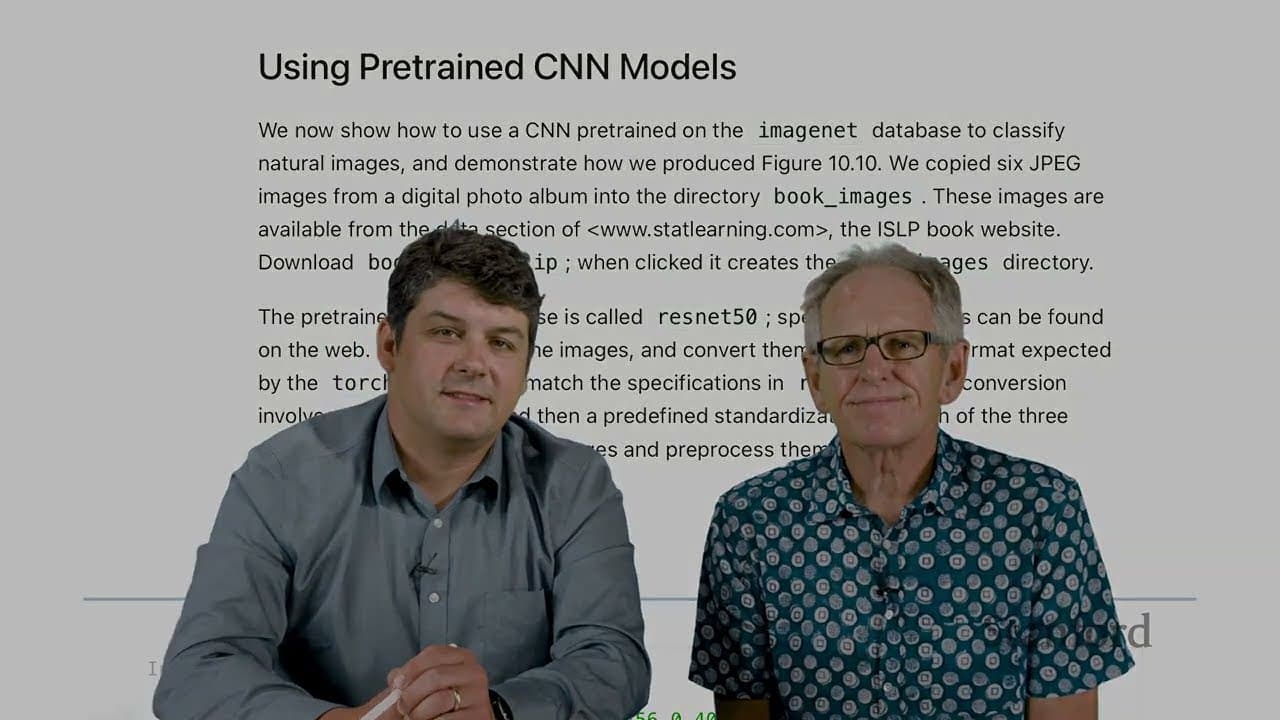
This content discusses the use of convolutional networks for image processing and showcases the application of these networks on the C4 100 dataset.
Transcript
our next topic are convolutional networks these are very popular models for image processing because they uh they capture local features quite well um and we're going to use some data from the C4 100 data set this is one of these uh big data sets that are curated by the the Deep Learning Community to sort of compare different models and the 100 sta... Read More
Key Insights
- ❓ Convolutional networks are highly effective in processing images due to their ability to capture local features.
- ❓ The C4 100 dataset is a widely used benchmark for comparing different models in image classification tasks.
- 🔠 Preprocessing is essential to standardize the input data and improve the training process.
- 🏛️ The multilayer architecture of convolutional networks consists of building block layers with convolutional filters and max pooling operations.
- ⌛ Training and optimizing convolutional networks can be time-consuming but can yield significant improvements in accuracy.
- 👋 Achieving 40% accuracy on the C4 100 dataset is considered good, surpassing the baseline of random guessing.
- 😑 Pre-trained models can be valuable resources, allowing users to leverage existing knowledge and save training time.
Install to Summarize YouTube Videos and Get Transcripts
Explore YouTube Video Summarizer or Get YouTube Transcript Extractor
Questions & Answers
Q: Why are convolutional networks popular for image processing?
Convolutional networks are popular for image processing because they excel at capturing local features in images, making them suitable for tasks such as object recognition and classification.
Q: What is the C4 100 dataset?
The C4 100 dataset is a curated dataset created by the Deep Learning Community to compare different models. It consists of 100 different classes for image classification, making it a challenging problem.
Q: What is the purpose of preprocessing the data in the torch Vision package?
The preprocessing step rescales the images to be in the range of 0 to 1, converts them to floating point values, and reorders the arrays. This standardization facilitates better training and consistency in the network.
Q: How are color images represented in convolutional networks?
Color images in convolutional networks are represented as RGB (Red, Green, Blue) channels. Each image has three color channels, and the dimensions are typically 32x32 pixels.
Q: What is the purpose of the building block layer in convolutional networks?
The building block layer is a customized layer that combines convolutional filters and max pooling operations. It is used to build the multilayer architecture of the convolutional network, applying the operations at different scales.
Q: What are some advantages of using pre-trained models in convolutional networks?
Pre-trained models allow users to leverage the work done by others and save training time. These models have been trained on large datasets and can be used for various image classification tasks by passing in custom images.
Q: What is the significance of the accuracy achieved on the C4 100 dataset?
Achieving 40% accuracy on the C4 100 dataset is considered good, considering that random guessing would only yield 1% accuracy. The field continuously works on improving these models to achieve higher accuracy.
Q: Can convolutional networks be further optimized using hardware accelerations?
Yes, certain hardware accelerations can be utilized to optimize the performance of convolutional networks. These accelerations can speed up the training and inference processes, improving overall efficiency.
Summary & Key Takeaways
-
The content focuses on convolutional networks, which are popular for image processing due to their ability to capture local features effectively.
-
The C4 100 dataset, a curated dataset for comparing different models, is used as an example in the analysis.
-
The process involves specifying the datasets, defining the network architecture, setting the loss function, training the network, and analyzing the results.
Read in Other Languages (beta)
Share This Summary 📚
Summarize YouTube Videos and Get Video Transcripts with 1-Click
Try YouTube Summary with ChatGPT & Claude or YouTube Transcript Generator
Explore More Summaries from Stanford Online 📚

Summarize YouTube Videos and Get Video Transcripts with 1-Click
Try YouTube Summary with ChatGPT & Claude or YouTube Transcript Generator