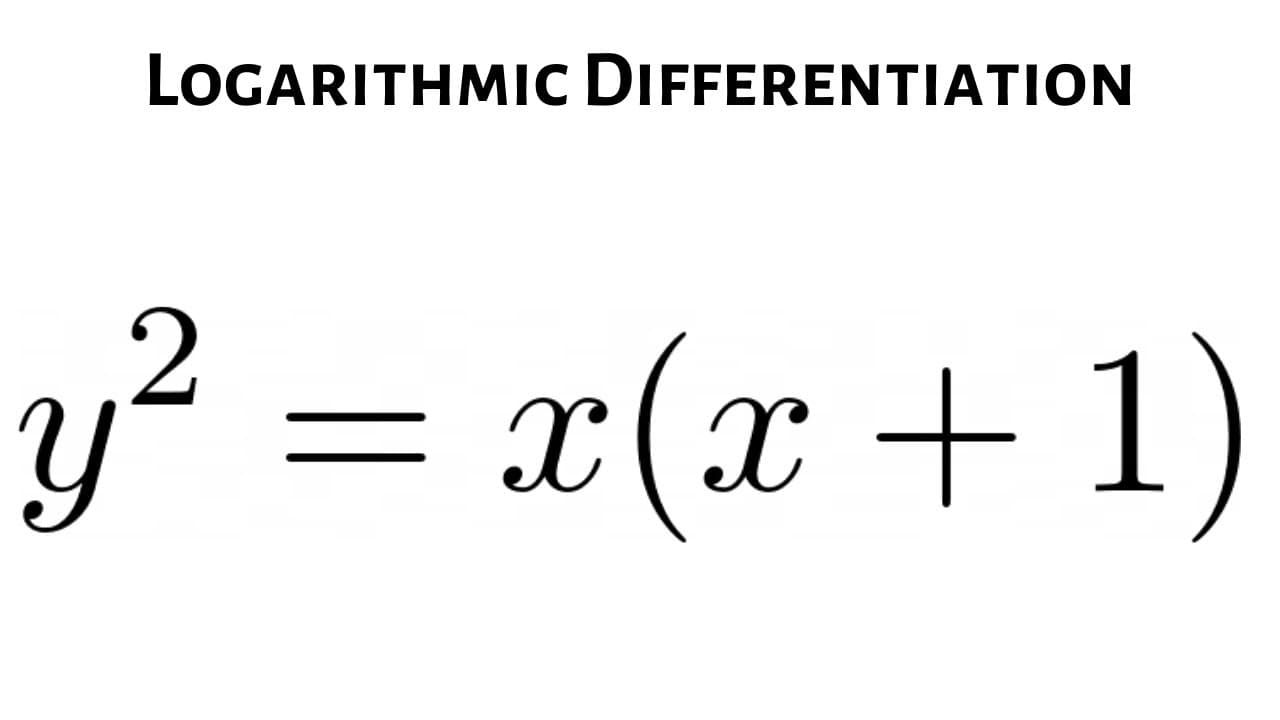
How to use Logarithmic Differentiation to Find the Derivative an Example with y^2 = x(x + 1)
TL;DR
Logarithmic differentiation is used to find dydx by taking the natural log and applying log properties.
Transcript
in this problem we're being asked to find dydx using logarithmic differentiation so when you use logarithmic differentiation to find the derivative the very first step is to take the natural log on both sides so we have the natural log of y squared equal to the natural log of and here we have x times x plus one just like that and then we use proper... Read More
Key Insights
- 🧑💻 Logarithmic differentiation involves taking the natural log of the equation to find the derivative efficiently.
- 📏 Applying log properties, product rule, and chain rule aids in simplifying and differentiating complex functions.
- 🍉 The final step in logarithmic differentiation requires solving for dydx by multiplying with the reciprocal terms.
- 📏 Understanding the steps and rules of logarithmic differentiation is crucial for finding derivatives accurately.
- 🍵 Logarithmic differentiation is a useful technique for handling equations involving products and composite functions efficiently.
- ❓ Practice and familiarity with logarithmic differentiation are essential for mastering the process of finding derivatives effectively.
- 🖐️ The properties of logarithms play a significant role in simplifying and differentiating functions in logarithmic differentiation.
Install to Summarize YouTube Videos and Get Transcripts
Explore YouTube Video Summarizer or Get YouTube Transcript Extractor
Questions & Answers
Q: What is the first step in logarithmic differentiation?
The initial step is to take the natural log of the equation to begin the process of finding the derivative using logarithmic differentiation.
Q: How is the product rule utilized in logarithmic differentiation?
The product rule is utilized to differentiate a product of functions by turning it into the sum of individual log terms to simplify and find the derivative effectively.
Q: Why is the chain rule important in logarithmic differentiation?
The chain rule allows for the differentiation of composite functions, ensuring that the derivative of the inside function is accounted for when finding dydx using logarithmic differentiation.
Q: How is the final answer for dydx determined in logarithmic differentiation?
By simplifying the equation and solving for dydx through appropriate manipulation and multiplication with the reciprocal terms, the final derivative is obtained in logarithmic differentiation.
Summary & Key Takeaways
-
Logarithmic differentiation involves taking the natural log of the equation and using log properties to simplify.
-
Applying the product rule and chain rule for logs helps rewrite and differentiate the equation.
-
The final step involves solving for dydx by multiplying both sides and simplifying.
Read in Other Languages (beta)
Share This Summary 📚
Summarize YouTube Videos and Get Video Transcripts with 1-Click
Try YouTube Summary with ChatGPT & Claude or YouTube Transcript Generator
Explore More Summaries from The Math Sorcerer 📚


Summarize YouTube Videos and Get Video Transcripts with 1-Click
Try YouTube Summary with ChatGPT & Claude or YouTube Transcript Generator