Polynomial remainder theorem proof | Polynomial and rational functions | Algebra II | Khan Academy
TL;DR
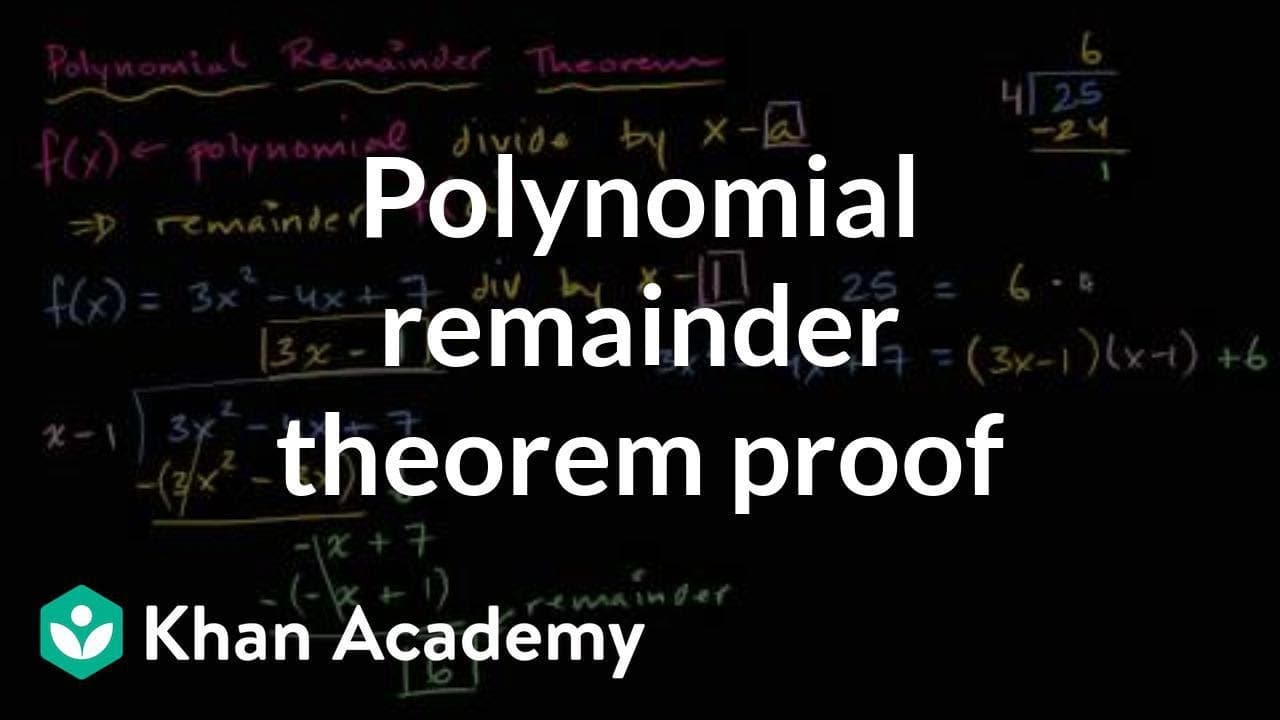
The video provides a proof of the polynomial remainder theorem, which states that any polynomial divided by x minus a will have a remainder equal to the polynomial evaluated at a.
Transcript
- [Voiceover] Let's now do a proof of the polynomial remainder theorem. Just to make the proof a little bit tangible, I'm going to start with the example that we saw in the video that introduced the polynomial remainder theorem. We saw that if you took three x squared minus four x plus seven and you divided by x minus one, you got three x minus one... Read More
Key Insights
- 🗂️ Polynomial long division determines the quotient and remainder when dividing a polynomial by x minus a.
- 😑 The polynomial can be expressed as the quotient times x minus a, plus the remainder.
- 🪘 The remainder in polynomial long division corresponds to evaluating the polynomial at a specific value.
- 😑 The polynomial remainder theorem applies to all polynomials divided by expressions of the form x minus a, where a is a constant.
Install to Summarize YouTube Videos and Get Transcripts
Explore YouTube Video Summarizer or Get YouTube Transcript Extractor
Questions & Answers
Q: How do we know when we've reached the remainder in polynomial long division?
In polynomial long division, we know we've reached the remainder when we encounter an expression with a lower degree than the divisor (x minus a).
Q: What is the significance of the analogy with traditional division?
The analogy with traditional division helps understand the concept of remainder in polynomial long division, where the polynomial can be expressed as the quotient times divisor plus remainder, similar to how a number can be expressed as quotient times divisor plus remainder in traditional division.
Q: Is the polynomial remainder theorem applicable to all polynomials?
Yes, the polynomial remainder theorem is true for any polynomial f(x) divided by any expression of the form x minus a, where a is a constant.
Q: How does the polynomial remainder theorem demonstrate the relationship between f(a) and the remainder?
According to the polynomial remainder theorem, if f(x) can be written as the quotient times x minus a, plus the remainder, then evaluating f(a) will give the value of the remainder.
Summary & Key Takeaways
-
The video starts by demonstrating an example of polynomial long division to show how the remainder is obtained when dividing a polynomial by x minus one.
-
The polynomial can be expressed as the quotient times x minus a, plus the remainder.
-
The proof shows that if f(x) can be written in this form, then evaluating f(a) will give the remainder.
Read in Other Languages (beta)
Share This Summary 📚
Summarize YouTube Videos and Get Video Transcripts with 1-Click
Try YouTube Summary with ChatGPT & Claude or YouTube Transcript Generator
Explore More Summaries from Khan Academy 📚



Summarize YouTube Videos and Get Video Transcripts with 1-Click
Try YouTube Summary with ChatGPT & Claude or YouTube Transcript Generator