Closure Process of Free Languages Problem 2
TL;DR
Context-free languages are closed under the concatenation operation.
Transcript
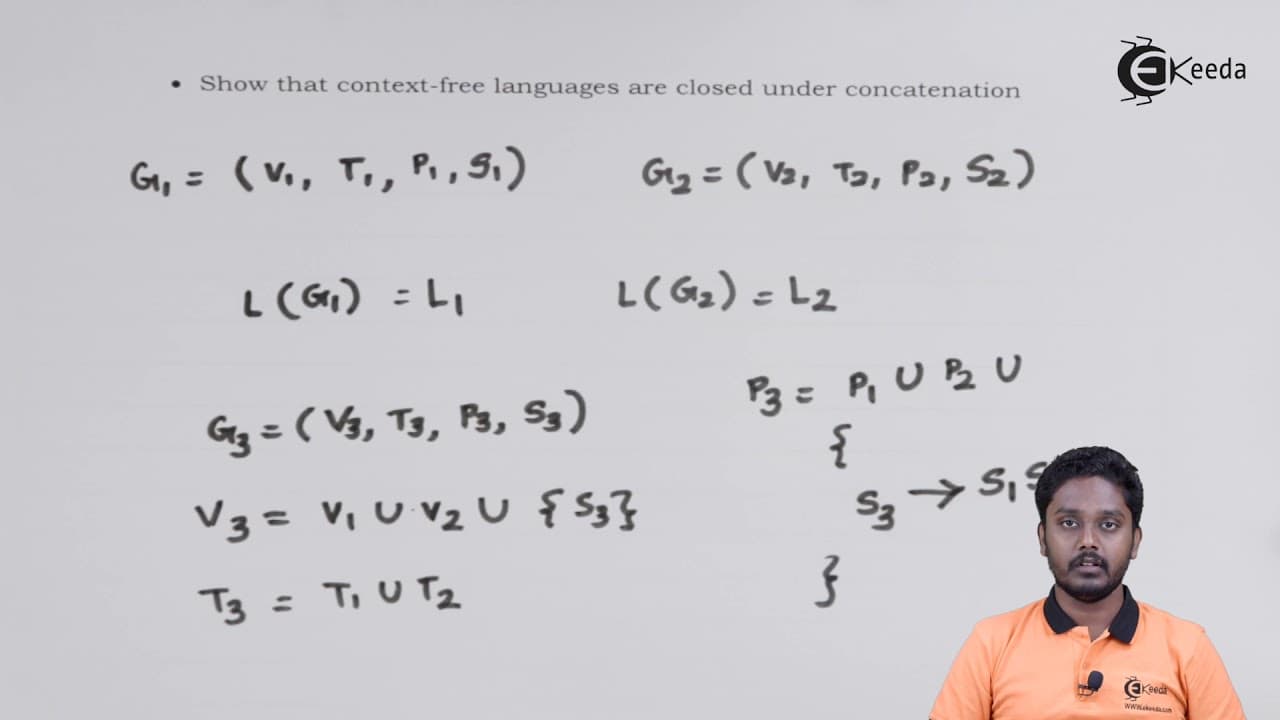
click the Bell icon to get latest videos from equator hello friends having proved that context-free languages are closed on the Union now let us try to prove context-free languages are closed under concatenation as well again they're using context-free grammar as the representation let us take two grammar G 1 and G 2 which are context-free having l... Read More
Key Insights
- 😚 Context-free languages are closed under the concatenation operation.
- 🥶 A new grammar, G3, can be constructed to represent the concatenation of two context-free languages, L1 and L2.
- 🤬 The construction of G3 involves defining the variables, terminals, productions, and start symbol based on G1 and G2.
- 🤬 By including all productions from G1 and G2, along with a production for concatenating the start symbols, it is proven that G3 represents the concatenation of L1 and L2.
- 😚 This demonstrates that context-free languages are closed under concatenation.
- 🥶 The closure properties of context-free languages refer to their ability to maintain certain properties when combined or operated on.
- ❓ Closure under concatenation is one of these properties.
Install to Summarize YouTube Videos and Get Transcripts
Explore YouTube Video Summarizer or Get YouTube Transcript Extractor
Questions & Answers
Q: What are the closure properties of context-free languages?
The closure properties of context-free languages refer to the ability of these languages to maintain certain properties when combined or operated on. Closure under concatenation is one of these properties.
Q: How is the concatenation of context-free languages represented using a context-free grammar?
The concatenation of two context-free languages, L1 and L2, is represented using a new grammar, G3. The productions of G3 include all productions of G1 and G2, as well as a production for generating the concatenation of the start symbols of G1 and G2.
Q: How is it proven that context-free languages are closed under concatenation?
By constructing the grammar G3, which represents the concatenation of two context-free languages, it is shown that the language accepted or generated by G3 is the concatenation of the languages accepted or generated by G1 and G2. This demonstrates that context-free languages are closed under concatenation.
Q: What are the components required to construct the grammar G3?
The components of G3 include the variables, terminals, productions, and start symbol. The variables and terminals are unions of those from G1 and G2, while the productions include all productions from G1 and G2, along with a production for concatenating the start symbols. The start symbol of G3 is also defined.
Summary & Key Takeaways
-
The video discusses the closure properties of context-free languages, specifically focusing on the concatenation operation.
-
A context-free grammar is used to represent two context-free languages, G1 and G2, and a new grammar, G3, is constructed to represent the concatenation of L1 and L2.
-
The construction of G3 involves defining the variables, terminals, productions, and start symbol based on G1 and G2.
-
By using this technique, it is proven that context-free languages are closed under the concatenation operation.
Read in Other Languages (beta)
Share This Summary 📚
Summarize YouTube Videos and Get Video Transcripts with 1-Click
Try YouTube Summary with ChatGPT & Claude or YouTube Transcript Generator
Explore More Summaries from Ekeeda 📚
Summarize YouTube Videos and Get Video Transcripts with 1-Click
Try YouTube Summary with ChatGPT & Claude or YouTube Transcript Generator