Visual understanding of centripetal acceleration formula | Physics | Khan Academy
TL;DR
The magnitude of the centripetal acceleration in circular motion is equal to the speed squared divided by the radius of the circle.
Transcript
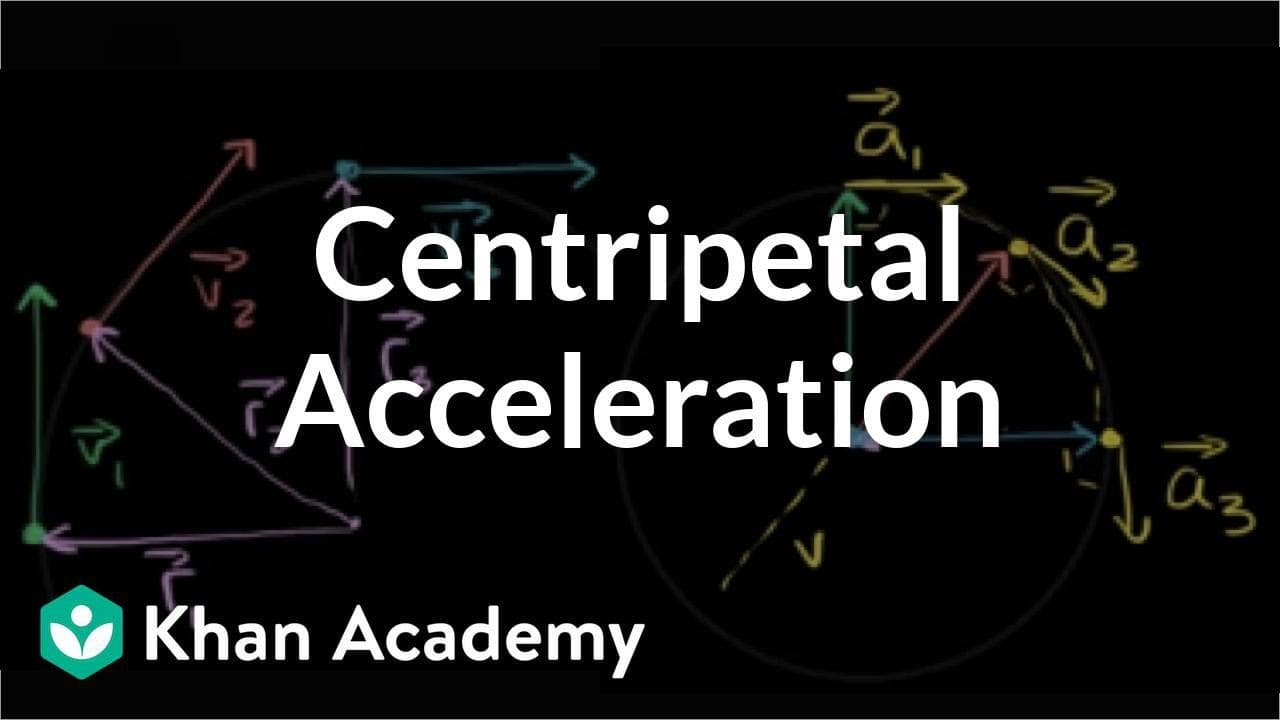
Let's say I have some object that's traveling in a circular path just like this. And what I've drawn here is its velocity vector at different points along that path. And so this right over here is going to be v1, velocity vector 1. This is going to be velocity vector 2. And this right over here is going to be velocity vector 3. And what we're going... Read More
Key Insights
- 🐎 In circular motion, the velocity vectors have constant magnitude (speed) but changing direction.
- 🧘 The position vectors have constant magnitude (radius) but changing direction.
- 😥 The centripetal acceleration vectors always point towards the center of the circle.
- 🐎 The magnitude of the centripetal acceleration is equal to the speed squared divided by the radius of the circle.
- 🧘 The time taken to travel along a path in circular motion is the same for both position vectors and velocity vectors.
- 🐎 The magnitude of the velocity vectors represents the speed at which the object is moving in circular motion.
- 🧘 The magnitude of the position vectors represents the radius of the circle in circular motion.
Install to Summarize YouTube Videos and Get Transcripts
Explore YouTube Video Summarizer or Get YouTube Transcript Extractor
Questions & Answers
Q: What does the magnitude of the velocity vectors represent in circular motion?
The magnitude of the velocity vectors represents the speed, which remains constant throughout the motion.
Q: What does the magnitude of the position vectors represent in circular motion?
The magnitude of the position vectors represents the radius of the circle, which remains constant throughout the motion.
Q: How do the acceleration vectors relate to the velocity vectors in circular motion?
The acceleration vectors, known as centripetal acceleration, are perpendicular to the velocity vectors and point towards the center of the circle.
Q: What is the formula for calculating the magnitude of the centripetal acceleration?
The magnitude of the centripetal acceleration is equal to the speed squared divided by the radius of the circle.
Summary & Key Takeaways
-
The velocity vectors in circular motion have constant magnitude (speed) but changing direction.
-
The position vectors in circular motion have constant magnitude (radius) but changing direction.
-
The centripetal acceleration, which is the acceleration towards the center of the circle, has the same magnitude as the velocity squared divided by the radius.
Read in Other Languages (beta)
Share This Summary 📚
Summarize YouTube Videos and Get Video Transcripts with 1-Click
Try YouTube Summary with ChatGPT & Claude or YouTube Transcript Generator
Explore More Summaries from Khan Academy 📚



Summarize YouTube Videos and Get Video Transcripts with 1-Click
Try YouTube Summary with ChatGPT & Claude or YouTube Transcript Generator