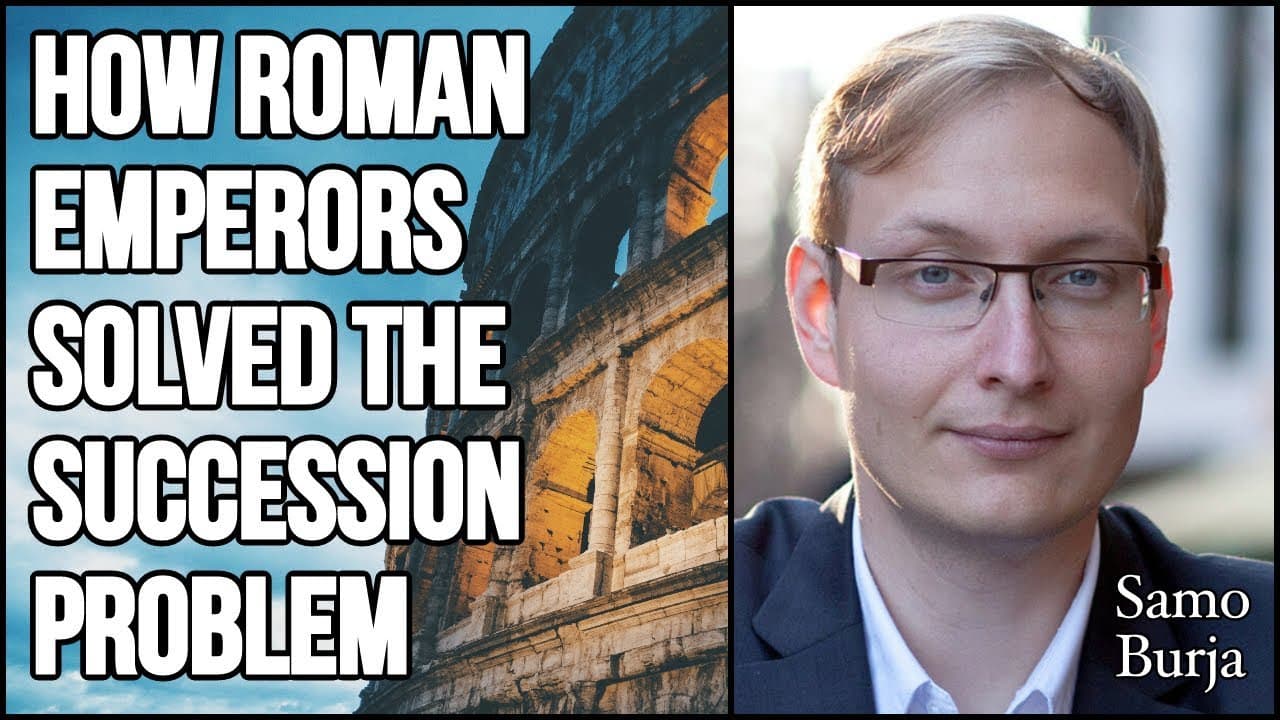
How Did Roman Emperors Solve the Succession Problem?
TL;DR
Roman emperors solved succession issues through adult adoption, where successors were given the adopter's name, legacy, and connections, resulting in stable rule during the era of the five good emperors. This practice also fostered loyalty and support from former rivals. Modern examples like Japan's 'mukoyoshi' show that adapting these ancient strategies could offer solutions for today's succession challenges.
Transcript
how Roman emperors handled the succession problem can you imagine the world where Steve Jobs doesn't have to create Apple from scratch but instead inherits all the resources and talented engineers of IBM or a different mature company this is a world with more Apple products a world with better technology and with better design can you then further ... Read More
Key Insights
- 🥺 Adoption of successors in ancient Rome allowed for a transfer of power, name, and glory, leading to stable succession and peace.
- ↩️ The practice of adoption in ancient Rome turned enemies into supporters, providing a solution to the succession problem.
- 🕴️ Japan's practice of "mukoyoshi" ensures successful succession in businesses by adopting sons-in-law and transferring the family name.
- 🖤 Modern America lacks the social context necessary for the adoption of successors to be acceptable.
- ✊ Successful succession requires not just the transfer of power but also the transfer of name, social connections, and legacy.
- 👮 Learning from ancient Rome and modern Japan, American culture and law need to adapt to find a solution to the succession problem.
- 👹 The Roman and Japanese succession practices are relevant and applicable to the modern world.
Install to Summarize YouTube Videos and Get Transcripts
Explore YouTube Video Summarizer or Get YouTube Transcript Extractor
Questions & Answers
Q: How did the Roman Empire solve the succession problem during the era of the five good emperors?
The adoption of successors in ancient Rome allowed for a stable transfer of power, name, social connections, and inheritance, leading to peace and prosperity during the era of the five good emperors.
Q: How did adoption in ancient Rome benefit both the adopter and the successor?
Adopting a successor in ancient Rome turned enemies into strong supporters, as the adopter's accomplishments reflected positively on the adoptee, enhancing their reputation and legacy.
Q: How did Japan's practice of "mukoyoshi" ensure successful succession in businesses?
By adopting sons-in-law and transferring the family name, Japan ensured that only those with the necessary business and leadership abilities could take over the company, ensuring a smooth transition.
Q: Why wouldn't ancient Roman adoption practices work in a modern American context?
The lack of importance placed on family names and lineage in modern America makes it unlikely for the adoption of successors to be seen as acceptable. The social context has changed, and family ties are no longer tied to business decisions.
Summary & Key Takeaways
-
The Roman Empire had a period called the era of the five good emperors, where adoption of successors led to peace and stable succession.
-
Adult adoption in ancient Rome involved giving the successor the name, social connections, and legal inheritance of the adopter.
-
Japan practices "mukoyoshi," where sons-in-law are adopted and take on the family name to ensure successful succession in businesses.
Read in Other Languages (beta)
Share This Summary 📚
Summarize YouTube Videos and Get Video Transcripts with 1-Click
Try YouTube Summary with ChatGPT & Claude or YouTube Transcript Generator
Explore More Summaries from Samo Burja 📚






Summarize YouTube Videos and Get Video Transcripts with 1-Click
Try YouTube Summary with ChatGPT & Claude or YouTube Transcript Generator