Public Lecture: New Approaches to Treatment of Depression and Bipolar Disorder (Part 2 of 4)

TL;DR
Exploring new depression treatments and the brain's role.
Transcript
can we learn something about the circuits in the brain that mediate depression and you have to go back and forth between animals and brains so this is a PET scan and what this scan shows you is the areas of activity in the helpless animal against the control and the non helpless animal against the control and I want you to look right here and right... Read More
Key Insights
- The lateral habenula, a small brain structure, plays a significant role in mediating depression and disappointment, impacting neurotransmitter activity.
- Deep brain stimulation (DBS) of the lateral habenula has shown promise in treating severe depression, as demonstrated in a case study of a patient with a 25-year history of depression.
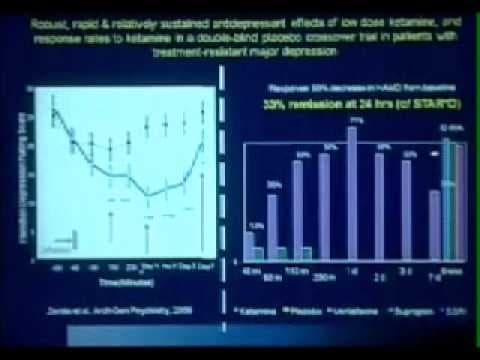
- Current depression treatments are limited, often taking weeks to work, highlighting the need for faster-acting solutions like ketamine that can rapidly alleviate symptoms.
- Ketamine activates the mTOR pathway, promoting synapse formation, suggesting that disrupted synaptic physiology in the prefrontal cortex is a key factor in depression.
- Environmental stressors, such as economic recessions, can exacerbate depression rates, indicating a complex interplay between external factors and brain systems.
- Depression and bipolar disorder are among the leading causes of disability worldwide, particularly affecting young individuals and contributing to significant economic costs.
- The imbalance of neurotransmitters like dopamine, norepinephrine, and serotonin, regulated by the lateral habenula, is central to mood disorders and addiction.
- Collaborative efforts between universities, NIH, and pharmaceutical companies aim to improve understanding and treatment of mental illnesses through public-private partnerships.
Install to Summarize YouTube Videos and Get Transcripts
Explore YouTube Video Summarizer or Get YouTube Transcript Extractor
Questions & Answers
Q: What role does the lateral habenula play in depression?
The lateral habenula is a small brain structure that mediates depression by controlling neurotransmitter activity, including dopamine, serotonin, and norepinephrine. It is associated with feelings of disappointment and regulates mood by influencing various brain systems. Overactivity in the lateral habenula is linked to depressive symptoms.
Q: How has deep brain stimulation been used to treat depression?
Deep brain stimulation (DBS) has been used to treat depression by targeting the lateral habenula. In a case study, a patient with a long history of severe depression showed significant improvement after undergoing DBS. This approach suggests that modulating activity in this brain region may alleviate depressive symptoms, offering a potential new treatment avenue.
Q: What are the limitations of current depression treatments?
Current depression treatments often take weeks to show effectiveness and may not work for all patients. Many treatments focus on altering neurotransmitter levels but fail to address the underlying brain circuit dysfunctions. This highlights the need for faster-acting and more targeted therapies, such as those that influence synaptic physiology directly.
Q: Why is ketamine considered a potential treatment for depression?
Ketamine is considered a potential treatment for depression due to its rapid action in alleviating symptoms, often within hours. It works by activating the mTOR pathway, which promotes synapse formation in the brain, counteracting the synaptic deficits observed in depression. However, its use is limited by potential for abuse and psychotomimetic effects.
Q: How do environmental stressors impact depression rates?
Environmental stressors, such as economic recessions, can increase depression rates by exacerbating existing vulnerabilities in individuals. Stressful conditions can trigger or worsen depressive episodes, indicating a complex interaction between external factors and brain systems. This underscores the importance of considering environmental influences in understanding and treating depression.
Q: What are the economic implications of depression and bipolar disorder?
Depression and bipolar disorder have significant economic implications due to their prevalence and impact on productivity. In the United States, direct costs of treatment and hospitalization are substantial, with additional losses in productivity due to disability. These mood disorders contribute to a large economic burden, emphasizing the need for more effective treatments.
Q: How do neurotransmitters relate to mood disorders?
Neurotransmitters like dopamine, norepinephrine, and serotonin play crucial roles in mood regulation. Imbalances in these chemicals are associated with mood disorders such as depression and bipolar disorder. The lateral habenula, which influences these neurotransmitters, is a key area of interest for understanding and treating these conditions by normalizing neurotransmitter activity.
Q: What collaborative efforts are being made to improve mental illness treatment?
Collaborative efforts to improve mental illness treatment involve partnerships between universities, the NIH, and pharmaceutical companies. These public-private partnerships aim to enhance the understanding of mental illnesses and develop more effective treatments. By combining resources and expertise, these collaborations seek to address the complex challenges posed by mood disorders and improve patient outcomes.
Summary & Key Takeaways
-
The lecture discusses the role of the lateral habenula in depression, highlighting its control over neurotransmitters and potential as a target for deep brain stimulation. A case study demonstrated significant improvement in a patient with severe depression through this method, offering hope for new treatment avenues.
-
Current depression treatments are often slow and inadequate, prompting exploration of alternatives like ketamine, which acts rapidly by promoting synapse formation. The lecture emphasizes the need for innovative solutions to address the widespread and disabling impact of mood disorders.
-
Depression and bipolar disorder are major contributors to global disability, affecting young people and incurring substantial economic costs. The lecture underscores the importance of understanding brain circuits and environmental factors in developing effective treatments and highlights collaborative efforts to advance research.
Read in Other Languages (beta)
Share This Summary 📚
Summarize YouTube Videos and Get Video Transcripts with 1-Click
Try YouTube Summary with ChatGPT & Claude or YouTube Transcript Generator
Explore More Summaries from Cold Spring Harbor Laboratory 📚



Summarize YouTube Videos and Get Video Transcripts with 1-Click
Try YouTube Summary with ChatGPT & Claude or YouTube Transcript Generator