Stanford Seminar - Multimaterial Design for Multifunctional Miniature Robots
TL;DR
Exploring the possibilities of multi-material design in miniature robots, inspired by the collective behaviors and individual mechanisms of small-scale animals, such as ants and trap-jaw creatures.
Transcript
I'm really excited and honored to be presenting today um my past and the present work on multi-material design for miniature robots but before I start talking about the miniature robots I would like to give you give you um kind of what actually inspired me to build this miniature robots and how I kind of basically build up on that philosophy of sma... Read More
Key Insights
- 🤖 Small-scale animals, like ants and trap-jaw creatures, possess collective behaviors and individual mechanisms that inspire the design of miniature robots.
- 🤖 Miniaturization and multi-functionality are challenging but critical in robot design, requiring innovative approaches and mass manufacturing capabilities.
- 💠 Shape memory alloy actuators, bending sheet type actuators, wave shape memory alloy actuators, and fluidic actuators offer unique possibilities for actuation and multi-functionality in robots.
- 🤖 Multi-material fabrication processes, such as 3D printing and layered manufacturing, enable the creation of versatile and mass-producible miniature robots.
Install to Summarize YouTube Videos and Get Transcripts
Explore YouTube Video Summarizer or Get YouTube Transcript Extractor
Questions & Answers
Q: How does the study of small-scale animals, such as ants and trap-jaw creatures, inspire the design of miniature robots?
Small-scale animals exhibit remarkable collective behaviors and individual mechanisms that can be emulated in miniature robots. For example, ants demonstrate collective problem-solving and teaching behaviors, while trap-jaw creatures possess unique jumping and crawling capabilities in cluttered environments.
Q: What are the key challenges in designing and manufacturing miniature robots?
Miniaturization and multi-functionality are major challenges in robotic design. Achieving small-scale components with embedded functionality and mass manufacturing capabilities require innovative approaches. Additionally, ensuring durability and reliability of these robots poses additional hurdles.
Q: How does the "tripod" robot contribute to the field of robotic swarms?
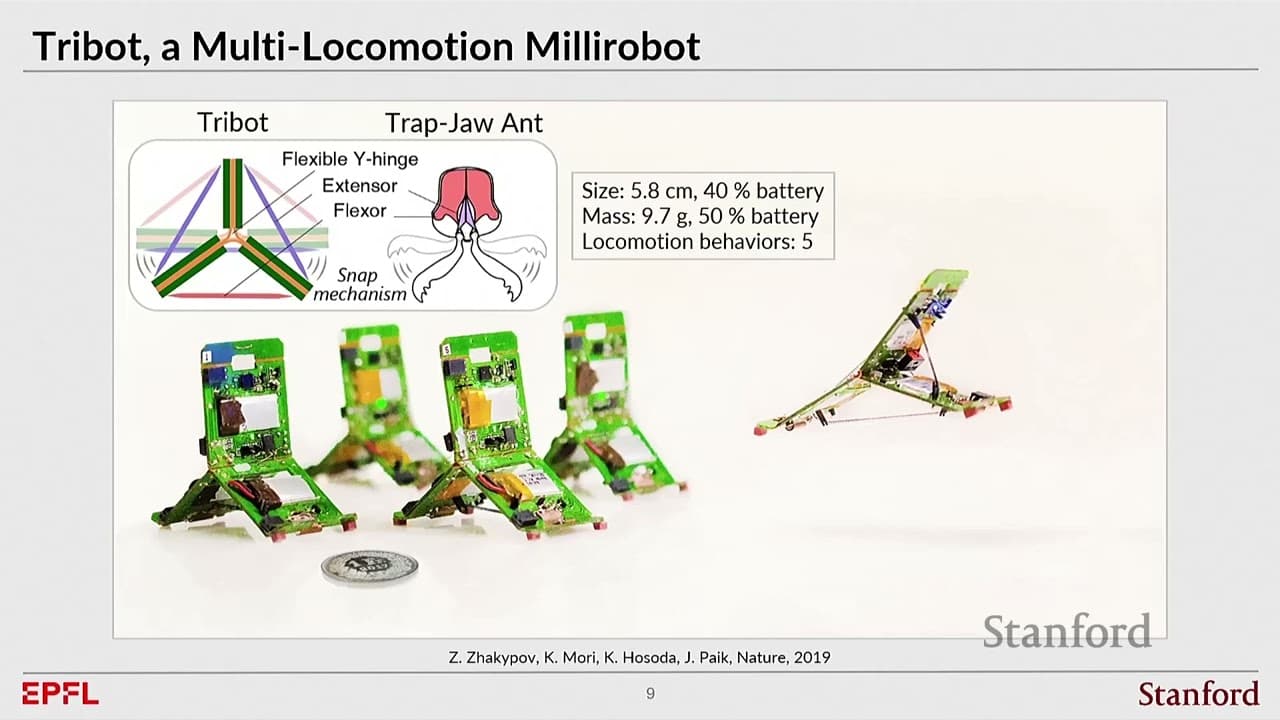
The tripod robot, inspired by trap-jaw creatures, showcases the potential for multi-locomotion capabilities in miniature robots. By combining jumping, crawling, and walking functionalities, these robots can navigate challenging environments and communicate towards a common task, making them ideal for use in robotic swarms.
Q: What are the benefits of using shape memory alloy actuators in robot design?
Shape memory alloy actuators offer several advantages, such as providing high torque, variable power output, and the ability to generate sudden power for jumping applications. Their behavior is similar to steel springs, but with the added benefit of being thermally-activated, allowing for precise control of actuation.
Summary & Key Takeaways
-
The speaker discusses the inspiration behind building miniature robots, drawing from the collective behaviors and individual mechanisms observed in small-scale animals like ants and trap-jaw creatures.
-
The challenges of miniaturization and multi-functionality in robot design are addressed, with a focus on mass production and scalability of robotic swarms.
-
The speaker introduces the design process for a multi-locomotion milli-robot called the "tripod," which emulates the jumping, crawling, and walking capabilities of trap-jaw creatures.
-
Various actuation methods, including shape memory alloy actuators, bending sheet type actuators, wave shape memory alloy actuators, and fluidic actuators, are explored for their potential use in creating versatile robotic systems.
-
Applications of these robots in haptic interfaces, virtual environments, and education are discussed.
Read in Other Languages (beta)
Share This Summary 📚
Summarize YouTube Videos and Get Video Transcripts with 1-Click
Try YouTube Summary with ChatGPT & Claude or YouTube Transcript Generator
Explore More Summaries from Stanford Online 📚

Summarize YouTube Videos and Get Video Transcripts with 1-Click
Try YouTube Summary with ChatGPT & Claude or YouTube Transcript Generator