Products
Features
YouTube Video Summarizer
Summarize YouTube videos
Web & PDF Highlighter
Highlight web pages & PDFs
Chat with PDF
Ask any PDF questions with AI
Ask AI Clone
Chat with your highlights & memories
Audio Transcriber
Transcribe audio files to text
Glasp Reader
Read and highlight articles
Kindle Highlight Export
Export your Kindle highlights
Idea Hatch
Hatch ideas from your highlights
Integrations
Obsidian Plugin
Notion Integration
Pocket Integration
Instapaper Integration
Medium Integration
Readwise Integration
Snipd Integration
Hypothesis Integration
Apps & Extensions
Chrome Extension
Safari Extension
Edge Add-ons
Firefox Add-ons
iOS App
Android App
Discover
Discover
Ideas
Discover new ideas and insights
Articles
Curated articles and insights
Books
Book recommendations by great minds
Posts
Essays and notes from readers
Quotes
Inspiring quotes collection
Videos
Curated videos and summaries
Explore Glasp
Glasp Story
How we grew from 0 to 3 million users
Glasp Newsletter
Weekly insights and updates
Glasp Talk
Interview series with great minds
Glasp Blog
Latest news and articles
Glasp Use Cases
Learn how others use Glasp
Build & Support
Glasp API
Access Glasp's API for developers
MCP Connector
Connect Glasp to Claude & ChatGPT
Community
Glasp Reddit Community
Students
Student discount and benefits
FAQs
Frequently Asked Questions
AboutPricing
DashboardLog inSign up

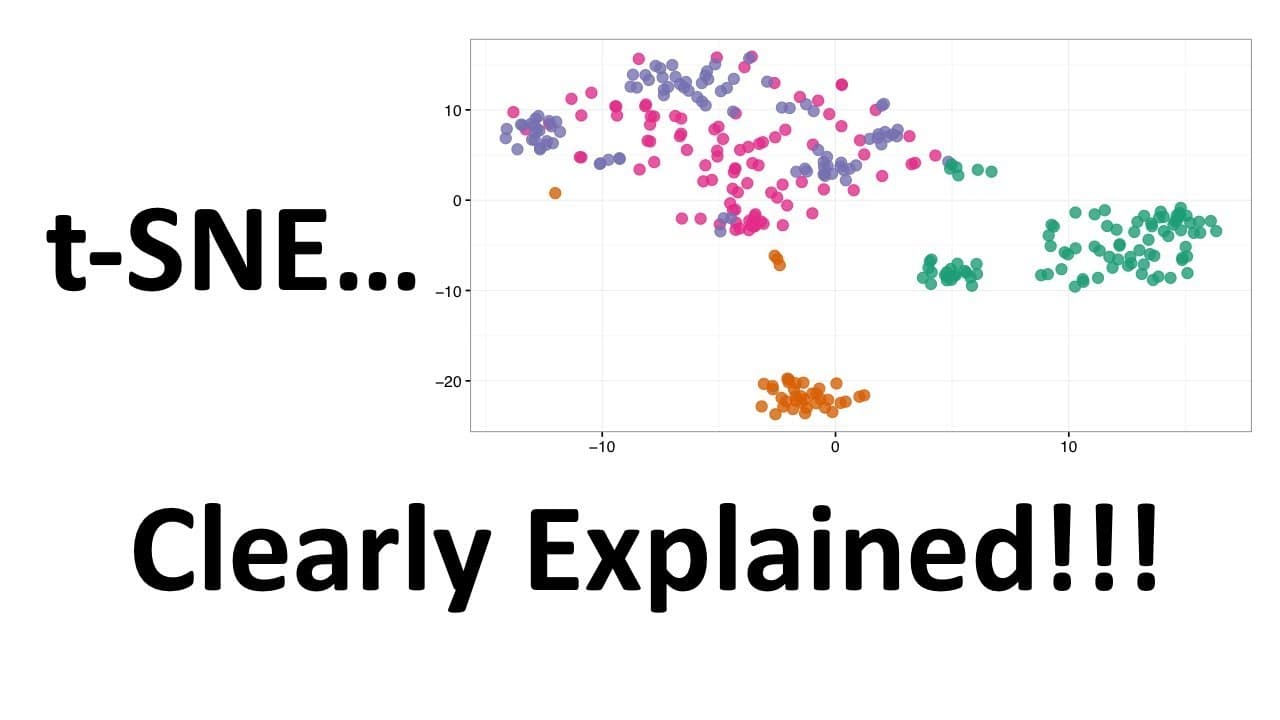
StatQuest: t-SNE, Clearly Explained
440.7K views
•
September 18, 2017
by
StatQuest with Josh Starmer
YouTube video player
StatQuest: t-SNE, Clearly Explained

TL;DR

Learn how t-SNE transforms high-dimensional data into a low-dimensional graph while preserving clustering.

Transcript

I'm drawing a graph doesn't it look cool but I didn't know how until I watched a quest hello and welcome to stack quest stack quest is brought to you by the friendly folks in the genetics department at the University of North Carolina at Chapel Hill today we're going to be talking about T Snee or tis knee to be honest I don't actually know how it's... Read More

Key Insights

  • 😘 t-SNE transforms high-dimensional data to a low-dimensional graph while preserving clustering.
  • 💯 Using similarity scores and a t-distribution, t-SNE iteratively optimizes point positions for accurate representation.
  • 💯 Scaling similarity scores to sum to 1 ensures clusters with varying densities are treated equally.
  • 🦻 The t-distribution prevents clusters from clustering in the middle, aiding in visualizing distinct clusters.
  • 😥 t-SNE's iterative process mimics a chess game, moving points gradually for optimal clustering alignment.
  • 😫 Understanding t-SNE's concepts with a simple example applies to more complex data sets.
  • 🥺 Requesting stack quests can lead to informative content tailored to viewers' interests.

Install to Summarize YouTube Videos and Get Transcripts

Explore YouTube Video Summarizer or Get YouTube Transcript Extractor

Questions & Answers

Q: How does t-SNE transform high-dimensional data into a low-dimensional graph?

t-SNE uses similarity scores and a t-distribution to project data onto a one-dimensional number line while preserving clustering.

Q: What is the significance of scaling similarity scores to sum up to 1 in t-SNE?

Scaling similarity scores to sum to 1 ensures that clusters with different densities are treated equally, maintaining accurate representations in the low-dimensional graph.

Q: Why does t-SNE use a t-distribution instead of a normal distribution?

The t-distribution prevents clusters from clumping in the middle, making it easier to distinguish and visualize distinct clusters in the low-dimensional graph.

Q: How does t-SNE iteratively adjust points to optimize clustering in the low-dimensional graph?

t-SNE moves points gradually, adjusting their positions based on similarity scores to align the low-dimensional representation with the original high-dimensional clustering.

Summary & Key Takeaways

  • t-SNE transforms high-dimensional data into a low-dimensional graph while retaining clustering.

  • It uses similarity scores and a t-distribution to project data onto a one-dimensional number line.

  • The process involves calculating similarities, scaling them, and iteratively moving points for optimal clustering.


Read in Other Languages (beta)

English

Share This Summary 📚

Summarize YouTube Videos and Get Video Transcripts with 1-Click

Download browser extensions on:

Try YouTube Summary with ChatGPT & Claude or YouTube Transcript Generator

Explore More Summaries from StatQuest with Josh Starmer 📚
Sample Size and Effective Sample Size, Clearly Explained!!! thumbnail
Sample Size and Effective Sample Size, Clearly Explained!!!
StatQuest with Josh Starmer
Regularization Part 3: Elastic Net Regression thumbnail
Regularization Part 3: Elastic Net Regression
StatQuest with Josh Starmer
Hypothesis Testing and The Null Hypothesis, Clearly Explained!!! thumbnail
Hypothesis Testing and The Null Hypothesis, Clearly Explained!!!
StatQuest with Josh Starmer
The AI Buzz, Episode #3: Constitutional AI, Emergent Abilities and Foundation Models thumbnail
The AI Buzz, Episode #3: Constitutional AI, Emergent Abilities and Foundation Models
The AI Buzz with Luca and Josh
How Does Gradient Boosting Work for Regression? thumbnail
How Does Gradient Boosting Work for Regression?
StatQuest with Josh Starmer
CatBoost Part 2: Building and Using Trees thumbnail
CatBoost Part 2: Building and Using Trees
StatQuest with Josh Starmer

Summarize YouTube Videos and Get Video Transcripts with 1-Click

Download browser extensions on:

Try YouTube Summary with ChatGPT & Claude or YouTube Transcript Generator

Apps & Extensions

  • Chrome Extension
  • Safari Extension
  • Edge Add-ons
  • Firefox Add-ons
  • iOS App
  • Android App

Key Features

  • YouTube Video Summarizer
  • Web & PDF Summarizer
  • Web & PDF Highlighter
  • Chat with PDF
  • Ask AI Clone
  • Audio Transcriber
  • Glasp Reader
  • Kindle Highlight Export
  • Idea Hatch

Integrations

  • Obsidian Plugin
  • Notion Integration
  • Pocket Integration
  • Instapaper Integration
  • Medium Integration
  • Readwise Integration
  • Snipd Integration
  • Hypothesis Integration

More Features

  • APIs
  • MCP Connector
  • Blog & Post
  • Embed Links
  • Image Highlight
  • Personality Test
  • Quote Shots

Company

  • About us
  • Our Story
  • Blog
  • Community
  • FAQs
  • Job Board
  • Newsletter
  • Pricing
Terms

•

Privacy

•

Guidelines

© 2026 Glasp Inc. All rights reserved.