Thin Cylinders Problem 4
TL;DR
Calculation of hoop strain, longitudinal strain, volumetric strain, and change in volume for a thin cylindrical shell subjected to uniform fluid pressure.
Transcript
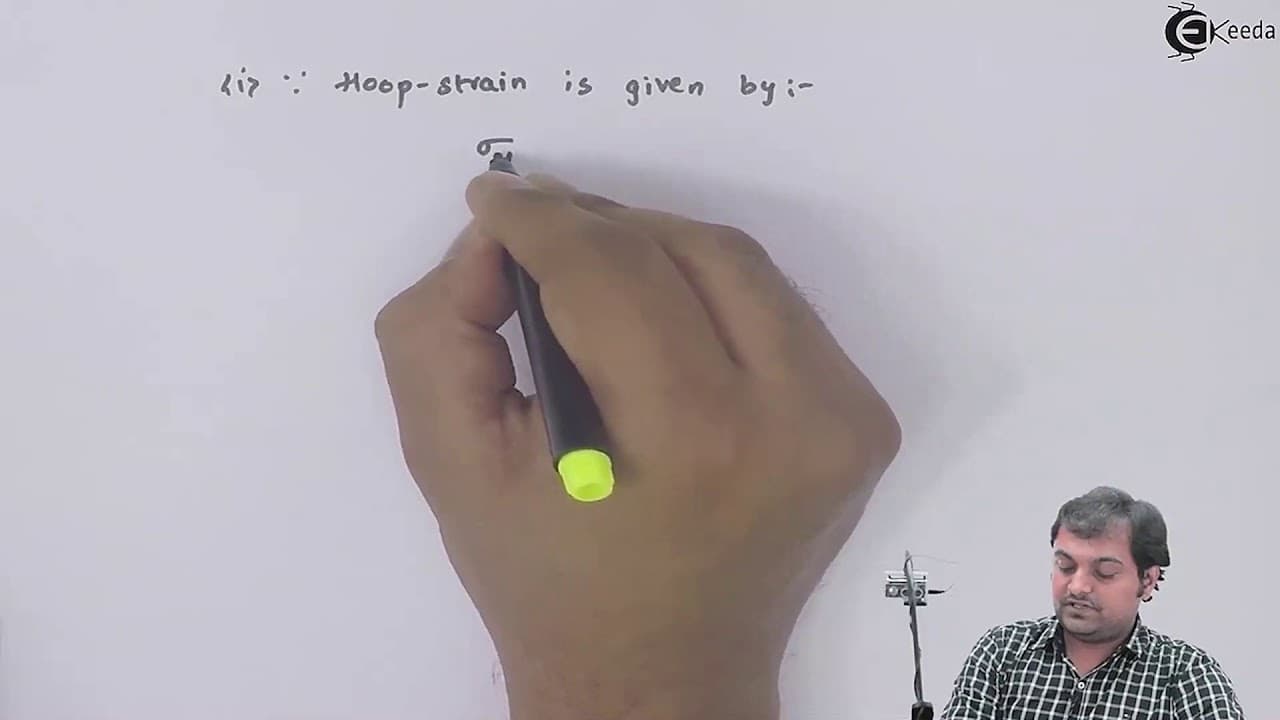
let us take the fourth question i'll mark this let's read what is given here a thin cylindrical shell is one meter in diameter and 2.5 meter length is subjected to uniform fluid pressure of 5 newton per mm square full stop find circumferential strain longitudinal strain volumetric strain and change in volume if thickness of the shell is 20 mm full ... Read More
Key Insights
- 🤭 Hoop strain, longitudinal strain, and volumetric strain can be calculated using hoop stress, longitudinal stress, modulus of elasticity, and Poisson's ratio.
- 🤭 The formula for hoop stress is Sigma_h = (Pd) / (2t) and for longitudinal stress, it is Sigma_l = 1/2 * Sigma_h.
- 🤭 The formula for hoop strain is E_h = (Sigma_h / E) - (μ * Sigma_l / E), and for volumetric strain, it is E_v = E_l + 2 * E_h.
- 🤨 The modulus of elasticity (E) and Poisson's ratio (μ) are given as 200 into 10 raised to 3 newton per mm square and 0.25 respectively.
- 🔇 The change in volume (ΔV) can be calculated using the formula ΔV = E_v * V, where V is the original volume.
- 🇦🇪 The given values, including diameter, length, thickness, and pressure, are converted to the required units for calculations.
- 🤨 The answers for hoop strain, longitudinal strain, volumetric strain, and change in volume are 5.47 into 10 raised to -4, 1.56 into 10 raised to -4, 1.25 into 10 raised to -3, and 2.45 into 10 raised to 6 mm cube respectively.
Install to Summarize YouTube Videos and Get Transcripts
Explore YouTube Video Summarizer or Get YouTube Transcript Extractor
Questions & Answers
Q: What is the formula for hoop stress and how is it calculated?
Hoop stress is given by the formula Sigma_h = (Pd) / (2t), where Sigma_h is the hoop stress, P is the internal pressure, d is the internal diameter, and t is the thickness of the shell.
Q: How is longitudinal stress related to hoop stress?
Longitudinal stress can be calculated as half of the hoop stress, i.e., Sigma_l = 1/2 * Sigma_h.
Q: How to calculate hoop strain using hoop stress and longitudinal stress?
The formula for hoop strain is E_h = (Sigma_h / E) - (μ * Sigma_l / E), where E_h is the hoop strain, E is the modulus of elasticity, and μ is Poisson's ratio.
Q: What is the formula for volumetric strain and how is it calculated?
Volumetric strain is calculated as the sum of longitudinal strain and twice the hoop strain, i.e., E_v = E_l + 2 * E_h.
Q: How to calculate change in volume using volumetric strain and original volume?
The formula for change in volume is ΔV = E_v * V, where ΔV is the change in volume, E_v is the volumetric strain, and V is the original volume.
Summary & Key Takeaways
-
A thin cylindrical shell with a diameter of 1 meter and a length of 2.5 meters is under a uniform fluid pressure of 5 newton per mm square.
-
The circumferential strain, longitudinal strain, volumetric strain, and change in volume are to be determined.
-
The thickness of the shell is given as 20 mm, with a modulus of elasticity (E) of 200 into 10 raised to 3 newton per mm square and a Poisson's ratio (μ) of 0.25.
Read in Other Languages (beta)
Share This Summary 📚
Summarize YouTube Videos and Get Video Transcripts with 1-Click
Try YouTube Summary with ChatGPT & Claude or YouTube Transcript Generator
Explore More Summaries from Ekeeda 📚




Summarize YouTube Videos and Get Video Transcripts with 1-Click
Try YouTube Summary with ChatGPT & Claude or YouTube Transcript Generator