Constructing hypotheses for two proportions | AP Statistics | Khan Academy
TL;DR
The content discusses how to create appropriate null and alternative hypotheses for significance tests in political polling and coin flip experiments.
Transcript
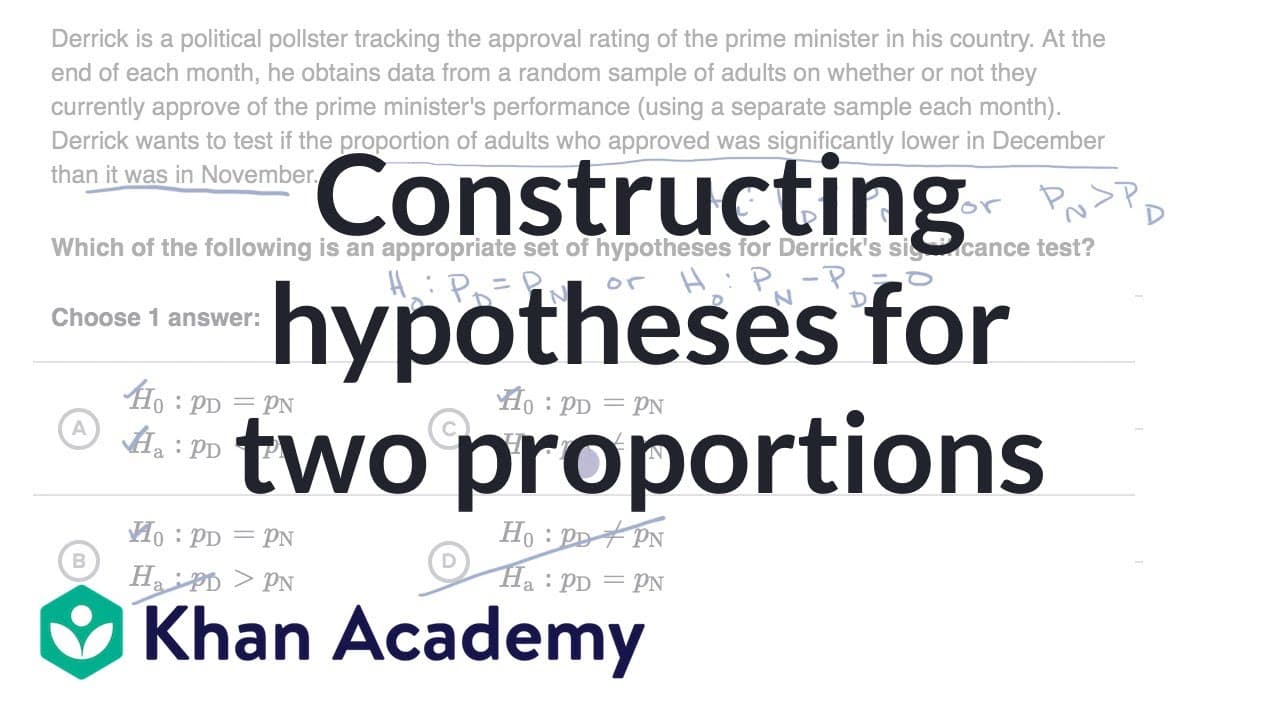
- [Instructor] Derrick is a political pollster tracking the approval rating of the prime minster in his country. At the end of each month, he obtains data from a random sample of adults on whether or not they currently approve of the prime minister's performance, using a separate sample each month. Derrick wants to test if the proportion of adults ... Read More
Key Insights
- 🏆 Null hypotheses assume no difference or no news in the data being tested.
- 😑 Alternative hypotheses express the specific difference or relationship being investigated.
- 🥺 Different wording in the alternative hypothesis can lead to different conclusions.
- 🐬 Significance tests can be applied to various scenarios, including political polling and coin flip experiments.
Install to Summarize YouTube Videos and Get Transcripts
Explore YouTube Video Summarizer or Get YouTube Transcript Extractor
Questions & Answers
Q: What is the purpose of creating a null hypothesis in a significance test?
The null hypothesis assumes that there is no difference or no news in the data being tested. It provides a baseline for comparison and is used to determine if there is evidence of a significant difference.
Q: How can the null hypothesis be stated in alternative ways?
The null hypothesis can be stated as the true proportion in one month being equal to the true proportion in another month or as the difference between the true proportions being equal to zero.
Q: What is the alternative hypothesis in Derrick's significance test?
The alternative hypothesis in Derrick's test is that the proportion of adults who approved in December was significantly lower than in November.
Q: How does Kiley's significance test differ from Derrick's?
Kiley's test aims to determine if there is a significant difference in the proportion of flips showing heads between a dime and a nickel, without specifying which proportion is higher or lower.
Summary & Key Takeaways
-
The first example focuses on a political pollster named Derrick who wants to test if the proportion of adults who approve of the prime minister's performance was significantly lower in December than in November.
-
The second example involves Kiley, who flips a dime and a nickel 100 times to test if there is a significant difference in the proportion of flips where each coin lands showing heads.
Read in Other Languages (beta)
Share This Summary 📚
Summarize YouTube Videos and Get Video Transcripts with 1-Click
Try YouTube Summary with ChatGPT & Claude or YouTube Transcript Generator
Explore More Summaries from Khan Academy 📚



Summarize YouTube Videos and Get Video Transcripts with 1-Click
Try YouTube Summary with ChatGPT & Claude or YouTube Transcript Generator