Hypothesis test for difference of means | Probability and Statistics | Khan Academy
TL;DR
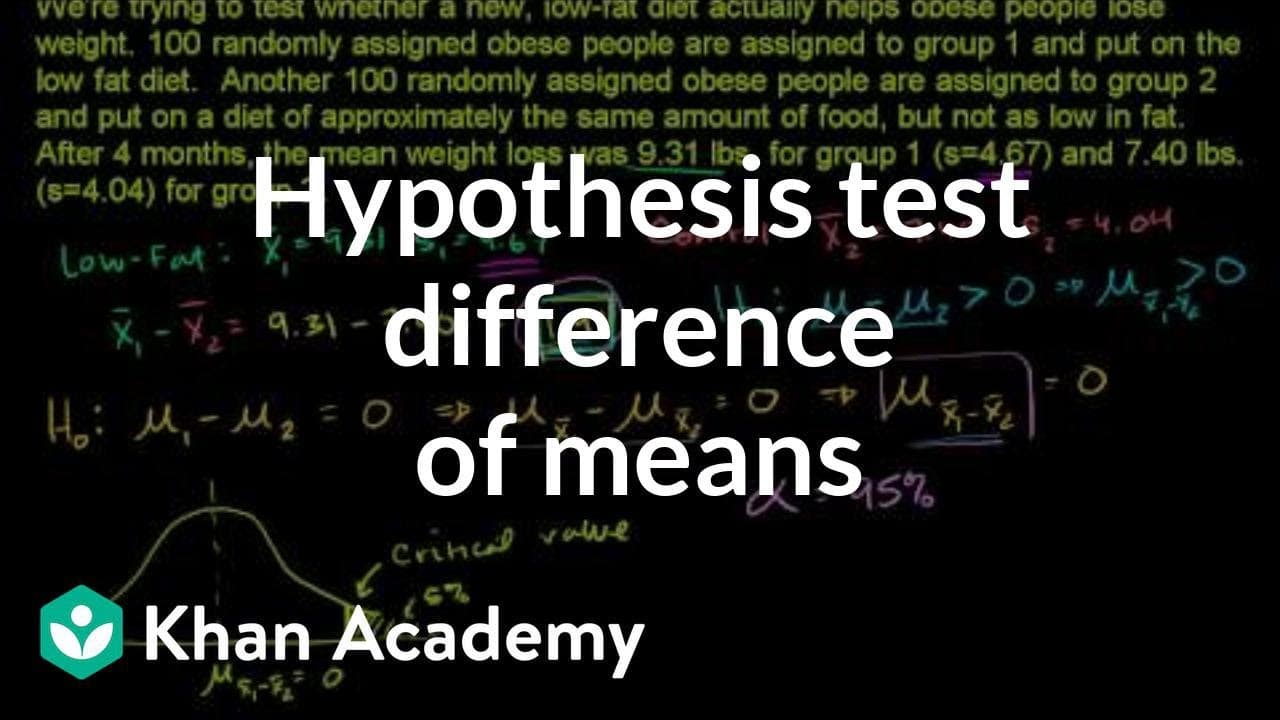
This video explains the process of conducting a hypothesis test to determine if a low-fat diet has any effect on weight loss.
Transcript
In the last video, we came up with a 95% confidence interval for the mean weight loss between the low-fat group and the control group. In this video, I actually want to do a hypothesis test, really to test if this data makes us believe that the low-fat diet actually does anything at all. And to do that let's set up our null and alternative hypothes... Read More
Key Insights
- 🛄 Hypothesis testing can be used to determine if there is enough evidence to support a claim.
- ❓ The null hypothesis assumes no effect, while the alternative hypothesis suggests a specific effect.
- 🎮 A significance level is chosen to control the probability of incorrectly rejecting the null hypothesis.
Install to Summarize YouTube Videos and Get Transcripts
Explore YouTube Video Summarizer or Get YouTube Transcript Extractor
Questions & Answers
Q: What is the purpose of conducting a hypothesis test in this context?
The hypothesis test aims to determine if the data provides enough evidence to support the idea that the low-fat diet contributes to weight loss.
Q: How is the null hypothesis defined in this scenario?
The null hypothesis states that the low-fat diet has no effect on weight loss, meaning that the difference in weight loss between the low-fat group and the control group is zero.
Q: How is the alternative hypothesis formulated?
The alternative hypothesis suggests that the low-fat diet does have an effect and leads to more weight loss. It proposes that the difference in weight loss between the low-fat group and the control group is greater than zero.
Q: What criteria are used to determine whether to reject the null hypothesis or not?
The significance level, set at 5%, is compared to the probability of obtaining the observed difference in weight loss assuming the null hypothesis is true. If this probability is below the significance level, the null hypothesis is rejected in favor of the alternative.
Summary & Key Takeaways
-
The video discusses setting up null and alternative hypotheses for a hypothesis test on the effectiveness of a low-fat diet.
-
The null hypothesis states that the low-fat diet has no effect on weight loss, while the alternative hypothesis proposes that it does.
-
A significance level of 5% is chosen, and the critical value for the test is determined using the standard deviation of the sample means.
Read in Other Languages (beta)
Share This Summary 📚
Summarize YouTube Videos and Get Video Transcripts with 1-Click
Try YouTube Summary with ChatGPT & Claude or YouTube Transcript Generator
Explore More Summaries from Khan Academy 📚



Summarize YouTube Videos and Get Video Transcripts with 1-Click
Try YouTube Summary with ChatGPT & Claude or YouTube Transcript Generator