Find all Values of x Satisfying the Given Conditions Quadratic Formula Example
TL;DR
Solving a quadratic equation with complex roots using the quadratic formula.
Transcript
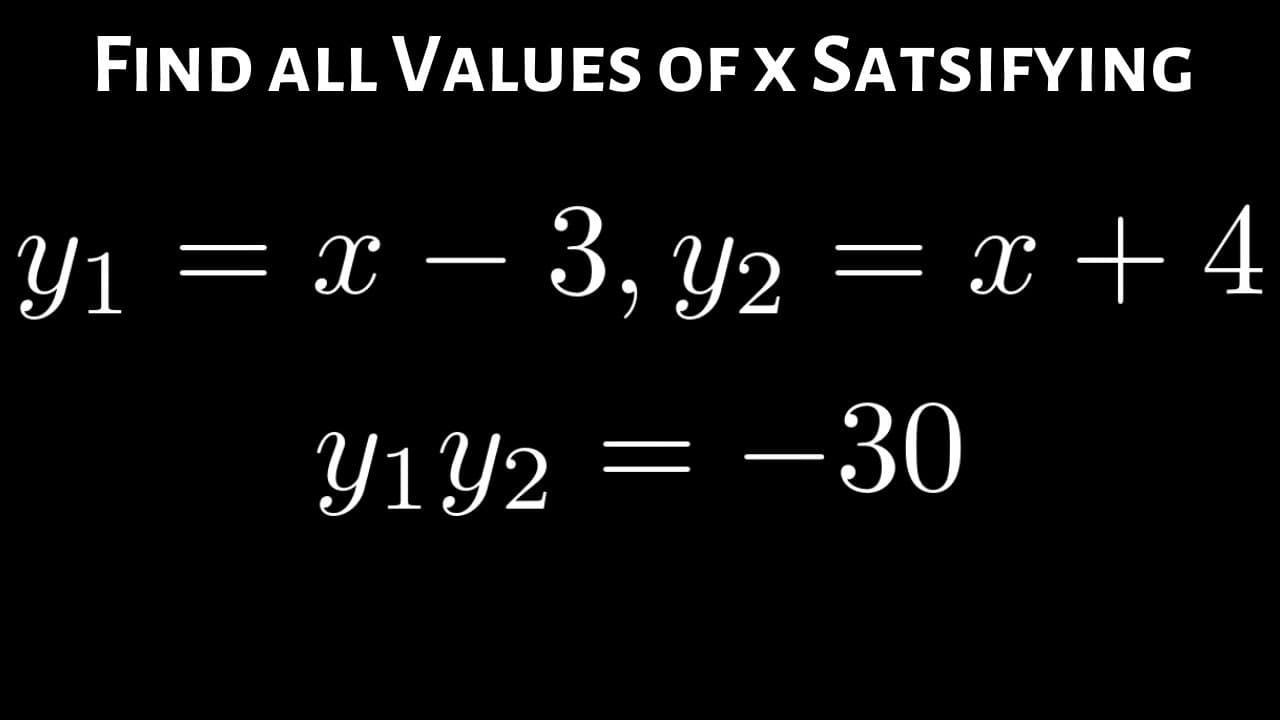
find all values of x satisfying the conditions so we have y one equals x minus three y two equals x plus four and then y one times y two equals negative thirty so basically we have to find x i think we can start maybe by using this and then just plugging these into this equation so solution that's the well means solution so y one y two equals negat... Read More
Key Insights
- 😑 Expressing quadratic equations as a product of linear factors simplifies the process of solving.
- 🧑🏭 Applying the quadratic formula is essential for finding roots in equations that do not easily factor.
- 🫚 Complex roots with the imaginary unit 'i' occur when the discriminant is negative in the quadratic formula.
- ❓ Understanding and manipulating quadratic equations provide a foundational skill in mathematics.
- ❎ Factoring, completing the square, and using the quadratic formula are common methods to solve quadratic equations.
- ❓ Quadratic equations often arise in various mathematical and scientific contexts.
- 👔 The quadratic formula provides a systematic approach to solving equations of the form ax^2 + bx + c = 0.
Install to Summarize YouTube Videos and Get Transcripts
Explore YouTube Video Summarizer or Get YouTube Transcript Extractor
Questions & Answers
Q: How is the quadratic formula used to solve the given quadratic equation?
The quadratic formula, x = (-b ± √(b^2 - 4ac)) / 2a, is applied after expressing the equation in the form ax^2 + bx + c = 0 and identifying the values of a, b, and c.
Q: Why is setting the quadratic equation equal to zero important for solving?
Setting the quadratic equation to zero helps in finding the values of x that satisfy the given conditions and allows for the application of methods like factoring or the quadratic formula to solve for x.
Q: What are the steps involved in solving the given quadratic equation for x?
The steps include expressing y1 * y2 as a quadratic equation, setting it equal to zero, applying the quadratic formula after identifying a, b, and c, and calculating the roots using the formula.
Q: How to deal with complex roots in quadratic equations?
Complex roots appear when the discriminant (b^2 - 4ac) is negative in the quadratic formula, resulting in sqrt(negative number) which introduces the imaginary unit 'i' in the solution.
Summary & Key Takeaways
-
Given y1 = x - 3 and y2 = x + 4, find the values of x that satisfy y1 * y2 = -30.
-
Express y1 * y2 as a quadratic equation and set it equal to zero for solving.
-
Apply the quadratic formula to find the roots of the equation.
Read in Other Languages (beta)
Share This Summary 📚
Summarize YouTube Videos and Get Video Transcripts with 1-Click
Try YouTube Summary with ChatGPT & Claude or YouTube Transcript Generator
Explore More Summaries from The Math Sorcerer 📚



Summarize YouTube Videos and Get Video Transcripts with 1-Click
Try YouTube Summary with ChatGPT & Claude or YouTube Transcript Generator