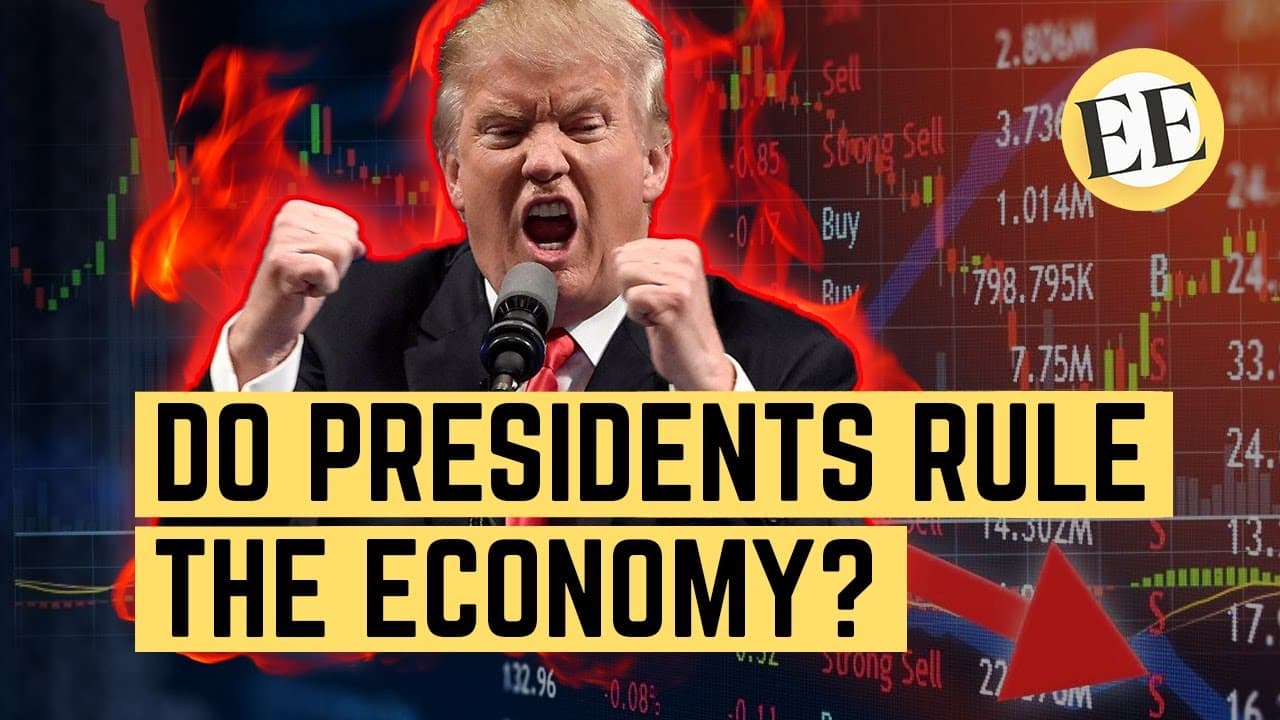
Can Presidents "Make or Break" an Economy?
TL;DR
Presidents can significantly influence the economy, both positively and negatively.
Transcript
The United States 2020 Presidential election has been called by pretty much every organization that covers the event in any capacity and while the final decision is not made until the special club that is the electoral college has presented its final decision, it’s apparent that Joe Biden will be the next president of the united states. This is... Read More
Key Insights
- The 2020 U.S. Presidential election marks a rare instance where an incumbent president loses re-election, amidst global crises.
- Transition challenges and legal disputes can destabilize economic support systems, impacting both national and global economies.
- Presidents can influence the economy through policies, but checks and balances limit their power to prevent unilateral economic damage.
- The stock market's performance is not always indicative of the overall economy's health, as seen with recent record highs.
- Government debt, while different from personal debt, can become problematic if the debt ceiling is not managed properly.
- A potential government shutdown due to debt ceiling issues could have severe economic consequences, especially during economic downturns.
- Defaulting on national debt could lead to catastrophic global economic impacts, affecting borrowing costs and the U.S. dollar's status.
- A president could theoretically harm the economy by vetoing critical fiscal measures, but systemic checks make this unlikely.
Install to Summarize YouTube Videos and Get Transcripts
Explore YouTube Video Summarizer or Get YouTube Transcript Extractor
Questions & Answers
Q: How can a president influence the economy?
A president influences the economy through policy decisions, such as tax reforms and government spending. These actions can impact business environments, employment rates, and overall economic stability. However, their power is constrained by legislative checks and balances designed to prevent unilateral economic decisions.
Q: What role does the debt ceiling play in economic stability?
The debt ceiling is a legislative limit on the amount of national debt that can be incurred by the U.S. Treasury, impacting government spending and fiscal policies. Failure to raise the debt ceiling can lead to government shutdowns and defaults, destabilizing the economy and increasing borrowing costs.
Q: Can a president single-handedly cause an economic collapse?
While a president can influence economic conditions, single-handedly causing a collapse is unlikely due to systemic checks and balances. These include congressional approval for major fiscal decisions and built-in safeguards against rash executive actions. Economic collapse typically involves multiple factors beyond presidential control.
Q: What are the potential consequences of a U.S. debt default?
A U.S. debt default could have catastrophic global repercussions, including increased borrowing costs, loss of confidence in U.S. Treasury bonds, and threats to the U.S. dollar's status as the world's reserve currency. It could lead to financial instability, affecting both domestic and international markets.
Q: How does the stock market relate to the overall economy?
The stock market is often viewed as a measure of economic health, but it doesn't always reflect the broader economy. Stock prices can be influenced by short-term factors, such as government policies or investor sentiment, and may not accurately represent economic conditions like employment or GDP growth.
Q: What impact does government debt have on economic policy?
Government debt influences economic policy by affecting fiscal decisions, such as spending and taxation. High debt levels can limit policy options, necessitating careful management to avoid negative consequences like increased interest rates or reduced investment in public services and infrastructure.
Q: How can infrastructure impact economic growth?
Infrastructure is crucial for economic growth, as it enhances productivity and efficiency. Well-maintained roads, bridges, and ports facilitate trade and commerce, while underfunded infrastructure can hinder economic activity and competitiveness, leading to long-term negative impacts on growth and prosperity.
Q: What safeguards exist to prevent a president from harming the economy?
Safeguards include the separation of powers, requiring congressional approval for significant fiscal measures, and judicial oversight. These checks ensure that no single branch, including the presidency, can unilaterally implement policies that could harm the economy, maintaining stability and preventing abuse of power.
Summary & Key Takeaways
-
The 2020 U.S. Presidential election resulted in a rare loss for the incumbent, amidst significant national and global challenges. This situation raises questions about presidential influence on the economy.
-
Presidential power over the economy is significant yet limited by checks and balances. Despite this, actions like vetoing fiscal measures can have profound impacts.
-
Economic complexities make modern economies vulnerable to disruptions. Government debt and fiscal policies are crucial areas where presidential influence can be felt, albeit with systemic safeguards.
Read in Other Languages (beta)
Share This Summary 📚
Summarize YouTube Videos and Get Video Transcripts with 1-Click
Try YouTube Summary with ChatGPT & Claude or YouTube Transcript Generator
Explore More Summaries from Economics Explained 📚



Summarize YouTube Videos and Get Video Transcripts with 1-Click
Try YouTube Summary with ChatGPT & Claude or YouTube Transcript Generator