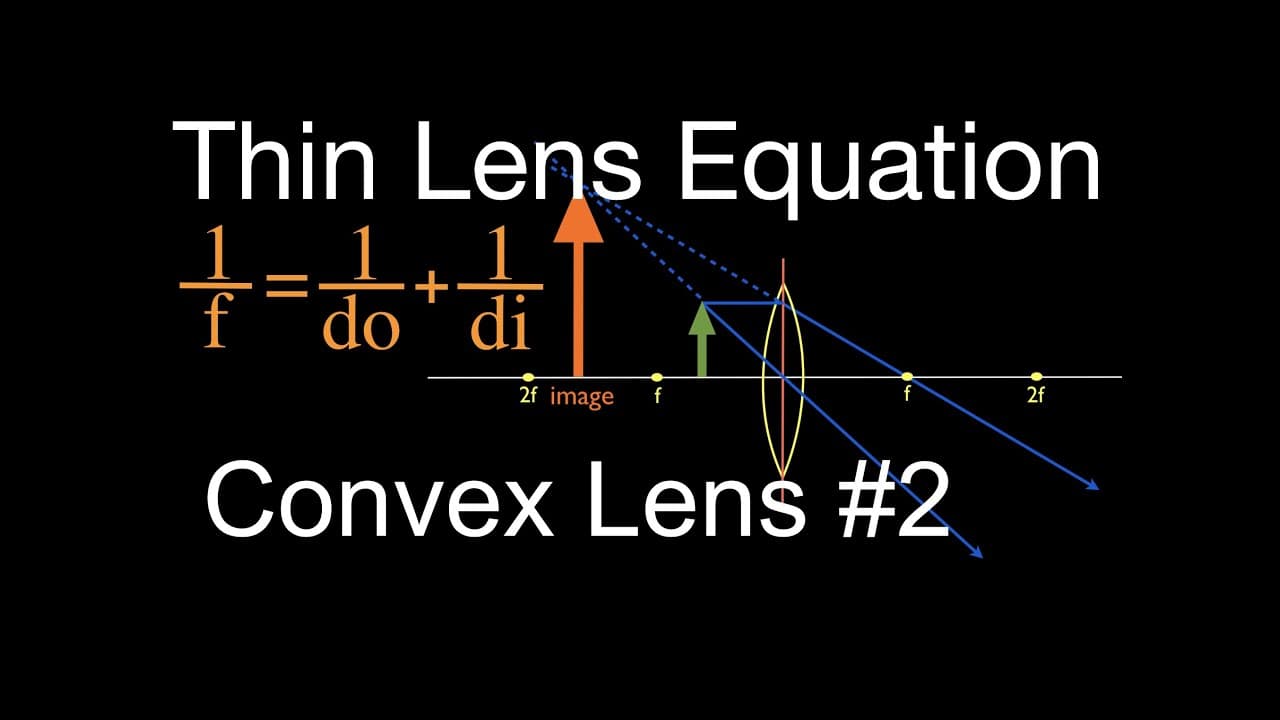
Thin Lens Equation (2 of 6) Convex Lens, Object Distance Less Then f
TL;DR
Learn how to use the thin lens equation for a convex lens to calculate image distance, size, and orientation when the object is inside the focal length.
Transcript
okay in today's video I'm going to go over how to use the thin lens equation for the convex lens so that we can calculate the image distance the image size and the image orientation and this is the case where the object is less than F okay the object distance is less than F from from the lens all right now you remember we kind of three cases once w... Read More
Key Insights
- 🤔 Understanding the thin lens equation for a convex lens is essential for calculating image characteristics accurately.
- 🖐️ Sign conventions play a crucial role in determining the direction and nature of images produced by convex lenses.
- 💁 Magnification values provide information on the relative size and orientation of images compared to objects.
- ❓ Proper calculation of image distance, size, and orientation requires attention to detail and adherence to correct procedures.
- 🥺 An upright image with a positive image height indicates a magnification greater than 1, leading to a larger image than the object.
- 🤔 Using a step-by-step approach and double-checking calculations ensures accurate results in thin lens equation problems.
- 🤔 Comparing expected outcomes with calculated results helps validate the accuracy of image characteristics determined using the thin lens equation.
Install to Summarize YouTube Videos and Get Transcripts
Explore YouTube Video Summarizer or Get YouTube Transcript Extractor
Questions & Answers
Q: How can the thin lens equation be used for a convex lens with an object inside the focal length?
The thin lens equation for a convex lens can be used by subtracting the reciprocal of the object distance from the reciprocal of the focal length to find the image distance. Remember to consider sign conventions and the object's position relative to the focal point.
Q: Why is it crucial to consider negative signs in calculating image characteristics for a convex lens?
Negative signs indicate the direction of the image, with a negative image distance implying a virtual image on the same side as the object. Properly interpreting negative values is essential for determining image orientation and size accurately.
Q: How does magnification play a role in determining the image size for a convex lens?
Magnification, calculated as the ratio of image distance to object distance, provides insight into how much larger or smaller the image will be compared to the object. A positive magnification value suggests an upright image, while a negative value implies an inverted image.
Q: What steps should be followed to ensure the correct application of the thin lens equation for a convex lens?
To use the thin lens equation accurately, it is essential to carefully set up the equation, consider sign conventions, substitute values correctly, and interpret the results in terms of image characteristics. Taking a systematic approach and verifying each step will lead to accurate solutions.
Summary & Key Takeaways
-
Explains how to calculate image distance, size, and orientation for a convex lens when the object is inside the focal length.
-
Provides step-by-step instructions on using the thin lens equation and considering sign conventions.
-
Emphasizes the importance of negative signs, equations, and calculations for obtaining accurate results.
Read in Other Languages (beta)
Share This Summary 📚
Summarize YouTube Videos and Get Video Transcripts with 1-Click
Try YouTube Summary with ChatGPT & Claude or YouTube Transcript Generator
Explore More Summaries from Step by Step Science 📚
Summarize YouTube Videos and Get Video Transcripts with 1-Click
Try YouTube Summary with ChatGPT & Claude or YouTube Transcript Generator