How to Solve Quadratic Equations by Factoring
TL;DR
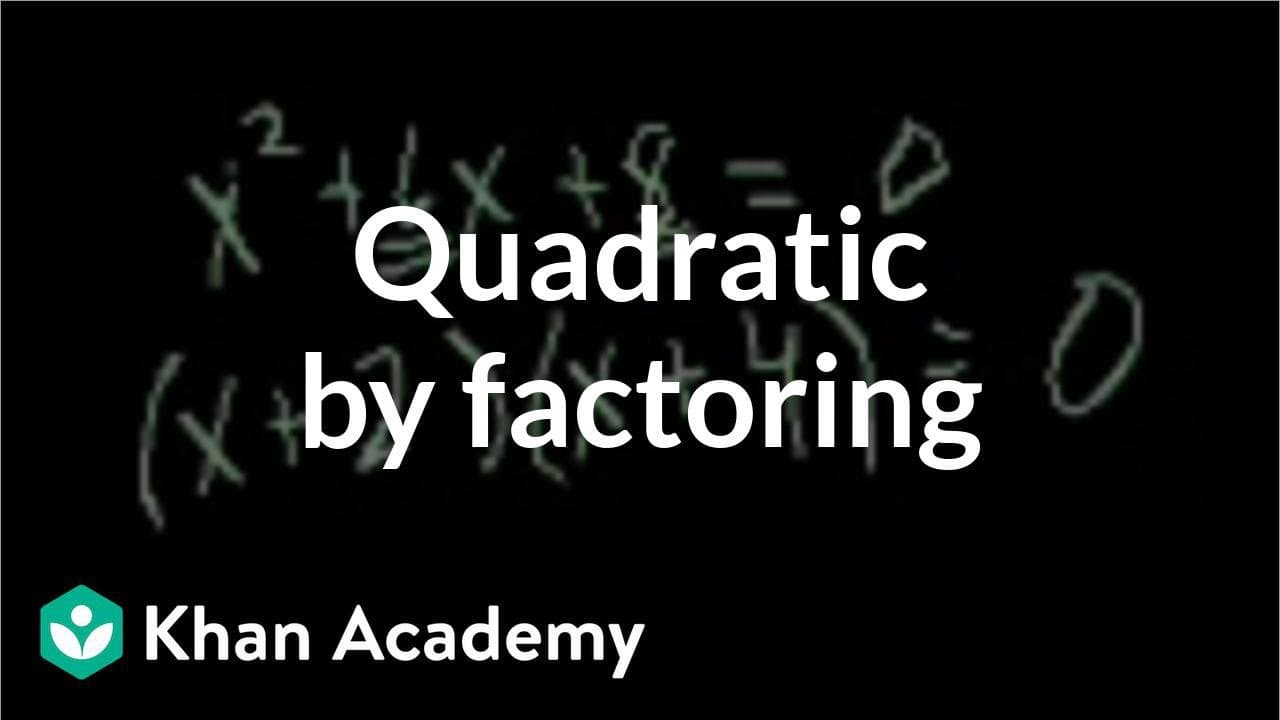
To solve quadratic equations by factoring, set the equation equal to zero and find two numbers that multiply to the constant term and add up to the linear coefficient. Factor the equation into binomials and set each binomial equal to zero to find the solutions for x.
Transcript
Welcome to solving a quadratic by factoring. Let's start doing some problems. So, let's say I had a function f of x is equal to x squared plus 6x plus 8. Now if I were to graph f of x, the graph is going to look something like this. I don't know exactly what it's going to look like, but it's going to be a parabola and it's going to intersect the x-... Read More
Key Insights
- 🧑🏭 Quadratic equations can be solved by factoring the equation and setting each factor equal to zero.
- 🍉 The factors of the constant term must add up to the coefficient of the linear term for factoring to be possible.
- ☺️ Factoring allows us to find the x-intercepts of the graph, which are the solutions to the equation.
Install to Summarize YouTube Videos and Get Transcripts
Explore YouTube Video Summarizer or Get YouTube Transcript Extractor
Questions & Answers
Q: What is the first step in solving a quadratic equation by factoring?
The first step is to set the equation equal to zero by setting the function equal to zero. This allows us to find the x-intercepts of the graph.
Q: How do you factor a quadratic equation with a leading coefficient of 1?
To factor a quadratic equation with a leading coefficient of 1, find two numbers that add up to the coefficient of the linear term and multiply to the constant term. These numbers can then be used to write the equation in factored form.
Q: What if the leading coefficient of the quadratic equation is not 1?
If the leading coefficient is not 1, divide the equation by the leading coefficient to make it easier to factor. Once the equation is in standard form with a leading coefficient of 1, proceed with factoring as usual.
Q: How do you find the solutions to the quadratic equation once it has been factored?
Set each binomial factor equal to zero and solve for x. The solutions obtained will be the x-values at which the graph of the function intersects the x-axis.
Summary & Key Takeaways
-
Quadratic equations can be solved by setting the function equal to zero and factoring the equation.
-
The factors of the constant term in the equation are used to determine the two numbers that add up to the coefficient of the linear term.
-
By finding the factors that satisfy these conditions, the equation can be factored into two binomials.
-
The solutions to the equation are obtained by setting each binomial equal to zero and solving for x.
Read in Other Languages (beta)
Share This Summary 📚
Summarize YouTube Videos and Get Video Transcripts with 1-Click
Try YouTube Summary with ChatGPT & Claude or YouTube Transcript Generator
Explore More Summaries from Khan Academy 📚



Summarize YouTube Videos and Get Video Transcripts with 1-Click
Try YouTube Summary with ChatGPT & Claude or YouTube Transcript Generator