Stanford EE104: Introduction to Machine Learning | 2020 | Lecture 4 - validation
TL;DR
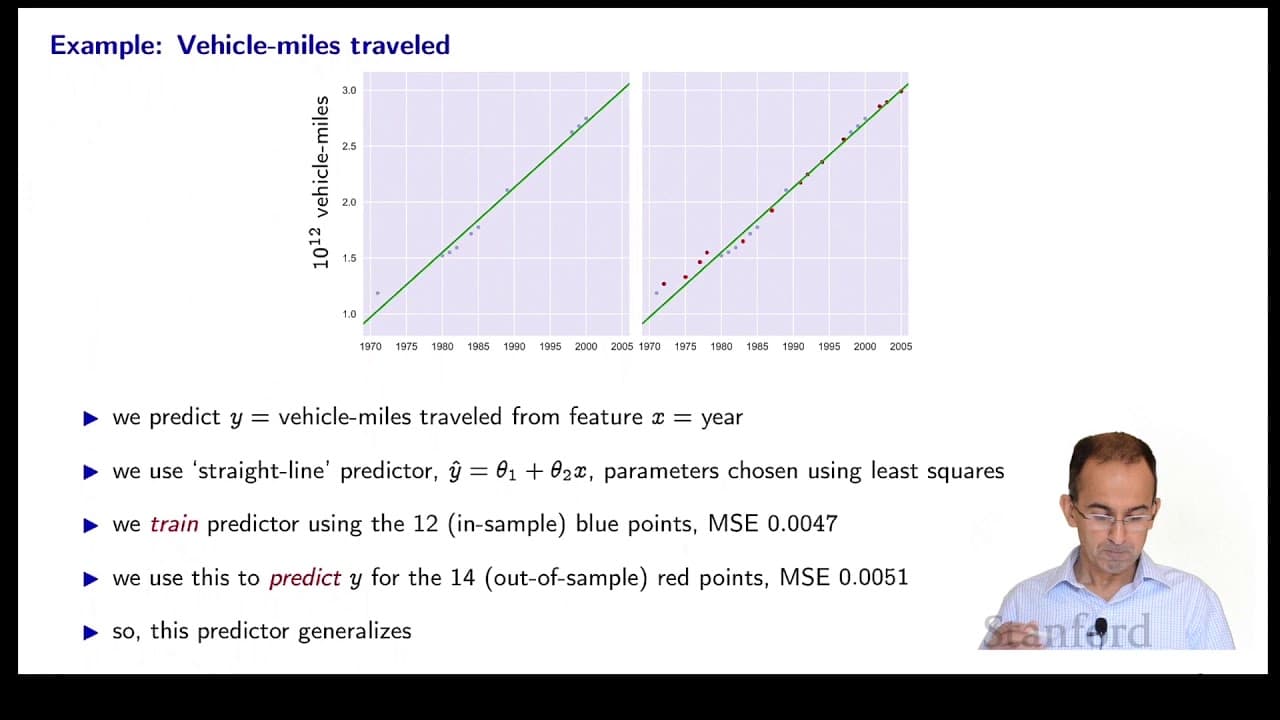
This content discusses the importance of performance metrics in evaluating different predictors and the process of validation to ensure the predictors generalize well to unseen data.
Transcript
welcome to the validation section so we've seen so far several different predictors which given an x can predict for us what the corresponding value of y should be and i want to talk now about how we're going to evaluate different predictors we have seen k nearest neighbors predictors we've seen tree based predictors we've seen neural network predi... Read More
Key Insights
- 📈 Performance metrics are essential for evaluating predictors and comparing their prediction errors.
- 🌍 Generalization is crucial for predictors to perform well on unseen data, indicating their reliability in real-world scenarios.
- ☠️ Validation techniques like out-of-sample validation and k-fold cross-validation help in assessing a predictor's performance on unseen data.
- ❓ Overfitting, where a predictor fits noise or variations in training data but fails to generalize, should be avoided.
- 📈 The choice of a suitable performance metric and validation method depends on the specific problem and the desired outcomes.
- ❓ Validation not only evaluates predictors but also validates the learning algorithm used to develop them.
Install to Summarize YouTube Videos and Get Transcripts
Explore YouTube Video Summarizer or Get YouTube Transcript Extractor
Questions & Answers
Q: What is a performance metric and why is it important in evaluating predictors?
A performance metric is a measure of prediction errors and is crucial in evaluating different predictors. It allows us to compare predictors and determine their effectiveness in predicting outcomes.
Q: What are some commonly used performance metrics?
Some commonly used performance metrics include mean square error, root mean square error, and mean absolute error. These metrics provide measures of the closeness between predicted and actual values.
Q: What is generalization in the context of predictors?
Generalization refers to a predictor's ability to perform well on unseen data. It means that the predictor can make accurate predictions on data that it has not been trained on.
Q: What is the purpose of validation in evaluating predictors?
Validation is the process of evaluating a predictor's performance on unseen data to determine its ability to generalize. It helps in selecting the best predictor among different candidates and ensures reliability in real-world scenarios.
Q: What is out-of-sample validation?
Out-of-sample validation involves splitting the data into a training set and a test set. The predictor is trained on the training set and then tested on the test set to assess its performance on unseen data.
Q: What is k-fold cross-validation?
K-fold cross-validation involves dividing the data into k subsets or "folds" for training and testing. The predictor is trained k times, each time using a different combination of k-1 folds for training and the remaining fold for testing. It provides a more robust and reliable evaluation of the predictor's performance.
Q: Why is it important to avoid revisiting the test set multiple times?
Revisiting the test set multiple times can lead to information leakage and bias the evaluation results. It is important to keep the test set untouched after the initial evaluation to ensure the reliability of the predictor's performance.
Q: What can be done once a suitable predictor is chosen?
Once a suitable predictor is chosen, the learning algorithm used to develop the predictor can be applied to the entire data set to learn from all the available data. This approach maximizes the learning potential and improves the predictor's performance.
Summary & Key Takeaways
-
The content discusses the need for performance metrics to evaluate different predictors and measure prediction errors.
-
Various performance metrics are mentioned, including mean square error, root mean square error, and mean absolute error.
-
The importance of generalization, which refers to a predictor's ability to perform well on unseen data, is highlighted.
-
The content introduces the concept of validation, including methods like out-of-sample validation and k-fold cross-validation.
Read in Other Languages (beta)
Share This Summary 📚
Summarize YouTube Videos and Get Video Transcripts with 1-Click
Try YouTube Summary with ChatGPT & Claude or YouTube Transcript Generator
Explore More Summaries from Stanford Online 📚

Summarize YouTube Videos and Get Video Transcripts with 1-Click
Try YouTube Summary with ChatGPT & Claude or YouTube Transcript Generator