Proofs on Integration of Some Standard Functions Part 1 - Integration - Diploma Maths - II
TL;DR
This video shows the proof for the integral of DX/√(a^2 - x^2) and establishes its value as sin^(-1)(x/a) + C.
Transcript
click the Bell icon to get latest videos from Ekeeda Hello friends in this video we are going to check proof for integral DX upon under root a square minus X square through that integral DX upon under root a square minus X square is equal to sine inverse X by a plus C in the previous chapter also derivative we have seen certain standard functions f... Read More
Key Insights
- 👍 The integral of DX/√(a^2 - x^2) can be proven using substitution and trigonometric identities.
- ☺️ By substituting X as a sin(theta) and differentiating with respect to theta, the integral is simplified.
- 😑 The simplification leads to the expression of the integral as the sine inverse of (x/a) plus a constant.
- 👨💼 The proof demonstrates the connection between the integral of DX/√(a^2 - x^2) and the trigonometric function sine inverse.
- 🎅 The result of sin^(-1)(x/a) + C can be used to solve various mathematical problems involving the given integral.
- 👻 The substitution of X as a sin(theta) allows for the utilization of the identity 1 - sin^2(theta) = cos^2(theta) to simplify the integral.
- ❓ The proof showcases the importance of using substitution and trigonometric identities in solving complex integrals.
Install to Summarize YouTube Videos and Get Transcripts
Explore YouTube Video Summarizer or Get YouTube Transcript Extractor
Questions & Answers
Q: What is the purpose of the video?
The purpose of the video is to demonstrate the proof for the integral of DX/√(a^2 - x^2) and establish its value as sin^(-1)(x/a) + C.
Q: How is the integral DX/√(a^2 - x^2) simplified using substitution?
The integral is simplified by substituting X as a sin(theta), which allows for the differentiation of X with respect to theta and the evaluation of DX.
Q: What trigonometric identity is used in the proof?
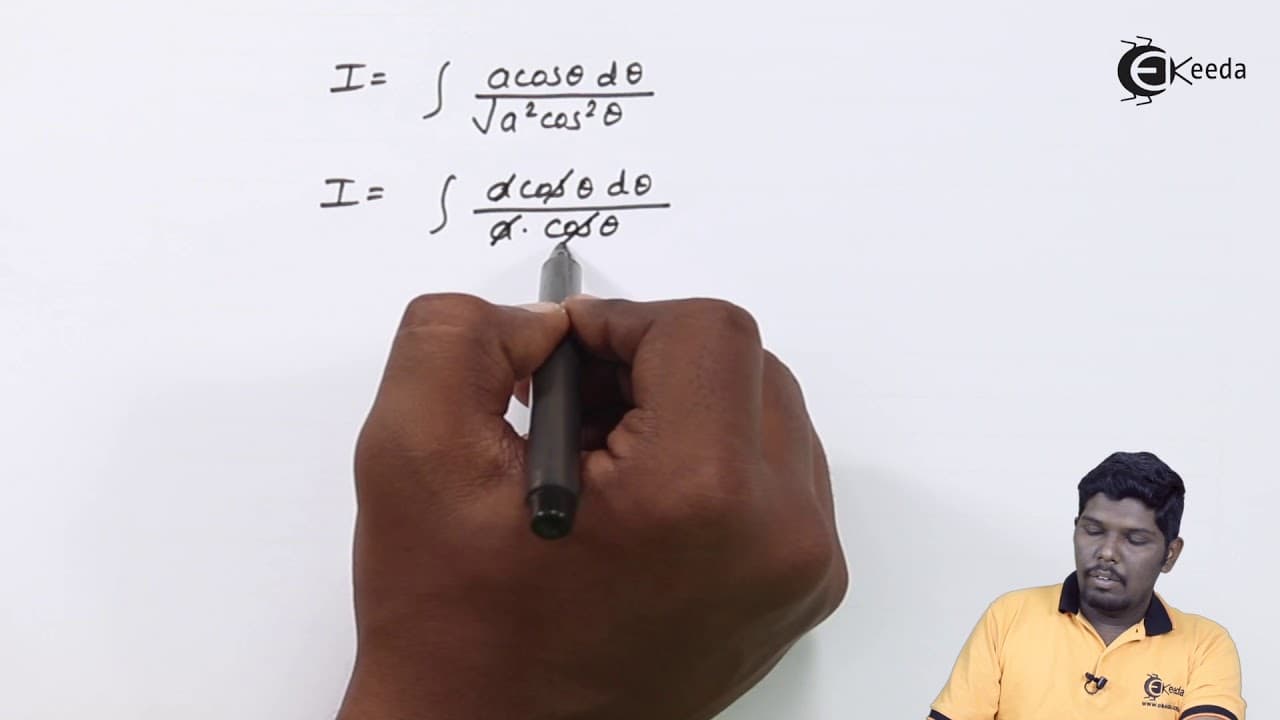
The identity used in the proof is 1 - sin^2(theta) = cos^2(theta), which simplifies the expression for DX/√(a^2 - x^2) to a cos(theta) d(theta)/√(a^2 - cos^2(theta)).
Q: How is the final result of sin^(-1)(x/a) + C derived?
The final result is derived by substituting the value of theta (sin^(-1)(x/a)) into the simplified integral expression and integrating with respect to theta to obtain theta + C, which simplifies to sin^(-1)(x/a) + C.
Summary & Key Takeaways
-
The video provides a step-by-step proof for the integral of DX/√(a^2 - x^2) using substitution and trigonometric identities.
-
By substituting X as a sin(theta), the video simplifies the integral and differentiates it with respect to theta.
-
The final result is found to be sin^(-1)(x/a) + C, proving the integral.
Read in Other Languages (beta)
Share This Summary 📚
Summarize YouTube Videos and Get Video Transcripts with 1-Click
Try YouTube Summary with ChatGPT & Claude or YouTube Transcript Generator
Explore More Summaries from Ekeeda 📚



Summarize YouTube Videos and Get Video Transcripts with 1-Click
Try YouTube Summary with ChatGPT & Claude or YouTube Transcript Generator