Limiting Reactant Practice Problem (Advanced)
TL;DR
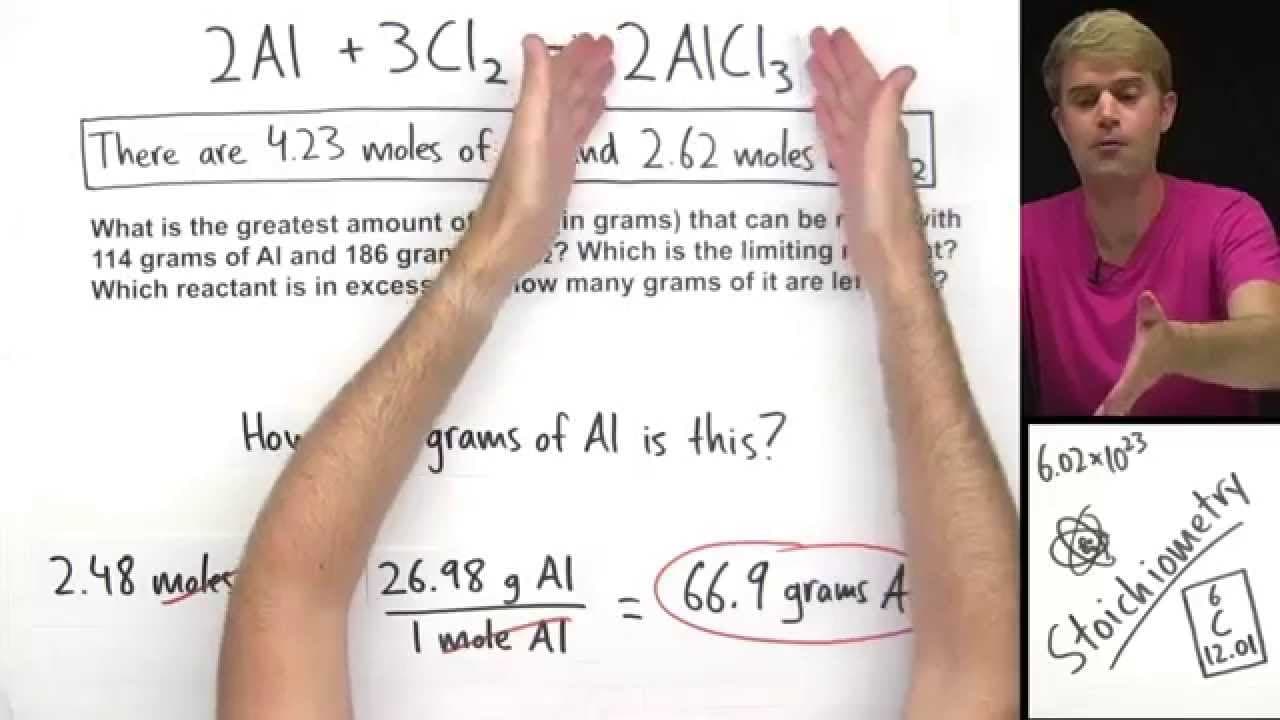
This content explains how to determine the limiting reactant and excess reactant in a chemical equation and calculate the maximum amount of product that can be produced.
Transcript
here we're going to work through a pretty advanced practice problem that asks about limiting reactant and excess reactant make sure you have a good understanding the basics before you tackle this one we'll use this equation to answer these questions what is the greatest amount of alcl3 in grams that can be made with 114 grams of al aluminum and 186... Read More
Key Insights
- 🍃 Determining the limiting reactant is crucial in understanding which reactant will be completely consumed and which will be left over.
- 🎭 Converting reactant quantities from grams to moles is essential to perform accurate calculations in stoichiometry.
- 🥳 The stoichiometric ratio allows for the calculation of the maximum amount of product that can be produced.
- ⛔ The excess reactant is the reactant that remains after the limiting reactant is fully consumed.
- 💆 The molar mass of each compound is needed to convert moles of reactant or product into grams.
- 🥳 The stoichiometric ratio is based on the coefficients of the balanced chemical equation.
- ❓ The concept of percent yield can be applied to determine the actual amount of product obtained compared to the maximum calculated amount.
Install to Summarize YouTube Videos and Get Transcripts
Explore YouTube Video Summarizer or Get YouTube Transcript Extractor
Questions & Answers
Q: How do you determine the limiting reactant in a chemical equation?
To determine the limiting reactant, you need to convert the mass of each reactant into moles using their respective molar masses. Then, calculate the moles of product that can be formed by each reactant. The reactant that produces the lowest number of moles of product is the limiting reactant.
Q: How do you calculate the maximum amount of product that can be produced?
Once you have identified the limiting reactant, use its moles to calculate the moles of product that can be formed using the stoichiometric ratio. Finally, multiply the moles of product by the molar mass of the product to obtain the maximum amount of product in grams.
Q: What is an excess reactant?
An excess reactant is the reactant that is not completely consumed in a chemical reaction. It is left over after the limiting reactant is completely consumed. The amount of excess reactant can be determined by subtracting the amount of reactant used from the total amount initially present.
Q: Why is it important to convert reactant quantities from grams to moles?
Converting reactant quantities from grams to moles is necessary because mole ratios are used to determine the limiting reactant and calculate the maximum amount of product. The stoichiometry in the balanced equation is based on moles, so all reactant quantities must be in moles for accurate calculations.
Summary & Key Takeaways
-
The content provides step-by-step instructions on how to convert grams of reactants into moles in order to determine the limiting reactant.
-
The author explains the process of using the stoichiometric ratio to determine how much of each reactant is needed to react completely.
-
The content demonstrates how to calculate the maximum amount of product that can be made, as well as the amount of excess reactant left over.
Read in Other Languages (beta)
Share This Summary 📚
Summarize YouTube Videos and Get Video Transcripts with 1-Click
Try YouTube Summary with ChatGPT & Claude or YouTube Transcript Generator
Explore More Summaries from Tyler DeWitt 📚
Summarize YouTube Videos and Get Video Transcripts with 1-Click
Try YouTube Summary with ChatGPT & Claude or YouTube Transcript Generator