Enabling Translation: The Motion Capture Lab
TL;DR
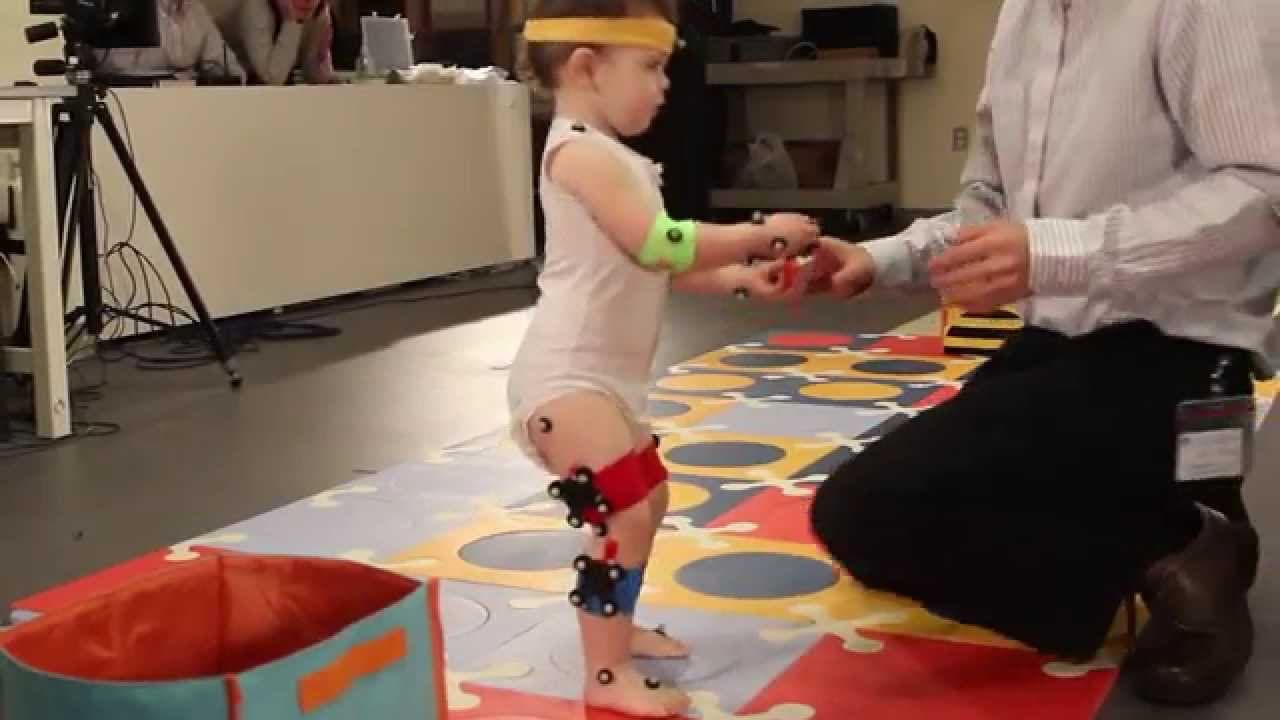
Motion capture lab plays a crucial role in understanding human performance and developing new medical devices for therapy and rehabilitation.
Transcript
what's exciting for us when we enter the motion capture lab is we have the opportunity to take a device or technology of therapy and actually test it on human subjects impact for us starts with human data and that's the data we hope to gather here in the motion capture lab my research is translational research my focus has been primarily on infants... Read More
Key Insights
- 🥺 The motion capture lab enables researchers to gather human data, leading to a better understanding of the impact of therapy devices.
- 💪 Designing synthetic muscles for infants and toddlers can be optimized using insights gained from the motion capture lab.
- 🤖 Understanding human walking patterns helps develop robots and software to assist patients with mobility impairments.
- 👻 The lab allows researchers to record a variety of data, including muscle activity, limb motion, and oxygen consumption, for in-depth analysis.
- 😷 Incorporating sensory enhancement technology, like vibrating shoe inserts, into medical devices improves balance and performance.
- 🥺 The motion capture lab facilitates the rapid iteration of device design and testing, leading to faster progress and success.
- 🐕🦺 It provides a single lab for building, testing, and evaluating devices, eliminating the need for external testing services.
Install to Summarize YouTube Videos and Get Transcripts
Explore YouTube Video Summarizer or Get YouTube Transcript Extractor
Questions & Answers
Q: How does the motion capture lab help in designing synthetic muscles for infants and toddlers?
The researcher uses the lab to gain insights into the placement, size, force, and torque generation of synthetic muscles, ensuring their optimal design for therapy in infants and toddlers.
Q: What is the purpose of studying human walking patterns in the motion capture lab?
Understanding how humans walk efficiently helps researchers develop robots and software to assist patients with walking disabilities, improving their mobility and quality of life.
Q: What types of data can be recorded in the motion capture lab?
The lab can record biomechanical and physiological data, including muscle activity, limb motion measured by accelerometers, and oxygen consumption. This data provides valuable insights into human performance.
Q: How does stochastic resonance technology contribute to medical devices in the motion capture lab?
Stochastic resonance technology, incorporated into devices like vibrating shoe inserts, sensitizes neurons without causing them to fire, improving balance and overall performance in therapy and rehabilitation settings.
Summary & Key Takeaways
-
The motion capture lab is used to test devices and technologies for therapy on human subjects, gathering crucial human data.
-
Researchers use the lab to design synthetic muscles, study human walking patterns, and record biomechanical and physiological data.
-
The lab also incorporates sensory enhancement technology, such as vibrating shoe inserts, to improve balance and performance.
Read in Other Languages (beta)
Share This Summary 📚
Summarize YouTube Videos and Get Video Transcripts with 1-Click
Try YouTube Summary with ChatGPT & Claude or YouTube Transcript Generator
Explore More Summaries from Harvard University 📚






Summarize YouTube Videos and Get Video Transcripts with 1-Click
Try YouTube Summary with ChatGPT & Claude or YouTube Transcript Generator