Correction calendar notation | Cosmology & Astronomy | Khan Academy
TL;DR
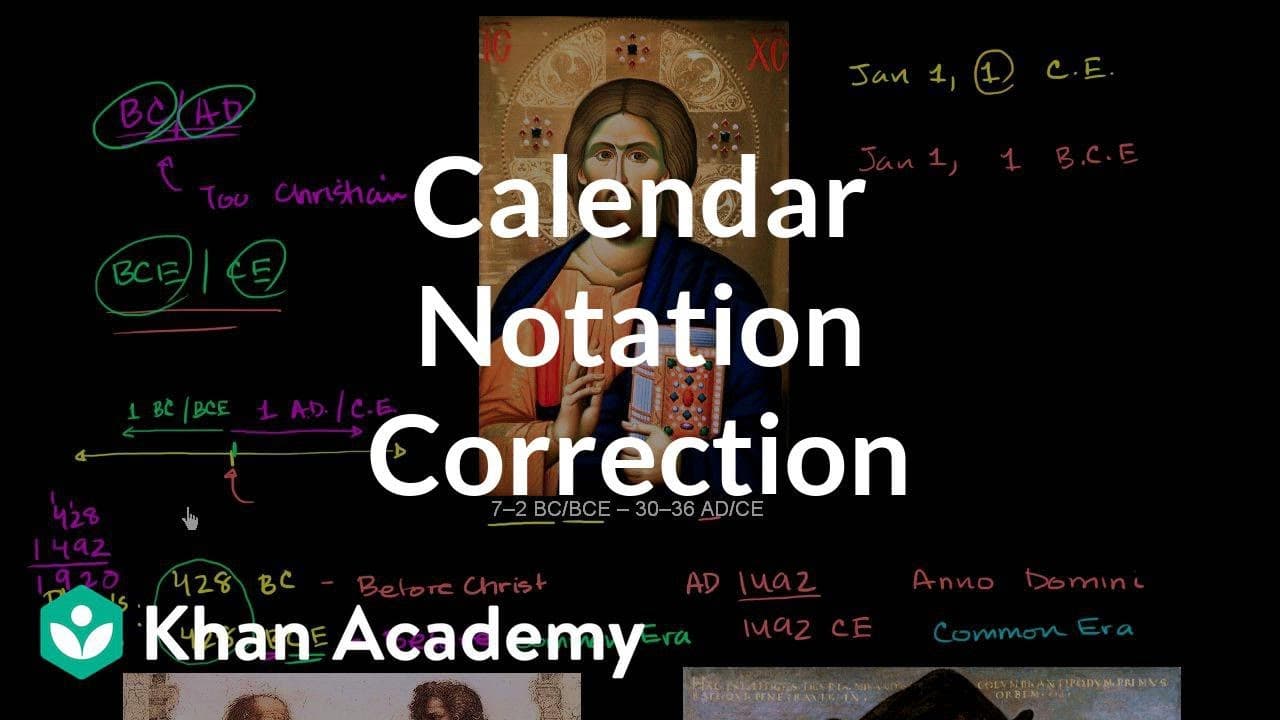
There is no year 0 in our calendar system, leading to incorrect calculations when measuring time between historical events.
Transcript
I told you in the last video on calendar notation that, regardless of whether you're using BC, AD or BCE and CE, that there is no year 0, that we had 1 BC. And then we had that theoretical birth of Jesus, and most historians don't think that he was born right exactly on January 1, 1 AD. But there's no year 0. Right after that, you go from December ... Read More
Key Insights
- 🖤 The calendar system's lack of a year 0 complicates calculations of time between historical events.
- 🫠 The birth of Jesus, which our calendars revolve around, is not precisely aligned with January 1, 1 AD.
- ⌛ Adjustments are necessary when calculating time after a theoretical event, such as subtracting a year to account for the missing year.
Install to Summarize YouTube Videos and Get Transcripts
Explore YouTube Video Summarizer or Get YouTube Transcript Extractor
Questions & Answers
Q: Why is there no year 0 in our calendar system?
The lack of a year 0 is due to historical calendar conventions and the transition from BC to AD. It was not considered necessary at the time, but it causes complications in calculations.
Q: What is the significance of the theoretical birth of Jesus?
The birth of Jesus is used as a reference point for our calendar system. However, it is widely known that Jesus was not born exactly on January 1, 1 AD, leading to discrepancies in calculations.
Q: How does the lack of a year 0 affect the time between historical events?
Without a year 0, the calculations need to adjust by subtracting a year when measuring time after a theoretical event. This correction is necessary to account for the missing year in the calendar system.
Q: How does the correction affect the calculation of time between Plato's birth and Columbus discovering the new world?
The correction means that the correct calculation should be 1,919 years, not 1,920 years as previously assumed. By subtracting 1 from 1,920, we account for the missing year.
Summary & Key Takeaways
-
The calendar system does not have a year 0, leading to confusion when calculating the time between historical events.
-
The birth of Jesus, which our calendars revolve around, is not exactly on January 1, 1 AD, and there is uncertainty about the actual birth date.
-
When calculating the time between events, the lack of a year 0 means adding or subtracting the years and then adjusting for the missing year.
Read in Other Languages (beta)
Share This Summary 📚
Summarize YouTube Videos and Get Video Transcripts with 1-Click
Try YouTube Summary with ChatGPT & Claude or YouTube Transcript Generator
Explore More Summaries from Khan Academy 📚



Summarize YouTube Videos and Get Video Transcripts with 1-Click
Try YouTube Summary with ChatGPT & Claude or YouTube Transcript Generator